·

·

Leeuwen's Discourses of identity

Leeuwen, Theo Van 2009. Discourses of identity. Language Teaching 42(2): 212-221.

In their [British linguists in the 1970s] view, style expressed social meanings of two kinds – meanings related to identity, and meanings related to specific roles, occupational roles, for instance, and specific contexts, e.g. specific types of discourse such as news reading, sports commentary and prayer. Social style, as they saw it, expresses ‘who we are’, in terms of stable categories such as class, gender, age and provenance, and in terms of specific socially regulated activities and the roles we play in them. The former were seen as more or less ingrained habits which are for the most part out of conscious control by the language user. The latter were seen as competencies, social rules of ‘appropriateness’ that must be complied with. (Leeuwen 2009: 212)
Identity - who we are in terms of class, gender, age, provenance (place of origin), and prayer (religion). Roles - specific out-of-awareness ingrained habits in specific contexts, competence of performing the role and rules for appropriate performance.
In both cases the distinctive features that manifest specific styles were not seen as meaningful, but as identifying ‘markers’, linguistic labels – as a kind of linguistic ‘uniform’, one could say, that reveals the social role of the wearer at a glance. At the same time, the authors recognized individual style, the ‘relatively permanent features of the speech or writing habits that identify someone as a specific person’ – style, in other words, as a kind of linguistic fingerprint or identifying mark that is in itself meaningless, but does distinguish a person from all others. Such ‘individuality’ was then to be distinguished from ‘singularity’, a form of stylistic individuality that is deliberately developed and manipulated – for instance, the style of a literary author. But, although individual style was recognized in this way, social determination and social variation were seen as the main area of study for linguistic stylistics. (Leeuwen 2009: 212-213)
It seems that the concept of style has both sociolectical and idiolectical versions: social role on the one hand and individual style (of a literary author, for example) on the other.
In short, the concept of style that came across to me in this time created a strong opposition between the social and in the individual. There was on the one hand social style, a matter of inescapable social classification in terms of categories such as class and gender, and of the strictly regulated obligations of social institutions and practices. And there was on the other hand individual style, which somehow managed to live in the interstices of social regulation, like grass growing between neatly laid, rectangular flagstones, and which could only exist because social regulation cannot cover every detail of our behaviour and therefore leaves room for the expression of individuality, even if only in small details, because there was, alongside the public world, the private world, which provided some room for unbuttoning and expressing individuality, and there was, in a world otherwise governed by bony-structured rules, some degree of license for breaking social conventions, especially for women, children and artists. (Leeuwen 2009: 213)
This is a neat contention (I like it). It is interesting that the allowance for individuality is made especially for women, children and artists - as if "real men" are supposed to be uniform, un-individual.
After the 1960s, the word ‘style’ was heard less and less. The intellectual mood of the day favoured the social, and the backgrounding of the individual which could already be felt in Investigating English Style evolved into a silencing of the individual, perhaps forefelt in Roland Barthes’ concept of ‘degree zero style’ as writing from which all traces of individual personality have been erased, ‘colourless writing, freed from all bondage’ which will set the author free from the ‘prison of style’ (Barthes 1967: 82) and also in his later emphasis on the ‘death of the author’ (Barthes 1977), which was just one of the manifestations of the emphasis on social determination that prevailed in the intellectual climate of the time. (Leeuwen 2009: 213)
Indeed even Ju. Lotman cited an English book about style from the 1950s (I can't say exactly what it was). In any case it seems that the concept of style was very popular in the 1960s (e.g. Martin Joos' language styles) but left the scene in the 1970s.
Such forms of expression are social because they not only allow people to express interpretations of the world, and shared affiliations with certain values and attitudes, but also to recognize others, across the globe, as sharing these interpretations and affiliations. They are also social because they emerged as corporations looked for new ways of creating market demand, with marketing experts replacing ‘demographics’ with ‘psychographics’, clusters of ‘behaviours’, ‘attitudes’ and ‘consumption patterns’. (Leeuwen 2009: 214)
Well that's an interesting term: "Psychographics is the study of personality, values, attitudes, interests, and lifestyles".
Lifestyles, on the other hand, are expressed differently and much less systematically, and rest on one of two principles, the principle of the ‘composite of connotations’ and/or that of experiential metaphor. Connotation, as was already explained by Barthes (1977) some forty years ago, is not systematically organized. It can be characterized as an unordered lexicon of culturally meaningful signifiers which derive their meaning from provenance, from ‘where the signifier comes from’. The principle is this. A sign from a certain domain – a certain period, or other context, such as region, country, culture, occupation, etc. – is imported into a domain where it has hitherto not been part of the repertoire. In that new domain it carries the associations – the values and attitudes – which, in that new domain, people have with the domain from which it comes, so expressing a kind of affiliation with those values, in the ‘lifestyle’ mode. To use, again, the example of dress, in recent times many signifiers from the military domain have entered the domain of street fashion. People walk around wearing drill trousers with a camouflage motif, for instance. (Leeuwen 2009: 215)
This makes me wonder if my SEGA Sonic varsity jacket connotes Americanness? I did have to do a google search to find out that it's called a varsity jacket; otherwise I would have associated it with American football or baseball. It is also called a letterman jacket and it is indeed associated with high school or college athletics.
However, there is also another form of control over our semiotic practices emerging, and that is technological control. At the same time that linguists began to reintroduce style as the expression of identity, software producers did the same thing. HTML, for instance, introduced the style sheet, on which you program what will be the overall characteristics of the text you are writing, especially through colour schemes and choice of typography, which offers its own metaphor potentials as I have tried to explain elsewhere (Van Leeuwen 2006). Thus the concept of style, and the way we create an identity for our text and for ourselves as its producer, is as it were built into the very tool we use to create it. (Leeuwen 2009: 219)
I could have never guessed that I would meet discussions of HTML in semiotics. But, indeed, CSS (Cascading Style Sheets) s a veritable semiotic resource.
A new concept of identity has come into being over the past thirty years or so. It merges the individual and the social, making individuality a social and socially regulated affair, rather than something which escapes the social, and making the social an apparently individual affair, open to choice, rather than coercive. This kind of identity is expressed through style, that is through semiotic characteristics which are constant for the duration of a whole text or communicative event, or for the identity of a person or corporation during a particular period. In that constellation, style is no longer the arbitrary marker of a particular identity, but it has meaning. It expresses attitudes, values, personality traits and so on, all of which therefore become more consciously and reflexively constructed. To construct such identities, people need to constantly monitor semiotic resources and the discourses that model them. (Leeuwen 2009: 219-220)
I'm essentially interested in this in terms of body language: how bodily behaviour has become not only a marker of race and culture, but of socially constructed individuality.

Why do Empty Signifiers Matter

Laclau, Ernesto 1996. Emancipation(s). London; New York: Verso.

Ch. 3. "Why do Empty Signifiers Matter to Politics?", Pp. 36-46.
An empty signifier is, strictly speaking, a signifier without a signified. This definition is also, however, the enunciation of a problem. For how would it be possible that a signifier is not attached to any signified and remains, nevertheless, an integral part of a system of signification? ... The only possibility for a stream of sounds being detached from any particular signified while still remaining a signifier is if, through the subversion of the sign which the possibility of an empty signifier involves, something is achieved which is internal to signification as such. What is this possibility? (Laclau 1996: 36)
Here we are in my opinion veering off from semiotics and entering the realm of philosophy wherein the sign does not compose of the the interrelationship of the signifier and signified but rather of the signififer and it's "possibility" to function as a signifier, detached from any "particular" signified. In a sense, though, every signifier is detached from a "particular" signified, because when we enter the Peircean semiotics then the hallmark of symbols is that they are "general".
An empty signifier can, consequently, only emerge if there is a structural impossibility of signification as such, and only if this impossibility can signify itself as an interruption (subversion, distortion, etcetera) of the structure of the sign. That is, the limits of signification can only announce themselves as the impossibility of realizing what is within those limits - if the limits could be signified in a direct way, they would be internal to signification and, ergo, would not be limits at all. (Laclau 1996: 37)
And we have a conundrum. It is initself despicable of me that I have to resort to quoting Greimas only hours after reading his dictionary, but here we have an "implicit philosophical doctrine" which states that there are "limits of signification". Does this contention "conform to empirical principles"? The case ultimately rests on me not having read de Saussure thus being unfamiliar with the implicit philosophical doctrines in Laclau. Personally, I would like to believe that there are no such "limits" to signification for there is, after all - and now I have to resort to Bakhtinian lingo - "an infinity and eternity of meaning".
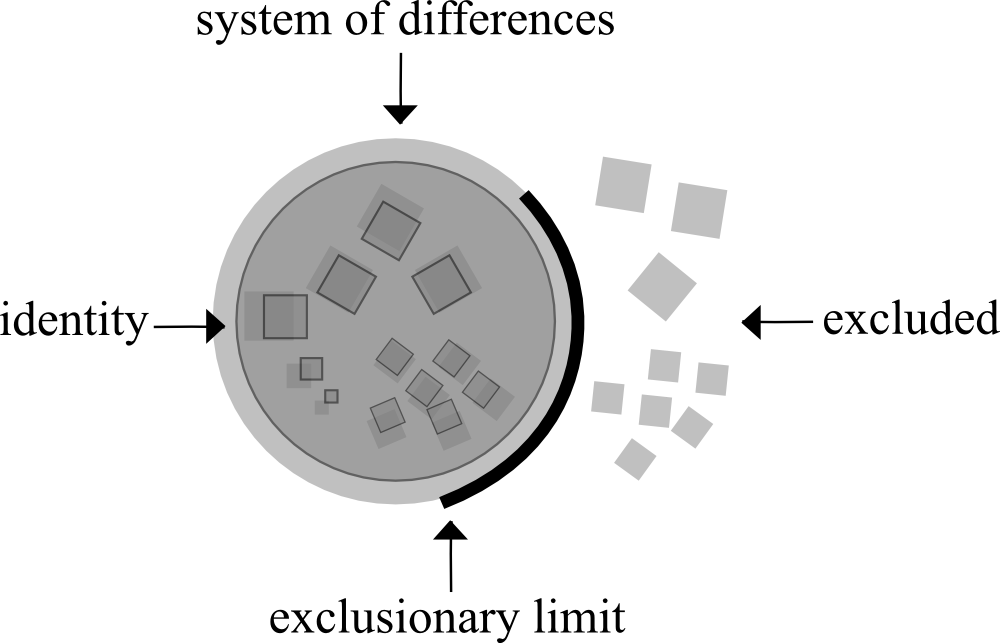
An initial and purely formal consideration can help to clarify the point. We know, from Saussure, that language (and by extension, all signifying systems) is a system of differences, that linguistic identities - values - are purely relational and that, as a result, the totality of language is involved in each single act of signification. (Laclau 1996: 37)
Today [13.11.2012] is also the day that I decided on one of the key terms in my bachelor's thesis: concourse. Decidedly ignoring B. L. Whorf's and one of Roman Jakobson's reviewer's use of the term, I am going to define it in line with Nauta and some buddhists; that is, generally, as "an act or process of coming together and merging". Thus if discourse is "a system of differences" then concourse is "a system of similarities". I'm going to appropriate an under-used concept and invest it with my own "difference". [This is where I left this text to go work on my article about concursivity, returning a month later] The problematic part about concursivity is bringing similarities to the fore - e.g. explaining how actual bodily behaviour and the semantic content of verbal descriptions coincide.
The condition, of course, for this operation [the pure cancellation of all difference] to be possible is that what is beyond the frontier of exclusion is reduced to pure negativity - that is to the pure threat that what is beyond poses to the system (constituting it that way). If the exclusionary dimension was eliminated, or even weakened, what would happen is that the differential character of the 'beyond' would impose itself and, as a result, the limits of the system would be blurred. Only if the beyond becomes the signifier of pure threat, of pure negativity, of the simply excluded, can there be limits and system (that is an objective order). But in order to be the signifiers of the excluded (or, simply of exclusion, various excluded categories have to cancel their differences through the formation of a chain of equivalences to that which the system demonizes in order to signify itself. Again, we see here the possibility of an empty signifier announcing itself through this logic in which differences collapse into equivalential chains. (Laclau 1996: 38-39)
It is very difficult to chew through this kind of discussion, but I imagine that in order to signify Russians, for example, as an enemy (pure danger), all different manifestations of Russiannes must be collapsed into a "chain of equivalences" - one should believe that all Russians are the same. I don't know much about Russia, but the example of Chinese would be better, as I am aware that there are five or six very different varieties of "Chinese" people.
Let me go back to an exmaple that we discussed in detail in Hegemony and Socialist Strategy: the constitution, according to Rosa Luxemburg, of the unity of the working class through an overdetermination of partial struggles over a long period of time. (Laclau 1996: 40)
Finally a concrete example, although the rest of the paragraph makes very little sense. In any case, the unity of the working class (in marxist rhetoric) is an empty signifier.
...gold is a particular use value which assumes, as well, the function of representing value in general. This emptying of a particular signifier of its particular, differential signified is, as we saw, what makes possible the emergence of 'empty' signifiers as the signifiers of a lack, of an absent totality. (Laclau 1996: 42)
The case of gols representing value in general seems like a regular case of a metonym. It almost seems that empty signifier is a weird form of metonym wherein "that which it is a part" does not exist.

Schönle on Lotman and CS

Schönle, Andreas 2002. Lotman and cultural studies: The case for cross-fertilization. Sign Systems Studies 30(2): 429-440.

Cultural studies emerged partly in response to a single-minded focus on high literature in English Departments, and it rests on a definition of culture as the totality of cultural production, including mass culture in all its variety. (Schönle 2002: 430)
This is how culture is defined in cultural studies. I think this definition differs from semiotics of culture in a few significant respects. Firstly, semiotics of culture doesn't seem to be as single-mindedly interested in cultural production, as cultural reception and a host of other cultural processes; e.g. production implies creation of new, while reception also includes rediscovering the past. Secondly, as cultural semiotics is a semiotic enterprise, it is most interested in semiotic aspects of culture, rather than social-psychological (as it is in cultural studies). And thirdly, indeed, cultural semiotics is not focused on mass culture, but rather high culture. Even when investigating mass culture pheonomena (such as cinema), Lotman focused on pieces (films) which were either significant to (film) theorists or high in taste.
As Tony Bennett puts it, cultural studies is "a term of convenience for a fairly dispersed array of theoretical and political positions which ... share a commitment to examining cultural practices from the point of view of their interaction with, and within, relations of power" (Bennett 1992: 23). (Schönle 2002: 431)
For cultural studies, cultural practices are interacting with and within power relations.
While Lotman is perhaps not as single-minded in his analysis of the nexus between cultural production and power, this collection discusses his conceptualization of the semiotic expression of power. His analysis of the relations between center and periphery echoes the infatuation with margins of culture in cultural studies. Lotman is acutely aware of the fact that ownership of information confers powers, and he discusses the ways in which groups fight for monopoly over information and develop special languages to keep other groups at bay (Lotman 2000a: 395). Even more pointedly, he underscores the intrinsic power (or energy) of signs, their ability to effect changes in their surroundings, so that the development of a particular discourse is in itself a form of power (Lotman 2000b: 9). (Schönle 2002: 431)
Power is expressed semiotically in relations between center and periphery. Ownership of information confers power and special languages and codes are developed to maintain monopoly over information and for keeping other groups at bay. Signs also have an intrinsic power (or energy) to effect changes in their surroundings. Compared to Foucault's conception of positive/productive power, it emphasizes not only the power of discourses, but other cultural practices as well (art, everyday behavior, etc.). With respect to special languages to withhold valuable information, Lotman's approach is similar to both Basil Bernsteins notion of restricted codes, and Foucault's understanding of culture, which is only accessible to a selected few (at least in the Antique culture he was studying in The Hermeneutics of the Subject).
Two competing paradigms of culture underpin the project of cultural studies: a humanist "culturalist" concept of culture as a whole way of life that can be described empirically and a "(post) structuralist" perspective that posits a web of discourse that determine identity and meaning and that need to be analyzed semiotically or rhetorically. The former view focuses on the experience of subjects who generate their own meanings and adapt social institutions to their own needs. The latter view conceives of the autonomous human subject as an ideological notion peddled by discourse in order to obfuscate the real identity of the subject as an effect of text (Hall 1980: 57-72). This debate, fundamental in cultural studies, has played itself out in various forms, affecting the ways one conceives of hegemony, identity, and resistance. (Schönle 2002: 431)
The "culturalist" concept sounds like Clyde Kluckhohn ("the total way of life of a people") and the "(post) structuralist" concept sounds like what Merrell calls "textualist essentialism" (the self as a web of narratives/discourses). Cultural studies seems to foster both conceptions, but one more heavily in the US and the other in the UK.
Lotman's definition of culture as a "bundle" of semiotic systems, that may, but need not be, organized hierarchically (Lotman 2000a: 397), shares the (post) structuralist premise of the primary role of discourse in founding reality. For example, Lotman considers participants in communicative exchanges full-fledged subjects only when they accept a set of restrictions imposed upon them by culture (Lotman 2000c: 562). Yet at the same time, Lotman's emphasis on the natural striving of culture toward diversity (Lotman 2000c: 564), indeed, on the obligatory presence of diversity for a semiotic environment to function propely, mitigates the subject's dependence upon discourse. Thus, subjects act on their impulse to autonomy by playing discourses against one another, recoding them in an act of autocommunication that generates novelty in the process. Thus Lotman grants individuals the capacity to intervene in semiotic systems and thereby affect their cultural environment. In a way, this conception bridges the two paradigms intrinsic to cultural studies. It maintains the discursive nature of reality but empowers the subject to manipulate codes and wrest some measure of autonomy. (Schönle 2002: 432)
The text/semiosphere organizes reality. To take part in the social construction of it, participants in communicative exchanges must accept restrictions imposed by culture. Using the words of Berger and Luckmann: the subject must accept the objectified stock of knowledge. The relationship of subjectivity and text/semiosphere/discourse is very similar in Lotman and Foucault, too. Just as individuals are the elements of the articulation of power/knowledge, so are individuals constituted by text/semiosphere, which enables it to function semiotically and construe its identity via self-description.
...Hall calls on Gramsci to suggest that "ideas only become effective if they do, in the end, connect with a particular constellation of social forces", i.e. if their "coupling" with the ruling classes is secured (Hall 1992: 43-44). While the nature of this connection is not entirely clear, it seems safe to assume that for Hall, ideologies are successful, i.e. become dominant, when they represent the ruling classe's view of social relations. Underpinning his discussion is the assumption that ideology has referential value, albeit, perhaps, a contested, plural, or ambiguous one.
In his treatment of auto-communication, Lotman shows that when a subject internalizes an extrinsic discourse, the process of recoding weakens, if not entirely suspends, the referential force of language. As a result, ideology's relation to social reality need not be as pertinent or direct as Hall presupposes, and it may therefore serve a more disparate set of groups, not solely social classes. Ideologies become successful, i.e. articulate the identity of a group, because they tie in with, and reinforce, a group's meta-discourses, its discursive memory, despite the fact that they may come from outside. Ideology, then, has neither a partial, nor distorted, but, rather, an imagined relation to social reality, one that sooner reflects a group's field of discourse, than its social experience. (Schönle 2002: 435-436)
In cultural studies, ideology represents the social relations (interests) of the ruling class. Using Lotman's concept of auto-communication, Schönle explains that in cultural semiotics the relationship between ideology and social reality is not so simple, as auto-communication makes allowances for re-coding ideological discourses, to discard the ideological influences.

Two lectures by Foucault in 1976

Foucault, Michel 1980. Power/Knowledge: Selected Interviews and Other Writings 1972-1977. Edited by Colin Gordon. New York: Pantheon Books.

Ch. 5. "Two lectures", Pp. 78-108.
I have sketched a history of sexuality or at least a history of knowledge of sexuality on the basis of... (Foucault 1980: 78)
This is very similar to what I'm doing: I'm not sketching history of body language, for such a thing would be impossible; I'm in actuality sketching the history of knowledge of nonverbal communication.
Still, I could claim that after all these were only trails to be followed, it mattered little where they led; indeed, it was important that they did not have a predetermined starting point and destination. They were merely lines laid down for you to pursue or to divert elsewhere, for me to extend upon or re-design as the case might be. They are, in the final analysis, just fragments, and it is up to you or me to see what we can make of them. For my part, it has struck me that I might have seemed a bit like a whale that leaps to the surface of the water disturbing it momentarily with a tiny jet of spray and lets it to believe, or pretends to believe, or wants to believe, or himself does in fact indeed believe, that down in the depths where no one sees him any more, where he is no longer witnessed nor controlled by anyone, he follows a more profound, coherent and reasoned trajectory. (Foucault 1980: 78-79)
Foucault talks about inconclusive, diffuse, repetitive, fragmented etc. character of his work because there were only trails to be followed and it didn't matter where they led. To put it in words he muttered in another lecture: since he posed questions that could not be answered, it was more interesting to examine the questions themselves.
I would say, then, that what has emerged in the course of the last ten or fifteen years is a sense of the increasing vulnerability to criticism of things, institutions, practices, discourses. A certain fragility has been discovered in the very bedrock of existence - even, and perhaps above all, in those aspects of it that are most familiar, most solid and most intimately related to our bodies and to our everyday behaviour. (Foucault 1980: 80)
This is why I think Foucault must be payed attention in reference to theories of everyday behavior.
By subjugated knowledges I mean two things: on the one hand, I am referring to the historical contents that have been buried and disguised in a functionalist coherence or formal systematisation. Concretely, it is not a semiology of the life of the asylum, it is not even a sociology of delinquency, that had made it possible to produce an effective criticism of the asylum and likewise of the prison, but rather the immediate emergence of historical contents. And this is simply because only the historical content allows us to rediscover the ruptural effects of conflict and struggle that the order imposed by functionalist or systematising thought is designed to mask. Subjugated knowledges are thus those blocs of historical knowledge which were present but disguised within the body of functionalist and systematising theory and which criticism - which obviously draws upon scholarship - has been able to reveal. (Foucault 1980: 81-82)
Subjugated knowledge is firstly HISTORICAL CONTENTS that have been buried and disguised in formal systems of thought (disciplines like semiology and sociology).
On the other hand, I believe that by subjugated knowledges one should understand different, namely, a whole set of knowledges that have been disqualified as inadequate to their task or insufficiently elaborated: naive knowledges, located low down on the hierarchy, beneath the required level of cogntiion or scientificity. I also believe that it is through the re-emergence of these low-ranking knowledges, these unqualified, even directly disqualified knowledges (such as that of the psychiatric patient, of the ill person, or the nurse, of the doctor - parallel and margianl as they are to the knowledge of medicine - that of the delinquent etc.), and which involve what I would call a popular knowledge (le savoir des gens) though it is far from being a general commonsense knowledge, but is on the contrary a particular, local, regional knowledge, a differential knowledge incapable of unanimity and which owes its force only to the harshness with which it is opposed by everything surrounding it - that it is through the re-appearance of this knowledge, of these local popular knowledges, these disqualified knowledges, that criticism performs its work. (Foucault 1980: 82)
Subjugated knowledge is also DIFFERENT KNOWLEDGE - disqualified as inadequate, insufficiently elaborated, naive, low-ranking, etc. Popular knowledge is particular, local, regional etc. It is through popular knowledge that criticism performs its work.
In the two cases - in the case of the erudite as in that of the disqualified knowledges - with what in fact were these buried, subjugated knowledges really concerned? They were concerned with a historical knowledge of struggles. In the specialised areas of erudition as in the disqualified, popular knowledge there lay the memory of hostile encounters which even up to this day have been confined t the margins of knowledge.
What emerges out of this is something one might call a genealogy, or rather a multiplicity of genealogical researches, a painstaking rediscovery of struggles together with the rude memory of their conflicts. And these genealogies, that are the combined product of an erudite knowledge and a popular knowledge, were not possible and could not even have been attempted except on one condition, namely that the tyranny of globalisign discourses with their hierarchy and all their privileges of a theoretical avant-garde was eliminated. (Foucault 1980: 83)
This actually makes sense in the case of semiotics - e.g. the definition of semiotics has mutated throughout the decades and at every point there awaits a rediscovery of a conflict - between different schools of philosophy, between different schools of linguists, between different fields of research, all trying either to grab hold of semiotics as it's own or to dismiss it somehow. The notion of semiotics being "a developed science of communication" or "science of nonverbal communication" is a point in case - this is not how it is thought of today.
What is [genealogu] really does it to entertain the claims to attention of local, discontinuous, disqualified, illegitimate knowledges against the claims of a unitary body of theory which would filter, hierarchise and order them in the name of some true knowledge and some arbitrary idea of what constitutes a science and its objects. Geneologies are therefore not positivistic returns to a more careful or exact form of science. They are precisely anti-sciences. (Foucault 1980: 83)
The genealogical approach would probably embellish Ouspensky's mysticism with reference to modern psychology.
And if we want to protect these only lately liberated fragments are we not in danger of ourselves constructing, with out own hands, that unitary discourse to which we are invited, perhaps to lure us into a trap, by those who say to us: 'All this is fine, but where are you heading? What kind of unity are you after?' The temptation, up to a certain point, is to reply: 'Well, we just go on, in a cumulative fashion; after all, the moment at which we risk colonisation has not yet arrived'. (Foucault 1980: 86)
I've met this question myself when one of my colleagues read the draft of my seminar paper. He inquired what I was trying to achieve with it, and I had no answer, because it is still an open question - indeed, I do not know what will be the outcome of my research.
...we have at our disposal another assertion to the effect that power is not primarily the maintenance and reproduction of economic relations, but is above all a relation of force. The question to be posed would be these: if power is exercised, what sort of exercise does it involve? In what does it consist? What is its mechanism? (Foucault 1980: 89)
I believe I am able to answer this with the help of Goffman's theory of face-work: that it is the force exercised to maintain an expressive order. But this I will have to investigate later in my thesis.
Furthermore, if it is true that political power puts an end to war, that it installs, or tries to install, the reign of peace in society, this by no means implies that it suspends the effects of war or neutralises the disequlibrium revealed in the final battle. The role of political power, on this hypothesis, is perpetually to re-inscribe this relation through a form of unspoken warfare; to re-inscribe it in social institutions, in economic inequalities, in language, in the bodies themselves of each and everyone of us. (Foucault 1980: 90)
Another point for the power of the expressive order. Maintaining a face is a form of unspoken warfare; it indeed does involve cooperating with allies (team-mates) and attacking (the faces of) opponents.
Its paramount concern, in fact, should be with the point where power surmounts the rules of right which organise and delimit it and extends itself beyond them, invests itself in institutions, becomes embodied in techniques, and equips itself with instruments and eventually even violent means of material intervention. (Foucault 1980: 96)
The conjunction point of Mauss and Foucault.
Let us not, therefore, ask why certain people want to dominate, what they seek, what is their overall strategy. Let us ask, instead, how things work at the level of on-going subjugation, at the level of those continuous and uninterrupted processes which subject our bodies, govern our gestures, dictate our behaviours etc. (Foucault 1980: 97)
Foucault is here urging us to look at the "material constitution" of the exercise of power.
Power must be analysed as something which circulates, or rather as soemthing which only functions in the form of a chain. It is never localised here or there, never in anybody's hands, never appropriated as a commodity or piece of wealth. Power is employed and exercised through a net-like organisation. And not only do individuals circulate between its threads; they are always in the position of simultaneously undergoing and exercising this power. They are not only its inert or consenting target; they are always also the elements of its articulation. In other words, individuals are the vehicles of power, not its point of application.
The individual is not to be conceived as a sort of elementary nucleus, a primitive atom, a multiple and inert material on which power comes to fasten or against which it happens to strike, and in so doing subdues or crushes individuals. In fact, it is already one of the prime effects of power that certain bodies, certain gestures, certain discourses, certain desires, come to be identified and constituted as individuals. The individual, that is, is not the vis-á-vis of power; it is, I believe, one of its prime effects. The individual is an effect of power, and at the same time, or precisely to the extent to which it is that effect, it is the element of its articulation. The individual which power has constituted is at the same time its vehicle. (Foucault 1980: 98)
Aww, that is good. I need to find a practical application for this contention.

Semiotics of Landscape


Prince, Hugh 1989. Art and agrarian change, 1710-1815. In: Cosgove, Denis and Stephen Daniels (eds.), The Iconography of Landscape: Essays on the Symbolic Representation, Design and Use of Past Environments. Cambridge: Cambridge University Press.

John Barrell has drawn upon this literature to argue that landscape painters did in fact address agrarian change, less in empirical surveys of topographical features than in symbolic depictions of social relations and perceptions. (Prince 1989: 98)
Too early in the article to make any differnece, but I do savour the jargon. To apply it on my own material: concursivity is the symbolic mediation of social relations and perceptions which manifest themselves in bodily behavior.
Picturesque views concentrate on crags, cliffs, waterfalls, woods, dead trees and crumbling ruins; romantic pictures seek to arouse powerful feelings of wonder and awe at the beauties and sublimities of cloud forms, geological structures and plant life. (Prince 1989: 98)
More usable lexemes. For my purposes, these could be used for discussing the aesthetics of body language. E.g. beauties and sublimities of body motion.
There can be no doubt that the artists and also their patrons regarded the topographical specificity of these pictures as critical for understanding their contents. (Prince 1989: 99)
E.g. correctly interpreting the concursive passages in literary texts is critical for understanding their contents.
William Marhsall observed that 'at all times, the manager of the estate was better enabled to detect bad husbandry ... by having the whole spread under the eye, at once'. John Barrell comments that an open field 'would thus present itself to the observer as a scene of continuous and simultaneous activity, carried on in all parts of the field yet visible "at a glance", and in which almost the entire village was engaged'. (Prince 1989: 102)
Sounds like a natural, temporary, panopticon.
We are sufficiently close to the turnip field to observe that the two nearest labourers are resting from their work, that three are inspecting a plough lying on its side and that two others are clutching armfuls of turnip roots. We cannot clearly read the expressions on their faces but their postures indicate that they are taking a break from tiring work. (Prince 1989: 107)
Art reviews apply concursivity as a regular technique, it seems. Infering the nature of the activity from posture.
The ploughmen recede into the distance; they are figures without faces, occupying subordinate positions within the natural environment. We do not meet them eye to eye; they do not disclose their individuality to us. We see them only in their relation to the landscape, following the plough, bound to the soil, performing their duties as labourers. Our eye commands the landscape and the landscape contains two faceless ploughmen. (Prince 1989: 111)
It is courious that according to this author, the eyes disclose individuality. And it seems that since this is yet another painting in which the faces are expressionless (painted too far to see), they are reduced to "figures without faces," and still the author does his best to put these figures into some relationship with the rest of the painting. It seems that human bodies are extremely important on paintings, even landscape portraits.
As John Barrell points out in the phrase, 'smiling brow', taken literally, makes no sense unless it is read as 'a brow puckered as in a gesture of smiling'. The mixed metaphor may express a tension between opposing sensations experienced by the ploughmen: on the one hand, feeling worn out by physical labour; on the other hand, feeling contented at accomplishing a necessary and useful job cultivating the soil. (Prince 1989: 112)
In Ekman's terms this would be called a "blend".


Ingold, Tim 2006. The Perception of the Environment: Essays in livelihood, dwelling and skill. London, New York: Routledge.

Ch. 11. "The temporality of the landscape", pp. 189-208.
I adhere to the view that social or cultural anthropology, biological anthropology and archaeology form a necessary unity - that they are all part of the same intellectual enterprise. (Ingold 2006: 189)
Well, I adhere to the view that sociosemiotics, cultural semiotics, biosemiotics and semiology form a necessary unity - that they are all part of the same intellectual enterprise, but you don't read me banging on about it. Oh, right, you just did. Boo-ya. Disciplines are pointless. Score for transdisciplinarity.
First, human life is a process that involves the passage of time. Secondly, this life-process is also the process of formation of the landscapes in which people have lived. Time and landscape, then, are to my mind the essential points of topical contact between archaeology and anthropology. (Ingold 2006: 189)
Well, every process involves the passage of time, that's why it's called a process intead of an event. And the second point could have been worded more carefully also - right now it seems like stepping back and forth conceptually, making baby steps towards an idea - when it could just as well have been stated that "the human life-process involves the passage of time during which landscapes which people inhabit are formed." And then it appears that the word "formation" is inefficient - it should be "transformed." Why am I supervising a chapter written back when I myself just finished basic school? I really do enjoy literature from the 1970s more - there was more emphasis on correct language, and exact expression of ideas, it seems. Nowadays you can "write" or rather assemple together words on any old toss and probably get it published. And regretfully, I am no exception.
For both the archaeologist and the native dweller, the landscape tells - or rather is - a story, 'a chronicle of life and dwelling' (Adam 1998: 54). It enfolds the lives and times of predecessors who, over the generations, have moved around in it and played their part in its formation. To perceive the landscape is therefore to carry out an act of rememberance, and remembering is not so much a matter of calling up an internal image, stored in the mind, as of engaging perceptually with an environment that is itself pregnant with the past. (Ingold 2006: 189)
Beautiful, somehow.
But where land is thus quantitative and homogeneous, the landscape is qualitative and heterogeneous. Supposing that you are standing outdoors, it is what you see all around: a contoured and textured surface replete with diverse objects - living and non-living, natural and artificial (these distinctions are both problematic, as we shall see, but they will serve for the time being). (Ingold 2006: 190)
A (good) preliminary definition of what a landsape is for this authors.
As the familiar domain of our dwelling, it is with us, not against us, but it i sno less real for that. And through living in it, the landscape becomes a part of us, just as we are part of it. (Ingold 2006: 191)
This is a fairly familiar metaphorical construction. It makes perfect sense in terms of the Umwelt theory: what I perceive in the environment (the landscape) is a reflection of myself, of my Merkwelt ("sign-world").
In the landscape, the distance between two places, A and B, is experienced as a journey made, a bodily movement from one place to the other, and the gradually changing vistas along the route. The surveyor's job, however, is to take instrumental measurements from a considerable number of locations, and to combine these data to produce a single piece which is independent of any point of observation. (Ingold 2006: 191)
The body is the point of observation and the surveyor creates an image of the landscape which is presumably without a body. This, I imagine, is theoretically difficult. Because a map, even a complex one riddled with pictures such as the Google Earth project, is nevertheless viewed from a perspective (above) interchanged with bodily positions (points of observations, perspectives of the photographs).
This picture is of the world as it could be directly apprehended only by a consciousness capable of being everywhere at once and nowhere in particular (the nearest we can get to this in practice is by taking an aerial or bird's-eye view). To such a consciousness, at once immobile and omnipresent, the distance between A and B would be the lenght of a line plotted between two points that are simultaneously in view, that line marking one of any number of journeys that could potentially be made (cf. Bourdieu 1977: 2). It is as though, from an imaginary position above the world, I could direct the movements of my body within it, like a counter on a board, so that to say 'I am here' is not to point from somewhere to my surroundings, but to point from nowhere to the position on the board where my body happens to be. (Ingold 2006: 192)
This is kinda trippy. It reminds me of a drawn picture of an astronaut standing on his own giant helmet, looking down at the helmet which he is at once holding in his hands and standing. The phrase "being everywhere at once and nowhere in particular" is nifty - it can be used to talk about the Big Brother.
There is a tradition of geographical research (see, for example, Gould and White 1974) which sets out from the premise that we are all cartographers in our daily lives, and that we use our bodies as the surveyor uses his instruments, to register a sensory input from multiple points of observation, which is then processed by our intelligence into an image that we carry around with us, like a map in our heads, wherever we go. The mind, rather than reaching into its surroundings from its dwelling place within the world, might be likened in this view to a film spread out upon its exterior surface. (Ingold 2006: 192)
This is really cool. Gould & White's book is titled Mental Maps.
A place owes its character to the experiences it affords to those who spend time there - to the sights, sounds and indeed smells that constitute its specific ambiance. And these, in turn, depend on the kinds of activities in which its inhabitants engage. It is from this relational context of people's engagement with the world, in the business of dwelling, that each place draws its unique significance. Thus whereas within space, meanings are attached to the world, with the landscape they are gathered from it. Moreover, while places have centres - indeed it would be more appropriate to say that they are centres - they have no boundaries. In journeying from place A to place B it makes no sense to ask, along the way, whether one is 'still' in A or has 'crossed over' to B (Ingold 1986a: 155). (Ingold 2006: 192)
This reminded me of the opening scene in Bradbury's Fahrenheit - Montag is sensorially aroused by the experience of warmth at a specific street corner.
It will alrady be apparent that I cannot accept the distinction offered by Yi-Fu Tuan, who argues that an environment is 'a given, a piece of relaity that is simply there', as opposed to the landscape, which is a product of human cognition, 'an achievement of the mature mind' (Tuan 1979: 90, 100). For that is merely to reproduce the dichotomy between nature and humanity. (Ingold 2006: 193)
Eh. The dichotomy set out by Tuan seems sensible. Being in a constant war with the mind/body dualism might be cool and desirable for a philosopher, but at some point you probably should put it aside (solve it for yourself in some measure) and move on to more interesting things.
But to think of environment in this sense is to regard it primarily in terms of function, of what it affords to creatures - whether human or non-human - with certain capabilities and projects of action. (Ingold 2006: 193)
This is so useful it needed to be underlined - there are many definitions of functionalism, but this one seems reasonable and brief enought to actually be useful.
...the environment is 'nature organised by an organism'.
The concept of landscape, by contrast, puts the emphasis on form, in just the same way that the concept of body emphasises the form rather than the function of a living creature. If the body is the form in which a creature is present as a being-in-the-world, then the world of its being-in presents itself in the form of the landscape. Like organism and environment, body and landscape are complementary terms: each implies the other, alternatively as figure and ground. (Ingold 2006: 193)
Ingold's conception of the body likens it to the anatomical body, rather than the anatomo-physiological body. In similar terms there are (in terms of perspectives or approaches) the social body, the psychological body (or body-image?) and probably also a semiotic body (the body in terms of it's sign-functions, it's significance or it's motions within the semiosphere).
Though the notion of embodiment has recently come much into fashion, there has been a tendency - following an ancient inclination in Western thought to prioritise form over process (Oyama 1985: 13) - to conceive of it as a movement of inscription, whereby some pre-existing pattern, template or programme, whether genetic or cultural, is 'realised' in a substantive medium. This is not what I have in mind, however. To the contrary, and adopting a helpful distinction from Paul Connerton (1989: 72-3), I regard embodiment as a movement of incorporation rather than inscription, not a transcribing of form onto material but a movement wherein forms themselves are generated (Ingold 1990: 215). (Ingold 2006: 193)
I'm beginning to get it: Ingold is a contrarian. But indeed he has a point: both Foucault (with his inscribed bodies) and Lotman (with his behavioral programmes) can be accused to some extent of preferring form over process.
Now in introducing the concept of temporality, I do not intend that it should stand as a third term, alongside the concepts of chronology and history. For in the sense in which I shall use the term here, temporality entails a perspective that contrasts radically with the one, outlined above, that sets up history and chronology in a relation of complementary opposition. The contrast is essentially equivalent to that drawn by Alfred Gell (1992: 149-55) between what he calls (following McTaggart) the A-series, in which time is immanent in the passing of events, and the B-series, in which events are strung out in time like beads on a thread. Whereas in the B-series, events are treated as isolated happenings, succeeding one another frame by frame, each event in the A-series is seen to encompass a pattern of retentension from the past and protentions for the future. Thus from the A-series point of view, temporality and historicity are not opposed but rather merge in the experience of those who, in their activities, carry forward the process social life. Taken together, these activities make up what I shall call the 'taskscape', and it is with the intrinsic temporality of the taskcape that I shall be principally concerned in this section. (Ingold 2006: 194)
Very reminiscent of Ju. Lotman's discussion of the passing of time. Taskscape seems like a useful notion; I'm just not sure yet how to use it.
How, then, should we describe the practices of work in their concrete particulars? For this purpose I shall adopt the term 'task', defined as any practical operation, carried out by a skilled agent in an environment, as part of his or her normal business of life. In other words, tasks are the constitutive acts of dwelling. (Ingold 2006: 195)
I'd go as far as saying that this is a missing puzzle piece from my nonverbalism project: bodily behavior as living-directed individual action - e.g. a "task" can be a very powerful device for analysing everyday life.
No more than features of the landscape, however, are tasks suspended in vacuum. Every task takes its meaning from its position within an ensemble of tasks, performed in series or in parallel, and usually by many people working together. (Ingold 2006: 195)
Sounds like a hermeneutic circle.
One of the great mistakes of recent anthropology - what Reynolds (1994: 410) calls 'the great tool-use fallacy' - has been to insist upon a separation between the domains of technical and social activity, a separation that has blinded us to the fact that one of the outstanding features of human technical practices lies in their embeddedness in the current of sociality. (Ingold 2006: 195)
This seems to be what Marcel Mauss argued against in his Techniques of the Body. For him, bodily techniques are socially constructed (mainly via imitation), and indeed embedded in sociality.
It is to the entire ensemble of tasks, in their mutual interlocking, that I refer by the concept of taskscape. Just as the landscape is an array of related features, so - by analogy - the taskscape is an array of related activities. [...] ...the taskscape is to labour what the landscape is to land... (Ingold 2006: 195)
This is how it can be useful - total institutions (such as the military) has a specific taskscape into which the soldier trainees are disciplined into.
Now if value is measured out in units of money, and land in units of space, what is the currency of labour? The answer, of course, it time - but it is time of a very peculiar sort, one that must be wholly indifferent to the modulations of human experience. To most of us it appears in the familiar guise of clock-time: thus an hour is an hour, regardless of what one is doing in it, or of how one feels. But this kind of chronological time does not depend upon the existence of artificial clocks. It may be based on any perfectly repetitive, mechanical system, including that (putatively) constituted by the earth in its axial rotations and in its revolutions around the sun. (Ingold 2006: 195)
Very precise. Because labour is indeed (at least in a capitalist society) measured in time, thus resulting in a situation wherein worktime is forced (oppressive) and it is constantly fought against up to the point of the workday being mostly constituted by procrastination and innocent play with interspersed periods of work (this is of course the case of the modern office).
The temporality of the taskscape is social, then, not because society provides an external frame against which particular tasks find independent measure, but because people, in the performance of their tasks, also attend to one another. (Ingold 2006: 96)
The taskscape is social because of social perception (we humans are quite unable to disattend to the behavior of others around us).
Looking back, we can see that Durkheim's error was to divorce the sphere of people's mutual involvement from that of their everyday practical activity in the world, leaving the latter to be carried on by individuals in hermetic isolation. In real life, this is not how we go about our business. By watching, listening, perhaps even touchin we continually feel each other's presence in the social environment, at every moment adjusting our movements in response to this ongoing perceptual monitoring. (Ingold 2006: 196)
So Ingold argues for instrumental action and social action being inseparable. Also, the adjustment of movements makes me wonder if this contention is at least slightly caused by nonverbalism, e.g. have most philosophers after the 1970s who talk of social stuff payed more attention to the movements of the bodies because of the body language discourse? I think it possible - Kristeva being knowledgeable about the work of Ruesch and Mahl is a case in point.
...there are cycles and repetitions in music as in social life, these are essentially rhythmic rather than metronomic (on this distinction, see Young 1988: 19). It is for precisely this reason that social time, pace Durkheim, is not chronological. A metronome, like a clock, inscribes an artificial division into equal segments upon an otherwise undifferentiated movement; rhythm, by contrast, is intrinsic to the movement itself. Langer has argued that the essence of rhythm lies in the successive building up and resolution of tension, on the principle that every resolution is itself a preparation for the next building-up (1953: 126-7). (Ingold 2006: 197)
As I haven't read Young and I've largely forgotten what Ingold means by chronologic, I ignorantly assume that the difference between rhythmic and metronomic is one of complexity: metronimic is "unvaryingly regular in rhythm", but rhythm itself can be very complex.
...the forms of the taskscape, like those of music, come into being through movement. Music exists only when it is being performed; it does not pre-exist, as is sometimes thought, in the score, any more than a cake pre-exists in the recipe for making it. Similarly, the taskscape exists only as long as people are actually engaged in the activities of dwelling, despite the the attempts of anthropologists to translate it into something rather equivalent to a score - a kind of ideal design for dwelling - that generally goes by the name of 'culture', and that people are supposed to bring with them into their encounter with the world. (Ingold 2006: 197)
Somehow I recognize the realist-idealist dispute in this: for Ingold, the notes are not the music and the recipe is not the cake, but he seems to miss the point that they contain the "ideas" of music and cake. And, indeed, master cooks and musicians could - for themselves - read these texts (the notes and the recipe) and experience or project the cake and music from their vast knowledge. Ingold seems to miss this.
Just as with music, the forms of the landscape are generated in movement: these forms, however, are congealed in a solid medium - indeed, to borrow Inglis' words again, 'a landscape is the most solid appearance in which history can declare itself' (ibid.). Thanks to their solidity, features of the landscape remain available for inspection long after the movement that fave rise to them has ceased. If, as Mead argued (1977 [1938]: 97), every object is to be regarded as a 'collapsed act', then the landscape as a whole must likewise be understood as the taskscape in its embodied form: a pattern of activities 'collapsed' into an array of features. (Ingold 2006: 198)
Both landscape and music are forms generated out of movement, but in very different ways. Taken together with Mead's contention, the landscape is indeed "taskscape in its embodied form", but music in this sense is a single task in it's embodied form.
Human beings do not, in their movements, inscribe their life histories upon the surface of nature as do writers upon the page; rather, these histories are woven, along with the life-cycles of plants and animals, into the texture of the surface itself. (Ingold 2006: 198)
I dislike Ingolds contrarity, but he is correct: whether it be the landscape "inscribed" by the movements of bodies or the body "inscribed" by the behavioral programmes of culture, in both cases it is not a creation (on a blank canvas) inasmuch as modification (of already-existing features).
My conclusion that the landscape is the congealed form of the taskscape does enable us to explain why, intuitively, the landscape seems to be what we see around us, whereas the taskscape is what we hear. To be seen, a thing need do nothing itself, for the optic array that specifies its form to a viewer consists of light reflected off its outer surfaces. To be heard, on the other hand, a thing must actively emit sounds or, through its movement, cause sound to be emitted by other objects with which it comes into contact. Thus, outside my window I see a landscape of houses, trees, gardens, a street and pavement. I do not hear any of these things, but I can hear people talking on the pavement, a car passing by, birds singing in the trees, a dog barking somewhere in the distance, and the sound of hammering as a neighbour repairs his garden shed. In short, what I hear is activity, even when its source cannot be seen. And since the forms of the taskscape, suspended as they are in movement, are present only as activity, the limits of my taskscape are also the limits of my auditory world. (Ingold 2006: 199)
This parallelism also makes sense in the sexist view that the man is active and the woman is passive: while the former discusses politics and shit, the latter must remain merely beautiful, a part of the atmosphere.
I am not an art historian or critic, and my purpose is not to analyse the painting in terms of style, composition or aesthetic effect. Nor am I concerned with the historical context of its production. (Ingold 2006: 201)
Very eloquent apology.
Of course, 'hill' and 'valley' are opposed terms, but the opposition is not spatial or altitudinal but kinaesthetic. It is the movements of falling away from, and rising up towards, that specify the form of the hill; and the movements of falling away towards, and rising up from, that specify the form of the valley. Through the exercises of descending and climbing, and their different muscular entailments, the contours of the landscape are not so much measured as felt - they are directly incorporated into our bodily experience. (Ingold 2006: 203)
Huh.


Wichester, Hilary, P. M., Lily Kong and Kevin C. Dunn 2003. Landscapes: Ways of imagining the world. Harlow: Pearson Education Limited.

Ch. 3. "Landscapes of everyday popular cultures", pp. 35-65.
While cultural geographers influenced by the Berkley School tended to focus their gaze on the exotic and the antiquarian, in recent years increasing research attention has turned to landscapes of everyday life. These take the form of ordinary landscapes in our daily routines, such as street names, shopping centres and neighbourhood spaces, which we examine in later chapters, as well as landscapes of popular cultures, such as those of food, film and music, which we focus on in this chapter. (Winchester, Kong and Dunn 2003: 35)
These are later in the chapter named foodscape, filmscape and musicscape. I think landscape became for these authors a theory or frame on it's own.
Films are a form of text or cultural product that are recognized as having particular influence in the social construction of national identities. National governments dedicate considerable resources to support their indigenous film industries. It is considered important that citizens consume films that reflect local cultural landscapes. (Winchester, Kong and Dunn 2003: 43)
Like Viimne Reliikvia and Kevade for Estonians.


Kõresaar, Ene 2002. The farm as the symbol of the state: Metaphorical depiction of the nation and the state in the childhood memories of older Estonians. In: Jaago, Tiiu (ed.), Lives, Histories and Identities Vol. II: Individual. Society. Life story. Tartu: University of Tartu, Estonian Literary Museum, 169-187.

Childhood is referred to in the biographies as a period of the happiest and the warmest memories. The childhood community - mostly the village - is the small [personal] world of the biographer - "rich in smokes [farms] and children, and paradise of flowers and birds" (f., 1923, EE552: 3). The childhood village is associated in the biographies with high social values like solidarity, mutual assistance and respect and informal equality. (Kõresaar 2002: 172)
I feel a good possibility of this being attributable to infantile (childhood) amnesia: anything before the age of 10 is quite unreliable. That's why the childhood memories can appear onesidedly warm, small, paradise-like with high social values.
Home as a specific and social room is described in detail in childhood memories. Biographers from farmers' families dedicate a considerable part of their biographies to their home farm, its size (as a rule, the area of the farm is given exactly!) and its physical environs, daily life on the farm (with animals as the inevitable part of the farm - their names are mentioned, too), to rare leisure time and typical arrangement of farm life. (Kõresaar 2002: 175)
Here I speculate that the exact area of the farm is given by rote memory - the size is something that has been discussed many times and the numbers have merely stuck. The names of the animals, on the other hand, seem very plausible. One of the professors who turned 60 this year stated in her biographical presentation that she, too, remembered the names of the farm animals well. Generally, dwelling seems to be a fairly common subject to discuss in biographies.
A country home in the childhood symbolises safety, stability and continuity. The inevitable part of farm descriptions - nature is here an equivalent of certain social and human qualities - harmony, freedom, natural purity and goodness, and in the biographies nature is given a 'national' content. A 'natural' childhood is also a 'national' childhood. (Kõresaar 2002: 177)
I presume this is because the Estonian national character is supposedly very close to nature [looduslähedane].
As a rule, both parents are described as hard-working and honest people. Father is skilled at every work, he is an artist of life, who takes the family through hard times and gives good education to children; mother is a clever housewife, talented home decorator. Mostly at least one of them has a talent, which is inherited by children. Usually it is musicality: father plays the violin or the concertina, mother sings well. Furthermore, father is socially active, he organises choir singing or is connected with the local parish administration (mother's activities are mentioned by some town children). Also father's progressive open-mindedness is remembered: father is among the first to buy a radio, a car, he experiments with new methods of construction and land improvement, mother's open-mindedness is exposed for instance in home decoration and using the skills studied at home economics courses. Yearn for education, love for literature, freshness of mind and being well-informed of various matters of life are more often mentioned about father, but similarly negative traits or habits (short temper, excess drinking, gambling). Father is a many-sided person, mother stays in the background, she is rather remembered for her own emotional safety (mother's singing in twilight) and care. (Kõresaar 2002: 181-182)
Although the author explicitly argues against this in the beginning of the article, I am still left with the feeling that the father is talked about more and more idealized because most of the biographies come from females. As it is the case that female life expectancy is much higher.


Sooväli, Helen, Hannes Paland and Mart Külvik 2003. The Role of Rural Landscapes in Shaping Estonian National Identity. In: Unwin, Tim and Theo Spek (eds.) European Landscapes: From Mountain to Sea. Tallinn: Huma, 114-121.

Another tendency during the 1990s has been the marginalisation of rural areas, leading to the loss of traditional landscapes and thereby lifestyles. At the same time, we wish to believe that rural landscape has always played a great role in constituting Estonian national identity. (Sooväli, Palang and Külvik 2003: 114)
As in the last article, Estonian national identity is here, too, connected with nature (rural landscapes).
Landscape may be understood (Tilley, 1994) as a signifying system through which the social is reproduced and transformed, explored and structured. Landscape, above all, represents a means of conceptual ordering that stresses relations. (Sooväli, Palang and Külvik 2003: 114)
One of the most clear-headed theoretical constructions I've come across in this course.
Vos and Meekes (1999) identify five main stages in landscape history in Western Europe: natural/prehistoric landscape which covers the period between Palaeolithic and ancient Greek times; Antique landscape which was followed by Mediaeval landscape. Landscape got a new concept in Renaissance times and the period up to the 19th century in landscape history could be called traditional agricultural landscape. From the 19th century together with the technical revolution we can talk about industrial landscapes. The present-day landscapes can be termed postmodern landscapes. Characteristic to these landscapes is a complex mosaic of different, often contradicting landscape types, controlled by people.
Distinct from Western Europe, Estonian rural landscape history can be divided into five stages, based on the shift of dominant ideologies in the society (Palang and Mander, 2000). Firstly, ancient landscapes which were shaped by the prime settlers of the territory throughout the post-glacial epoch. This period came to an end in the early 13th century (traditionally 1227) when Estonia was occupied by foreign invaders and the local people were christianised. The second stage of landscape history, from 1227 to 1919, could be called estate landscapes. This was a time when the land belonged to the Baltic German estate-owners and locals were working for them as serfs. The first farm landscapes emerged after the abolition of serfdom in Estonia and livonia in the middle of the 19th century, alongside the national awakening. The Land reform in 1919 ended the existence of large estates and the Estonian farmer became the owner of the land. This era laster till the Soviet occupation and the collectivisation of agriculture in the 1940s. The subsequent collective landscapes were dominated by socialist ideals and the erecting of new structures upon a demolished past. After the collapse of the Soviet Union, the Land Reform of 1991 made the land one of the priorities of the state. According to the reform procedures the former owners and their descendants were returned back to the lands they once had owned. As there is no clear philosophy behind the current landscape change, neither in terms of ideology nor economy, these could be called postmodern landscapes.(Sooväli, Palang and Külvik 2003: 116)
Essentially, the Estonian landscape history differs from Western Europe most markedly by the industrial/farm landscape and postmodern landscape being interjected by the Soviet collective landscape.
Estonians had no specific landscape symbols used as icons that they could identify themselves with, in contrast to the case with the Imatra rapids in Finland for example (Sörlin, 1999). Estonian national identity was primarily constituted by the learned men from the university town of Tartu where the surrounding landscapes differ somewhat from the rest of the country. Characteristic to this part is a mosaic landscape of hills, lakes and forests. Consequently, the landscape elements that were used in shaping the national identity are characteristic of that part of Estonia. The songs written by Estonian authors for the three first Estonian National Song Festivals held in 1869, 1877, and 1880 contain three larger symbolic landscape discourses - forest, hill and valley. Other landscape features, very characteristic of Estonia such as sea and bogs were seldom mentioned. [...] Probably the sea was so far away from the learned men and therefore no songs on the sea themes were sung in the song festivals. (Sooväli, Palang and Külvik 2003: 116-117)
Haha, those darn learned men.


Palang, Hannes 2010. Time boundaries and landscape change: collective farms 1947-1994. European Countryside 2(3): 169-181.

The currently prevailing historical narrative treats 1930s as the golden era and everything that happened afterwards is unconditionally bad and unjust. The Soviet narrative, contrarily, depicted the 1930s landscape as unjust and the Soviet one as just and progressive. (Palang 2010: 178)
A good example of ideological connotations.

And now something completely different:
Soldiers! Don't give yourselves to brutes, men who despise you, enslave you; who regiment your lives, tell you what to do, what to think and what to feel! Who drill you, diet you, treat you like cattle, use you as cannon fodder. Don't give yourselves to these unnatural men - machine men with machine minds and machine hearts! You are not machines, you are not cattle, you are men! You have the love of humanity in your hearts! You don't hate! Only the unloved hate; the unloved and the unnatural. Soldiers! Don't fight for slavery! Fight for liberty! (Charlie Chaplin, The Great Dictator)

The Techniques of the Body

Mauss, Marcel 1973. The Techniques of the Body. Economy and Society 2(1): 70-88.

Thus, even before they can swim, particular care is taken to get the children to control their dangerous but instinctive ocular reflexes, before all else they are familiarised with the water, their fears are suppressed, a certain confidence is created, suspensions and movements are selected. (Mauss 1973: 71)
Instincts (reflexes) and emotions (fear, confidence) are taught to be controlled, movements and suspensions (stops, pauses, temporary preventions) are selected to be included in the behavioral repertory.
This was an idea I could generalise. The position of the arms and hands while walking form a social idiosyncracy, they are not simply a product of some purely individual, almost completely physical arrangements and mechanisms. (Mauss 1973: 72)
This sounds like a nonverbal sociolect, although -lect is the wrong suffix, as it refers to lexemes. Sociokinesics?
Lastly, another series of facts impressed itself upon me. In all these elements of the art of using the human body, the facts of education were dominant. The notion of education could be superimposed on that of imitation. (Mauss 1973: 73)
It is important that it is an art. This point of view sees a creative, agentive, reflexive, aspects of using one's body. And indeed, we acquire most of our repertory by way of imitation, behavioral mimesis.
I should never stop if I tried to demonstrate to you all the facts that might be listed to make visible this concourse of the body and moral or intellectual symbols. Here let us look for a moment at ourselves. Everything in us all is under command. I am a lecturer for you; you can tell it from my sitting posture and my voice, and you are listening to me seated and in silence. We have a set of permissible or impermissible, natural or unnatural attitudes. Thus we should attribute different values to the act of staring fixedly: a symbol of politeness in the army, and of rudeness in everyday life. (Mauss 1973: 76)
Significant on so many levels. Concourse! Commanding one's body. Permissibility. Context.
The weaned child. It can eat and drink; it is taught to walk; it is trained in vision, hearing, in a sense of rhythm and form and movement, often for dancing and music. (Mauss 1973: 79)
Of course rhythm is involved in dancing and music, but it is also extremely important in bodily movements in social interactions (synchrony, mirroring, interchange rhythms, etc.).
By definition, rest is the absence of movements, movement the absence of rest. (Mauss 1973: 81)
This can be put in Judith Hanna's terms: movement is the release of energy in space, rest is the conservation of energy (less expenditure).
I ordered the soldiers not to march in step drawn up in ranks and in two files four abreast, and I obliged the squad to pass between two of the trees in the courtyard. They marched on top of one another. They realised that what they were being made to do was not so stupid. In group life as a whole there is a kind of education of movements in close order. (Mauss 1973: 85)
Mauss noticed the importance of cultural patterning of movements. He called it education of movements.
Cases of invention, of laying down principles, are rare. Cases of adaption are an individual psychological matter. But in general they are governed by education, and at least by the circumstances of life in common, of contact. (Mauss 1973: 85-86)
Although cultural patterns of bodily movements are not "invented" or layed down in principles, they are learned or adapted in the course of shared existence in society ("life in common").
I think that the basic education in all these techniques consists of an adaption of the body to their use. For example, the great tests of stoicism, etc., which constitute initiation for the majority of manking, have as their aim to teach composure, resistance, seriousness, presence of mind, dignity, etc. The main utility I see in my erstwhile mountaineering was this education of my composure, which enabled me to sleep upright on the narrowest ledge overlooking an abyss. (Mauss 1973: 86)
This falls in line with Goffman's discussion of the face (having to do with presence of mind, dignity, respectfulness, etc.). Also, define:composure - "The state or feeling of being calm and in control of oneself.", synonymous with calmness, equanimity, serenity, coolness. This is very much related to maintaining a face.
It consists especially of education in composure. And the latter is above all a retarding mechanism, a mechanism for inhibiting disorderly movements; this retardation subsequently allows a co-ordinated response of co-ordinated movements setting off in the direction of a chosen goal. (Mauss 1973: 86)
Ah! Because disorderly movements threaten the face.

Sharp, Lesley A. 2000. The Commodification of the Body and Its Parts. Annual Review of Anthropology 29: 287-328.

...specialized realms of knowledge and power - including the nation-state, the military, magic, clinical biomedicine, and scientific knowledge and research - expose diverse constructions of the body, its potential fragmentation, and, ultimately, its commodification. (Sharp 2000: 288)
In my first article I had to begin with the working definitions and construct a definition of the human body as it is viewed from the standpoint of nonverbal communication research (nonverbalism). In a way it also pointed at a means of commodification: the body language discourse (the anecdotal, uncritical, pseudo-scientific diversity) commodifies bodily behavior.
The body may be fragmented both metaphorically and literally through language, visual imaging, or the actual surgical reconstruction, removal, or replacement of specific parts. In turn, what do such (de)constructions say about body boundaries, the integrity of the self, and the shifting social worth of human beings? As revealed below, scientific forms of knowledge currently fragment the body with increasing regularity. (Sharp 2000: 289)
Thus, fragmenting is also a marginal concursive operation (one can talk about one part of the body and neglect the others; e.g., only describe the face or physical build of a person). At the moment I am most interested in the nonverbal self, e.g. the "embodied" integrity of the self.
As Lock (1993a) has argued in this journal, anthropology has frequently privileged phenomenological approaches above others. Theorists have drawn especially from Merleau-Ponty (1962) and, more recently, employ Bourdieu's (1977) configuration of habitus, as derived in part from earlier essays on the "techniques of the body" and personhood by Mauss [1973 (1935), 1985 (1938)]. Questions frequently focus on the nature of being-in-the-world, where illness foregrounds the sense of the body-as-self. As the phenomenological philosopher Leder argues (1990:69, 80), whereas wellness may allow the body to "dissappear from awareness and action," pain and disability are often accompanied by "a heightened thematization of the body" (see also Fine & Asche 1988, French 1994, Murphy 1987). A focus on embodiment thus ultimately foregrounds the dualistic separation of body and self. This dualism, so rampant in medical practice, facilitates the depersonalization - and, thus, dehumanization - of persons-as-bodies, a process that ultimately allows for the commodification of the body and its parts. (Sharp 2000: 289-290)
This is of course nothing new. Nikolai Foregger put it bluntly: "Philistine wisdom asserts that only during an illness does one feel one's body. The dancer, however, must always be sensitive to his body's harmony and be aware of every contraction of the muscles." (Foregger 1975: 76). And one of course cannot forget the Platonic contention that the body is an endless source of trouble. The heightened thematization of the body in pain is discussed throroughly by Elaine Scarry (1985). The depersonalization and dehumanization aspect is relevant for my purposes, as this has to do with denying subjectivity (mind, free will, etc.) to bodies and according them to some form of discipline or regulation (e.g., the case of the military).
...commodification exposes the limits of embodiment theory because this process inevitably brings to the foreground the objectification of the body over subjective experience. (Sharp 2000: 290)
Exactly.
THe mystery of commidities lies in the fact that "Value ... does not stalk about with a label describing what it is"; instead it "converts every product into a social hieroglyphic. Later on, we try to decipher the hieroglyphic, to get behind the secret of our own social products" (Marx 1978:319-322). (Sharp 2000: 291)
This is a neat expression; and very applicable. If the body language discourse commodifies bodily behavior then it in fact transforms movements and postures into "social hieroglyphics" which have to be deciphered. This becomes very obvious when we account for people who are not familiar with the body language discourse and claim that they have never had to "puzzle over" (decipher) body language ([lucy 09-08-2009 00:12]).
As Patterson (1982) has argued, dehumanization - as a form of objectification - is intrinsic to enslavement, often characterized by a profound sense of "social death." Slavery is also the point of departure for other exploitative labor practices: Domestic service and child labor, for example, are frequently described as legalized forms of enslavement. In these and other context, the labor process may, in turn, fragment the body. Thus, in English, workers have long been referred to as "hands" [Dickens 1994 (1854)]. The social worth of these and other categories of persons depends heavily on their economic value, so they may also fall prey to forms of bodily trafficking. (Sharp 2000: 293)
I came to the conclusion that involuntary military service is a form of enslavement by viewing it in light of I. Berlin's theory of freedom. It makes sense in this context also, even to the extent of fragmentation. Although instrumental (mediated by a weapon), soldiers may be referred to as "guns" (short for "gunman") and other such examples - these may seem a bit odd viewed in this light, e.g. a "sniper" is a weapon but also the person who uses that particular weapon.
In this vein, women consistently emerge as specialized targets of commodification, where the female body is often valued for its reproductive potential. (Sharp 2000: 193)
I was wondering how to express this in specific words. This has been bothering me for a while now, even more so that the term "body language" has been appropriated by fitness and health organizations to be used metaphorically. Women are indeed more involved with bodies, beautifying and perfecting them, as if their appearance - the outward manifestation (sign) of their reproductive potential - is the only aspect of feminity to be pursued.
Although female bodies dominate scholarly discussions, male bodies may also fall prey to exploitative practices. [...] When set against discussions of women's bodies as highlighted here, far less concern is voiced, for example, over the military use of soldiers' bodies, or the commercial status of sperm donation. (Sharp 2000: 294)
I am instantly reminded of A Love Like Pi's song "Young Men": "Oh, the young men die / And the people shrug their shoulders / Let them go." Somehow it is the case that a young man found dead is a fact of nature, but a young woman found dead is a tragedy. Judging how the male has much shorter (genetically predisposed) life expectancy and how many useless old women there are around - in a rational world - it should be the other way around.
Female reproduction raises many thorny questions about choice as well as about body ownership and integrity. Childbirth, after all, generates a host of medically valued by-products, including the umbilical cord, placenta, and fetal brain matter and other tissues from neonates who do not survive. In such contexts, women might ask are these me? Are they mine? Or are they social property? Pescheky (1995) asserts that alternative readings are possible: e.g. Bangladeshi women's activist F. Akhter scorns Western feminist constructions of the body as property as mirroring capitalist, patriarchal itnerests; to regard the body as property reduces it to "a 'reproductive factory,' objectifies it, and denies" the "natural [reproductive] power" of the body (see Petchesky 1995: 394-95). The irony here is that heated debates over self-ownership - whether phrased in Lockeian, Kantian, or Marxist terms - arise because so much is at stake. As Andrews (1992) argues, it is one thing to claim one's body as one's own property; it is another entirely for other parties to lay claim to it. One only need consider the all-too-real potential of cloning, paired with current attempts to develop an artificial womb, to realize the ability of science to wrench control (and ownership) of culturally specific understandings of "natural" or embodied forms of pregnancy and birth (Squire 1995). These developments bear the frightening potential to render female reproduction and motherhood obsolete. (Sharp 2000: 300)
Yet another #self notion. Aldous Huxley was prophetic in relation with this discussion. If female reproduction and motherhood do become obsolete no one can claim ownership over children, and thus offspring becomes patentless. It is only a step from there to "viviparous" becoming a dirty word.
A political-economic approach to reproduction uncovers other conundrums. Individual nation-states, for example, may insist upon radically different understandings of the body. Militaries, after all, consistently appropriate soldiers' bodies in a host of spatio-temporal settings; and the dehumanizing violence wrought upon bodies through torture exposes nefarious claims upon particularized categories of transgressive bodies (Axel 2000, Daniel 1997, Das 1997, Green 1998, Scarry 1985). (Sharp 2000: 300)
Yup, appropriation of bodies by a total institution. And, of course, Scarry is mentioned.
  • Leder D. 1990. The Absent Body. Chicago: Univ. Chicago Press
  • Fine M. Asche A. 1988. Disability beyond stigma: social interaction, discrimination, and activism. J. Soc. Issues 44:3-21
  • Patterson O. 1982. Slavery and Social Death: A Comparative Study. Cambridge, MA: Harvard Univ. Press
  • Axel B. 2000. The Nation's Tortured Body: Violence, Representation, and the Formation of a Skih Diaspora. Durham, NC: Duke Univ. Press

Murray, Stephen O. and Marcel Mauss 1989. A 1934 Interview with Marcel Mauss. American Ethnologist 16(1): 163-168.

I am the only sociologist who was a student of Emile Durkheim when he was at Bordeaux, before coming to the Sorbonne. I believe that he was the greatest sociologist France has ever had, and I think I am not saying this because he was my uncle. He was great because of (1) the vast range of his scientific knowledge; (2) the fineness and scrupulous character of his own scientific work; (3) the soundness of his profound generalizations inductively arrived at from his materials; (4) his originality and freshness of thought; (5) his extremely extensive activity within his field; and (6) his ability to win men to his side and to inspire them to continue the labor which he showed them needed to be done. (Murray & Mauss 1989: 163-164)
Characteristics of a great mind.
As to my own work, Iam not interested in developing systematic theories. I simply work away on my materials, and if, here and there a valid generalization appears, I state it, and pass on to something else. My major interest is not to set up some broad general theoretical scheme that covers the whole field (an impossible task!), but only to show something of the dimensions of the field, of which so far, we have only touched the edges. We know something, a little here and there, that's all. Having worked in this way, my theories are scattered and unsystematic, and there is nowhere that one can find them summarized. (Murray & Mauss 1989: 165)
Mauss characterizing his own work.
If our French universities have a superiority over American ones, it lies in this fact: that we have many scholars who love scholarship and do research for its own sake. They are indifferent to publication, and many have published little or nothing, but they think, and they know. Their knowledge is so profound that everyone is afraidof them. Tucked away in their studies, boring into unfamiliarrealms, with no one to limit them in any way, they discover new truth that enriches our scholarship immeasurably. In them is our universities' strength! (Murray & Mauss 1989: 165-166)
Wow. Cocky but inspiring.

Bertonoff, Deborah 1967. A Comparative Study of the Movement Accentuation of the Body in Different Nations. Journal of the International Folk Music Council 19: 53-54.

THE three gods of the Indian pantheon are represented in sculpture with many arms, so as to symbolize a multiplicity of actions executed simultaneously. I find a similar manifestation in the classical Indian dance: a contrapuntal simultaneousness in pointing out the direction, and rhythmical accentuation, of the movement executed by the different parts of the body, each of them acting and reacting in its own way. The stony position of a quasi-polyrhythmic phenomenon in the sculptures is transformed in the dance into a polyrhythm of movement. (Bertonoff 1967: 53)
I had no idea that this was the reason for the multiple hands.
From my own choreographical and research work, from always having observed and used bodily reactions in the dance, I have long been aware that every part of the body has a mind and sense of its own. (This is, from a different angle, the same conclusion which led Ouspensky, in his New Model of the Universe, to say that during a dream each one of the different parts of the body thinks independently of the other parts, and in a different way from the others.) Such an experience may lead to a deeper knowledge of the body's reactions to rhythm; using Ouspensky's hypothesis once more we have to say that the feet think, feel and react in their own particular ways; so does the head; the arms, the hands, the fingers, moreover, think and feel by themselves and have each their own memories, their own mental images, their own associations. (Bertonoff 1967: 53)
American psychiatrist - about the same time - posited that when a person's limbs move in different rhythms the person is most likely a schizophrenic. After doing a quick search on Ouspensky (I thought the author had wrongly transliterated B.A. Uspensky's name) I discovered that he was a Russian mystic who wrote about an interesting concept named self-remembering (and I'm an avid fann of #self notions, so I have to look into it.). This was an extremely short but very useful piece.

Lock, Margaret 1993. Cultivating the Body: Anthropology and Epistemologies of Bodily Practice and Knowledge. Annual Review of Anthropology 22: 133-155.

Since the body mediates all reflection and action upon the world, its centrality to the anthropological endeavor seems assured, but a perusal of the canon of social and cultural anthropology indicates that the body's explicit appearance has been sporadic throughout the history of the discipline. (Lock 1993: 133)
This is how I feel about semiotics. The body mediates both the Merkwelt and the Wirkwelt and surely is central to the semiotic endeavor, yet explicit reference to the body is scarce in semiotic discourse.
Keat has pointed out that contemporary philosophers and social scientists have spent a great deal of time discussing the distinctiveness of human beings, but at the same time have held firm to an assumption about the "non-distinctiveness" of the human body. Because human evolution and variation among human populations ahve always been part of the anthropological bailiwick, anthropologists have proved a good deal more alert to the theoretical challenges posed by the body than have other social scientists. Nevertheless, they have tended to accept that the physical body falls "naturally" into the domain of the basic sciences and is therefore beyond the pervue of social and cultural anthropology. (Lock 1993: 134)
This I encountered in Sharp's (2000) article also: there's a tendency to speak about a non-distinct body, an abstraction which should encompass all varieties of the human form.
A shift in perspective can be observed since the late 1970s. Bethelot has recently noted that the "body would appear to be everywhere". Paradoxically, since closer attention has been paid to bodily representation, the body has become more elusive, fluid, and uncontrollable. Many researchers who have attempted to theorize and grapple with epistemology have become progressively eclectic in their efforts to portray the body in its infinite complexity while becoming increasingly aware that the "problem" of the body will not be settled. (Lock 1993: 134)
I believe this is what is called the corporeal turn. Perhaps it only coincides with but perhaps it is caused by the surge of interest in nonverbal communication which occurred in the beginning of the 1970s.
For the Annales group, the corporeal body was a tabula rasa, the "first and most natural tool of man" - an artifact from which the social order was created. Mauss believed that all bodily expression is learned, nevertheless he tried, through comparative taxonomy, to demonstrate the interdependence of the physical, psychosocial, and social domains, and both he and Van Gennep showed that body techniques, whether used primarily in ritual or in everyday life, correspond to sociocultural mapping of time and space. (Lock 1993: 135)
Well, I am now aware of the Annales school/group, and I somewhat concur with the body being the first and most natural instrument in man's use, yet I did know (did not come to realize this from "The Techniques of the Body") that Mauss fell into the "relativist" camp on the notorious argument. But of course it makes sense - anthropology looks for differences in comparing different societies and cultures; yet I am reluctant to take Lock at her word and will see in the future if Mauss's view was indeed as onesided as it appears here.
Ellen has called for recognition of a dialectical relationship between "the cerebral, the material and the social" (54:370). He concedes that because cognitive structures are biologically grounded, body classifications cannot be arbitrary; culture simply provides the appropriate labels to affix to physical sensations. (Lock 1993: 136)
Ayayay how close this is to the Tomkins/Ekman neurocultural account of emotion. Yet culture is not only about language (the lexical labels) but also structures the physical sensation in many ways. Ironically, Ellen's article is the very same "Anatomical classification and the semiotics of the body" which appeared alongside with Ekman's expose in The Anthropology of the Body (Blacking ed. 1977).
Ellen also claims that in another sense culture can be dominant, and nature, including the body, is then redefined and reified largely in terms of culturally determined categories - rather than perception dominating classification, it is the classificatory system [code?] itself that becomes concretized. The shifts in orientation of authors such as Ellen, Douglas, Sahlins, and other stimulated a fundamental reformulation of the problem of the body as one of semiosis, in other words, how the body functions as both a "transmitter" and "receiver" of information, in turn a function of the positioning of the individual in society. Nevertheless any connection between knowledge and practice remains essentially obscure, as does the problem of individual meanings attributed to cultural symbols and their manipulation, related in turn to relationships of power. (Lock 1993: 136)
Damn this is good. It neatly connects semiosis (bodily sign-processes) and social positionality. For the obscure problems of knowledge, practice, and the transactions between individual and sociocultural, I have began to utilize the notion of self-communication (or rather a whole complex of #self notions which enable to recognize the subjective position in numerous practices, including power operations).
Over the past twenty years, conceptual appraoches to the body have tried to overcome a radical separation of knowledge and practice (in poststructuralist terms, of text and enactment), largely through decentering the cognitive construction of knowledge. Interpretations that seek explicitly to collapse mind/body dualities, or that are essentially dialectical or montage-like in form, are now privileged. The body is no longer portrayed simply as a template for socila organization, nor as a biological black box cut off from "mind," and nature/culture and mind/body dualities are self-consciously interrogated. (Lock 1993: 136)
Aww fuck I used "text" and "(re)enactment" in my article. Does this make me a poststructuralist? Surely my nonverbalist project is not inhibited by these notions, but they merely enable me to reduce complex phenomena into more fathomable ones. I also feel a bit guilty because I have interrogated the nature/culture dualities already and the mind/body duality is not far off. Aww... This is what happens when you're immersed in the literature of the 70s and suddenly come across a paper from the 90s which is immersed in the same discourse - Lock has drawn conclusions which I am still trying to draw. Damn.
...subjectivity and it's relation to biology and society cannot be ignored. (Lock 1993: 136)
At least I have formulated my own conceptual map or phraseology. This exact sentence I woud phrase: "individual semiosis and it's relation to species-specific and socio-cultural processes cannot be ignored."
As a result, coneptual dichotomies inevitably metasticize into one another. (Lock 1993: 137)
They do what? It appears this is a common misspelling of metastasize {me-TAS-ta-size} - "to change, spread or transform dangerously or destructively."
Drawing on a reformulation of Mauss' concept of habitus, Bourdieu's theory was explicitly grounded in the repetition of unconscious mundane bodily practices. Formulated in opposition to Levi-Strauss, it was designed to overcome a rigid dualism between mental structures and the world of materjal objects. Bourdieu can be accused of ignoring dissent and social transformation, but he has had, along with de Certeau and Elias, a pervasive influence on anthropological thinking about the bodily practices of everyday life, thier reproduction through enculturation, and their relationship to discourse. (Lock 1993: 137)
I wonder what does it say about me that I already know about all these men?
Foucault's discussion of biopower has had a profound effect on anthropological representations of the body. Central to his theory is the concept of "surveillance," institutionalized through disciplinary techniques, resulting in the production of docile bodies. (Lock 1993: 140)
Somehow I have missed the "docile bodies" part of Foucault's argument, but then again I haven't read his major works yet. Presently it seems to describe very exactly of what happens in Orwell's 1984.
Rather than focusing on the physical domination of subjects by institutions, Seremetakis analyzes the expression of pain by individual subjects, interpreting it as a challenge to hegemonic order. Through an examination of the semiotics of expressed grief and its relationship to shared moral inferences, she shows that truth claims can be asserted through emotion, and concludes that it is particularly when the subject is in conflict with the social order that emotions are forcefully expressed. (Lock 1993: 141)
This is one way to go about it. And a good way, I presume, as in all of my source materials (the three dystopias) the protagonists are in conflict with the social order and express doubt, confusion, anger and pain at the situation. That is, instead of the institutional approach, the ways the individual responds to institutions can be viewed. The rest of the article similarly gives short overviews of different anthropological works, many of them overlapping with Sharp's article. As a sidenote, this relatively short article has a record amount of references ("literature cited"): 258. That's approximately the amount I coult muster if I used EVERY book and article I have read during the past 2.5 years AND a lot of my citations are frankly unusable. So kudos, M.L.
  • Le Breton D. 1985. The Body and Individualism. Diogenes 131: 24-45.
  • Jackson M. 1983. Thinking through the body: an essay on understanding metaphor. Soc. Anal. 14: 127-149.

Kroeber, A. L. 1956. The Place of Boas in Anthropology. American Anthropologist 58(1): 151-159.

The strictures of Boas' Kwakiutl ethnography seem largely to reduce to a charge that he did what seemed feasible and important to him, and not what his critics would have preferred him to do. First of all, he gathered an enormous corpus of data - pretty much unexampled, at least in America. (Kroeber 1956: 151)
This seems to be a pertinent problem in almost any type of creation, be it science or entertainment. The best thing to do seems to be exactly this - what is feasible (possible) and seems important (good).
...linguistic facts are adhered to with unanimity within a language and therefore have a greater objectivity and certitude than most cultural ones. Everyone speaking English agrees that the plural of "tree" is "trees" and that most other words pluralize the same way, but that there are a few others that use "-en" instead. In non-linguistic culture there are far more alternatives and choices. (Kroeber 1956: 152)
This is very true. I think it is largely because language use is explicit - there are rules to be followed and language users are very aware of them (the rules are taught at school). But in the nonverbal sphere there are very few explicit rules and even those that are seem to be malleable. For example, if you misspell awfully lot of words in a text you appear to be uneducated; but if you choose to paint pictures in a non-realistic or even childish way it is your artistic merit. With social interaction the picture is of course much more complicated, because there ARE rules, they are simply very difficult to point out because the context is more important than the behavior itself.
I doubt very much that Boas neglected cultural dynamics. He certainly professed it as his chief aim in anthropology during the some twenty or thirty final years of his life when he is charged with having held up its development. In fact, he may possible be credited with having originated the slogal "cultural dynamics." And it is a sort of slogan, or, at least, one of those phrases arousing pleasurable emotions. Like freedom, and working in depth, and synthesis, all of us are for it. Has anyone ever announced a preference for cultural statics? (Kroeber 1956: 153)
Welp, presumably, "the conservatives" - whoever they may be - have a preference for culturla statics. But indeed, even in cultural semiotics, dynamics is heralded as something that arouses pleasurable emotions. Ours is of course very rigid, semiospherical model, in which cultural dynamics has been reduced to the interactions of texts, languages and codes, but whatever; there are better models available, surely.
Tarde tried to analyze the psychology involved in tradition, change, fashion, etc., and applied keen perception to many concrete situations in culture history. He was translated by Elsie Clews Parsons in her early, sociological days. Like William James, Tarde has been nearly forgotten by psychologists because of the preference for objective techniques over ideas. (Kroeber 1956: 154)
Tarde has of course by now given new life in French philosophy by Deleuze and his students. Interestingly, there is a book by Tarde in UTLIB, titled On communication and social influence : selected papers (1969) which undoubtedly falls into my field of interest.

Garnett, A. Campbell 1950. In Search of the Miraculous by P. D. Ouspensky. Annals of the American Academy of Political and Social Science 268: 248-249

David Hume's famous essay on miracles concluded that the only real miracle is that people believe in them. In this book, miracle is defined in a highly sophisticated way as the penetration into an unknown reality behind "the thin film of false reality" which constitutes our ordinary experience. Nevertheless, one does not read far before seeing that Hume's conclusion applies here too. (Garnett 1950: 248)
The thin film of false reality and penetrating it reminds me of what Devereux wrote about the philosophy of Yoga: "The underlying psychology of yoga is sophisticated but simple. A key concept is illusion, or maya. Maya is a sanskrit term which refers to the unreal world in which we life."
The author's description of his youthful thoughts reveal a speculative but completely uncritical mind with a lively curiosity concerning the mystical. He meets an Indian "teacher" referred to as "G" and in the course of the succeeding years absorbs from him a tissue of nonsense concerning astral bodies and the determining influence of the moon on human events that is utterly ludicrous. (Garnett 1950: 249)
Heh. This is how I feel about semiotics at times, especially with the less scientific and more "mystical" lecturers: that we (the students) are made to absorb a tissue of nonsense. Wikipedia of course tells us that this "teacher" is George Gurdjieff.
For a political scientist there are two sobering thoughts in discovering a book like this. The first is the evidence it affors of the extent to which even intelligent people can be attracted to fantastically illogical schemes of thought, unsupported by anything worth calling evidence, and out of harmony with the traditional patterns; for a certain level of intelligence somewhat above the average is required to read a book of this sort, and the publishers evidently think there are enough buers to make it profitable. The second is the fact that the "teachers" revered in India, a country of great strategic importance in our world today, are steeped in this sort of uncritical mysticism, and out of it can come a variety of illogical fanaticisms responsive to whatever the pressures of the course of events may be. (Garnett 1950: 249)
Here we have a good case of ethnocentrism: the author of this review passes judgment on the thought systems of India being "fantastically illogical", "uncritically mystical" and "fanatistic" - a contention important ONLY BECAUSE India is "a country of great strategic importance." It is frightening that a political scientist, intelligent enough to merit writing reviews, can exhibit such crude attitudes.

Gordon, Mel 1978. Gurdjieff's Movement Demonstrations: The Theatre of the Miraculous. The Drama Review: TDR 22(2): 32-44.

Drawing on pre-Christian Assyrian, Phrygian, Armenian, Zoroastrian, Sufi, Tibetan, and Persian elements at the time of the Russian Revolution, George Ivanovich Gurdjieff attempted to create a school of thought that would coordinate and expand Western man's anatomic and intellectual centers of energy into newly dynamic forms. Certain physical and mental activities, Gurdjieff believed, could bring about a total alteration of consciousness. For over sixty years his philosophy has found adherents among the intelligentsia of the Russian, French, and English-speaking world. Directors, choreographers, musicians, designers, painters, writers, and psychologists like Nikolai Evreinov, Sergei Diaghilev, Thomas de Hartmann, Alexander and Jeanne Saizmann, Louis Jouvet, Felix Labisse, J.B. Priestley, Aldous Huxley, Katherine Mansfield, Frank Lloyd Wright, Moshe Feldenkrais, and Peter Brook have all sought artistic inspiration in the esoteric teachings of the Russian-born mystic. (Gordon 1978: 34)
My brief familiarity with Gurdjieff's thought on wikipedia indicates towards the common element here being psychedelic drugs, e.g. Huxley'd soma.
Throughout his adolescence, Gurdjieff developed a joint interest in religion and science. At Kars, he prepared both for the priesthood and for a vocation in medicine. But after a prolonged study of the most up-to-date texts in psychology and neurophysiology, Gurdjieff concluded that none of the current theories could adrequately explain the supernatural phenomena that he had observed since his childhood. Of course, much of what he saw was simple tricks or the result of hypnotic suggestion, but some of it, Gurdjieff felt, was not. (Gordon 1978: 34)
This merely adds a drop into my cup of "psychology and neurophysiology constitute a petri dish for wack ideas." Neurobiology I consider the most dangerous - knowing a lot about the functioning of the nervous system, brrrr.
It was at this time that Gurdjieff read the translation of the recently rediscovered tables of the Gilgamesh epic. The long-lost poems just published in an archeological journal closely resembled the chants about Gilgamesh that his father sang to him as a child. The fact that this complicated myth was handed down orally with such great precision for over 5,000 years electrified Gurdjieff. Perhaps, as was frequently suggested to him, certain kinds of occult wisdom and practice were preserved as well in faraway or inaccessible places. (Gordon 1978: 34-35)
This is a powerful suggestion and I have felt something analogous in my own work - that there is a wealth of knowledge hidden away in the repositories of libraries and only recently digitalized databases.
In the monasteries and cliff communities of Abyssinia, among the wisemen of the Hindu Kush, and elsewhere, Gurdjieff began to find what he sought. He learned not only the language but each region's customs and rituals. In Bokhara and Afganistan, Gurdjieff was taught dervish-whirling and other Sufi ceremonial magic. After the return of the century, Gurdjieff found himself at the court of the Dali Lama in Lhasa. Besides immersing himself in Tibetan ritual practices, Gurdjieff acted, according to British intelligence, as an undercover agent for the Czar. It is now widely accepted that during his period of intense spiritual-seeking, Gurdjieff engaged in political espionage and dubious business activities to fund his travels and those of his friends. (Gordon 1978: 35)
This seems probably. If he indeed acted like a proto-anthropologist, and was soul searching (or just looking for fights), he might have just as well passed socio-political information to his homeland. Even the earliest travellers are reported to do this, presently I see no harm in this kind of "cross-pollination". It makes for interesting reading.
The function of all art - that is, sacred or objective art, a key to the fourth way - Gurdjieff maintained, was not the invocation of esthetic beauty or the imitation of surface reality, but rather the initiation of the recipient into a completely different plane of understanding, to awaken him into experiencing the sense of cosmic place and time, to permanently shatter and enlarge his socially-delimited notion of personality. (Gordon 1978: 37)
It is a crude simplification on my part, but it sounds like "altered states of consciousness," which can be brought about by the physical movement of the body (e.g. dance).
The movement work soon became a focal point of the Institute, as Gurdjieff further elaborated on one of his theses - that man is controlled by three interconnected vital centers: those of cognition, feeling, and movement. Each thought or sentiment expressed itself in a gesture or pose. Correspondingly, every movement creates a change in the mind or nervous system. According to Gurdjieff, particular physical or psycho-physical activities, such as those he learned in Central Asia or Tibet, could alter one's means of perception or intellection in very radical ways. (Gordon 1978: 38)
This sounds like a common proposition in modern social and cultural studies: that man consists of the cognitive and affective "embodiment." And I presume "embodiment" to mean an active (not a static, unmoving, braindead) body.
The sacred gymnastics employed a different kind of logic, being more for the dancers than the spectators, although they were frequently performed before large audiences. Unliek Dalcroze's eurhythmics and Laban's eukinetics, which were also created to affect the performer's psychological state, Gurdjieff's gynmastics often lacked any sort of graceful or beautiful dance rhythms. Instead, participants were given complicated angular or difficult movements to reproduce. (Gordon 1978: 39)
I should look into eukinetics when I finally come to Laban(otation).
During this period, Gurdjieff developed his "Stop Exercise," a training devise that would eventually be a trademark of his Institute and system. Again, believing that internal and physical actions were intrinsically linked, Gurdjieff states that one major reason mankind's spiritual evolution had been stymied was the individual's reliance on habitual mental, emotiona, and motor activities. By altering one aspect in one of the vital centers, other changes would follow. According to Gurdjieff, the average person possesses about thirty automatic attitudes or poses. All of man's physical movements are concerned with passing from one habitual position to another. These limited postures are generally socially conditioned. Each epoch, each nationality, each occupation has its own particular repertory of movements that prevents the individual from perceiving new sensations and thoughts. An English scholar cannot understand the thought-processes and feelings of a Manchu prince or medieval French laborer without studying and imitating the way each expresses fear or carries his body or sits. Before one can comprehend new sources of knowledge, a motor change must be affected. (Gordon 1978: 39)
This is where Gurdjieff seems like an early nonverbalist. Indeed, his first-hand "anthropological" experience with how different societies and cultures carry their bodies must have seem self-evident to him. In our day-to-day activities we rarely if ever notice how limited our bodily movements actually are. It is indeed possible that acquiring a larger repertory or even "stepping out of the box" of repertories and inventing unique movements could produce cognitive processes and affective states unknown in routine life.
Any break in a person's prearranged movement patterns, Gurdjieff believed, would result in a change of consciousness. While eating or socializing on the stage, when they were least expecting it, Gurdjieff would command his students to stop. Between positions, as if they were caught in a photograph, the students were isntructed to hold these new poses, completely arresting their musculature. Without changing the tension of their facial muscles, their gaze, and so forth, each student was required to concentrate on each new grouping of muscles, to block out any old flow of feeling or thinking, to absorb just what he experienced at the instant of the command. Occasionally, since they could not unfreeze their awkward postures at the moment of the command, disciples fell right offstage when performing. Over a period of time, Gurdjieff's pupils developed a totally new, unnatural and non-habitual sense of balance. That and the sharp and unpredictable tableauz impressed many spectators. (Gordon 1978: 39)
Neat. I am a person with a very limited repertory. Perhaps I should work the Stop Exercise during my military service to combat the disciplinary restriction of body movements most likely evident in army training. At this point I'm presuming that the objective of the training process in military is to reduce the movements of the body to those of the most utilitarian, most powerful, most efficient... That is, like Orwell's "newspeak", it aims to get rid of movements that are not "useful" for war. By exercising the Stop Exercise one could still acquire unprescribed agility.
Like a wiseman in a Sufi community, Gurdjieff made personal demands on each of his students. A woman who enjoyed eating sweets and smoking would be forbidden to do so. Special exercises in attention and "self-remembering" would be tailored to the needs of each student. (Gordon 1978: 41)
This is what I'm most interested in. How would these exercises be tailored individually? What were they?
Smoking an Egyptian cigarette and dressed in a tuxedo, Gurdjieff approached one end of the stage. On the opposite side were his students. Suddenly Gurdjieff tossed something into the air. Racing to catch it, the performers were stopped with Gurdjieff's command. Frozen into a kind of racetrack photo, the pupils were transformed into statues of "petrified rabbits," as one critic wrote. Letting a minute pass, Gurdjieff gave another command for them to relax. Returning to the side of the stage, the performers repeated the exercise several times. (To demonstrate a student's complete immobility, on one occasion, Gurdjieff walked up to him and pushed him over.) (Gordon 1978: 43)
Le impressive.

Mace, C. A. 1931. Faculties and Instincts. Mind 40(157): 37-48.

EXPLANATIONS of the experiences and the behaviour of men and the lower animals by reference to a system of dispositions called the 'instincts' have enjoyed a considerable vogue in recent years. The enjoyment, however, has been more than a little dirturbed by a group of critics who would convict the whole procedure of fundamental error. (Mace 1931: 37)
The language of the late 20s and early 30s is pleasurable in a way: dispositions, vogue, mild, strictures, etc.
It is sometimes said, for example, that the 'faculty' must be rejected from scientific Psychology because it is an unobserved and unobservable entity. This however is a consideration of very little weight. Unobserved and unobservable entities play an honorouble part in all sciences. The description would apply to a coefficient of expansion, to a Mendelian unit character, to an electron and to many of the cause factors which are 'postulated' to explain observed facts. (Mace 1931: 37-38)
"Faculty" is "an inherent mental or physical power." It seems to be in some way related to "competence" expounded since the 50s. In a characteristic lingo, what we would today call "covert behavior" in behavioristic jargon, is here "unobserved and unobservable" - a much more clear expression. It is also worth noticing that much of semitic phenomena are merely "postulated to explain observed facts." That is, semiotics is very theory-laden. Mace makes a case for this not being so bad, as there are many unobservable entities which still play an honorable part in the sciences.
A second of the less fundamental lines of criticism arises from the fact that performances which are supposed to spring from the same faculty are independently variable. Memory for faces may be good and memory for names poor. Such facts, however, so far from constituting an objection to the conception of a faculty would in fact increase their number. They would modify our classification of the faculties without affecting the validity of the concept as such. (Mace 1931: 38)
There seems to be a similar problem in semiotics with the notion of "code" - the varieties of codes are possibly infinite. Another example falls into the same category as the example brought by Mace: that today psychologists recognize several dozens of different "memory systems." As a sidenote, the word "soporific" is interesting - "Tending to induce drowsiness or sleep." Very simple, yet unknown.
McDougall defines an instrinct as a "disposition which determines its possessor to perceive and pay attention to objects of a certain class, to experience emotional excitement of a particular quality upon perceiving such an object, and to act in regard to it in a particular manner, or at least to experience an impulse to such action". (Mace 1931: 45)
Mace's own discussion is beyond my comprehension (too philosophical? I'm not getting the jist of the arguments) but this definition is neat. If explained correctly in light of definition, nonverbalism could be described as an "instinct". It would be an acquired instinct, of course, and contrary to the common use of the term (by which an instinct is not acquired), but still, it's neat.
In the first place I think it would be widely agreed that McDougall's use of the term 'instinct' is unfortunate. It may be admitted that the dispositions which he calls 'instincts' certainly exist. But the word is required for an immense variety of specific tendencies which his formulae fail to cover. I should therefore favour a revival of a term which has been unnecessarily discarded from our psychological vocabulary. His instinct might be described as the fundamental propensities. (Mace 1931: 46)
It would indeed make more sense if McDougall's definition be appropriated to "propensities", a rare word, but distinct from "instinct" and relatively similar (without the biological connotations). In short, nonverbalism can be a propensity. Define: "An inclination or natural tendency to behave in a particular way." Synonyms: inclination, tendency, leaning, proclivity, bent. I especially like the last one. This is of course "thin ice," as surely there are more such terms which are "discarded" from scientific vocabularies.
To summarise. Criticism of the doctrine of instincts as involving the fallacy of the discredited faculty-psychology must be in part accepted as just. There is, however, no single fallacy of this type, but rather a whole series. These have in common the attempt to explain observed events by reference to conepts which may be described as "formal derivatives" of the observed events. (Mace 1931: 48)
And of course nonverbalism could be accused of these fallacies and I will remain blissfully ignorant of them because I have no interest in logic. I will not fare well in the field of science, but as long as I am able to humor myself and "potential readers" with gaining knowledge, all's fine.

Kenez, Peter 1980. Letters from Russia 1919. by P. D. Ouspensky. Slavic Review 39(3): 496-497.

I have seldom seen a more useless little book. P. D. Uspenskii, the famous mystic and comrade of Gurdjieff, spent some months in 1919 in White-occupied Ekaterinodar. He wrote five "letters" for the British journal, New Age, in which he tried to describe the conditions in the war-torn country. The articles were very brief and now make up less than fifty short pages of text. Whatever Uspenskii's other talents, he was not a good journalist. He had no eye for the small detail which would bring his subject alive. He lavked the ability to explain to the uninformed the tremendous complexities of the political situation. Thus, his book offers little more than exclamations about how terrible things were. (Kenez 1980: 496)
I have seldon seen a more negative review. Nevertheless, some valid points to keep in mind can be abstracted from this critique: notice the small detail and explain it in it's complexity. Another reviewer (on the web) explains that Ouspensky was travelling in Egypt, Ceylon and India and learnt upon his return to Russia that there was a war. Thus it is easily explainable why Ouspensky was not aware of everything the reviewer in 1980 was.
I cannot imagine anyone who could possibly profit from reading this book. (Kenez 1980: 497)
Perhaps one day I could prove this reviewer wrong.

Anonymous Reviewer 1956. The Psychology of Man's Possible Evolution. by P. D. Ouspensky. The Quarterly Review of Biology 31(4): 340.

Ouspensky deals, in the course of five lectures grouped here in book form, with the problem of man's ability to know himself as an acting machine, brought to a certain level of perfection by nature but capable of evolving to greater perfections by self-knowledge, self-development and self-determination of direction. His theme is that man can take over at a point where nature left off, but that to do this man must develop inner qualities and capabilities of which he is now but dimly aware or even fails to recognize. Few would disagree with this point of view, but Benjamin Franklin summed this up more simpli in Poor Richard's Almanac: There are three things extremely hard, steel, a diamond, and to know one's self. (AUTOR xxxx: X)
This is the age-old case of γνῶθι σαυτόν ("know thyself", gnōthi seauton).