For an index of other posts in this series,
jump to the end of this post. This one reviews the following sources:
Ashwin, Clive 1984. Drawing, Design and Semiotics. Design Issues 1(2): 42-52.
However, there are historical and cultural reasons why verbal discourse about drawing has remained in an unnecessarily primitive nad undeveloped state compared with other fields such as law or medicine. (Ashwin 1984: 42)
Likewise there should be consideration as to why phatic studies has remained in such "an unnecessarily primitive and undeveloped state".
This article reviews semiotics, the science of signs, as a possible intellectual groundwork for developing a theory of drawing. Drawing as a system of signs has important cultural origins that are reflected in etymology. The German Zeichen, meaning sign, gives us zeichnen for the verb to draw, that is to make signs. Similar connections can be seen in the Italian segno (sign), disegno (drawing, design), and disegnatore (designer). The English drawing takes its form from the action of pulling, which is characteristic of so much drawing activity, but a similar etymological link can be seen in the words sign and design. (Ashwin 1984: 42-43)
I'd like to take semiotics as the "intellectual groundwork" for phatic studies as well, but I'm not sure how well that would fare in the general scheme of things. The etymological portion here is commendable.
Having introduced the tripartite division of signs into indexes, icons, and symbols, the functions of communication via sign systems can be discussed with special reference to their relevance to drawing for design. It has been claimed that sign systems serve at least six principal functions. A message (drawing) may be referential in that it attempts to describe or communicate a form or idea in an objective and dispassionate a manner as possible. It may be emotive in that it attempts to communicate certain subjective responses of the emitter in terms of, for example, excitement, attraction or repulsion for the thing depicted. It may be conative (or injuctive) in that it persuades or exhorts the receiver to respond and behave in a certain way. It may be poetic in that the principal intention is not to communicate facts or influence behavior, but to create an intrinsically admirable (or beautiful) self-justifying form. A phatic communication is one that does not attempt to record or communicate facts, views, or information, but serves as a means of initiating, maintaining, or concluding communication between the emitter and the receiver. (Expressions such as "Hullo, can you hear me?" are not so much requests for information as ways of maintaining discourse.) Communication may also be metalinguistic, created for the express purpose of clarifying other signs, which may be in the same or another medium. A good example is the key provided on a map. (Ashwin 1984: 45-46)
This author has, presumably quite innocently, caught on to the fact that Jakobson's linguistic functions pertain to various sub-systems of language, or simply "sign systems". Notice also the variants in the three-partite overall effects (initiating and concluding).
Signs may be characterized as having three possible levels of specificity. Monosemic systems offer only one correct interpretation; other interpretations are not viable alternatives: they are considered mistaken and wrong. Hence, cartographic signs and engineering drawings are predominantly monosemic. Polysemic systems offer more than one legitimate interpretation. Hence a figurative drawing of a car for an advertisement might evoke a variety of acceptable responses from interpreters, such as speed, power, reliability, and so forth. However, although the range of permissible responses might be wide, it is not infinite, and many would be rejected by the emitter (draughtsman) as wrong or unintended. Pansemic systems offer apparently unlimited possibilities of interpretation, a good example being much nonfigurative drawing and painting. It is impossible in this case to reject any reading of the communication as equivocally wrong or unacceptable. (Ashwin 1984: 46)
What is this? Where is this from?
The phatic function - Phatic communications are easy enough to find in speech. Expressions such as "Ah, well" and interjections such as "sort of" or "of course" serve principally as signals to maintain discourse or dialogue and have little or no intrinsic meaning. Much more complex statements might nevertheless be essentially phatic in function. Opening a public speech with "Unaccustomed as I am to public speaking" or closing a travelog wit h"and so we say farewell to" are examples of phatic utterances masquerading as referential communication. Although phatic utterances easily degenerate to cliches and can become a source of humor and an object of ridicule, they do serve an important purpose in initiating, maintaining, redirecting, concluding communication. Anyone who has ever tried to eliminate everything redundant from his speech will appreciate what a strain it places on the speaker and what curious language it can produce. (Ashwin 1984: 50)
This touches on two important points. Firstly, phaticity is elusive. Anything and everything seems to hold the potential to become phatic. And secondly, not unrelatedly, as Burnard (2003) in the previous post emphasized, there is indeed a kind of "negotiation" between phatic and non-phatic conversation, which here is captured in the term "redirection".
Phatic communications play an important role in many areas of drawing for design. The presence (or absence) of framing devices such as lines and rules and the deplayment of graphic motifs such as arrows are extensively used to capture and direct the attention of spectators. Drawing for comic papers has generated an immensely complicated semiotic code rich in phatic devices and signs. These signs include special ways of framing drawing to indicate the relation between separate frames, and devices such as lines, arrows, nad escapements are used to maintain movement, change location, shift focus, and direct the narrative. From a purely semiotic point of view, comic papers constitute one of the most complex and sophisticated areas of drawn communication. (Ashwin 1984: 50-51)
It would appear that in the visual medium it cannot help but boil down to management and direction of attention, much like in Paul Virilio's concept of the
phatic image.
Helbo, André 1981. The Semiology of Theater, Or: Communication Swamped. Poetics Today 2(3): 105-111.
in the chapter devoted to theater in his Introduction à la sémiologie, Mounin declares that the postulate which states that theater can be approached directly sub specie communicationis is unacceptable; "[...] this would assume that those very problems were resolved which scrupulous and complex analysis of the theatrical spectacle should reveal first, define afterwards, explore within the full range of the data, then perhaps begin to solve" (1971: 87). (Helbo 1981: 105)
I agree. The "communicationalization" of various areas of the cultural sphere often gets out of hand. Communication is everywhere, but not everything
is communication.
Reduction to the conative function does not seem sufficient to characterize the theatrical phenomenon. We will demonstrate, with the example of a particular theatrical code, the set, that this function is inseparable from the phatic function and that it is integrated into a process which can be qualified as communicative without thereby answering to the norms which Mounin proposes. (Helbo 1981: 107)
I have no idea what is going on here. I begin to remember how much I detest "French" discourse. You know the one. The one that makes no damn sense. Is the proposition here that the conative function is inseparable from the phatic function?
In this bipolarity one recognizes Prieto's (1972) distinction between the notificative indication and the significant indication (the first being a signal indicating to the receiver that the sender intends to transmit a message to him; the second indicates to the receiver that the meaning which the sender is trying to establish figures among those which the receiver can accept, and indicates a class of possibilities and its predicate as a function of circumstances). (Helbo 1981: 108)
As much as this sounds like "willingness to communicate" in Relevance Theory approach to phatics, I really don't "get" this. What's the context? Nope, can't read
Messages et signaux.
Thus, the set communicates to the public the form and content of the location where text and performance acquire their meaning. The public's attention (and eventually the signal that the receiver has understood the communication: applause, whistling, muttering) are the response to this communication. (Helbo 1981: 108)
Does the author realize that if the bracketed interjection is removed then the sentence is not grammatically correct? "The public's attention [...] are the response to this communication" is not proper English. I agree that there's an element of phaticity (emphasis on contact) in applause, whistling, and muttering, but there seems to be no real theory here. On an illustrative note, I recently watched Dylan Moran's
Off The Hook and he ordered the audience to stop clapping (and laughing) by telling them something to the effect of "Believe me, I know you're there."
As Franco Ruffini notes (1974: 37), "communication on the part of one of the interlocutors can be limited to the phatic function [...] which in general utilizes a different code from that of the other interlocutor." (Helbo 1981: 108)
What? No.
Reiss, Katharina 1981. Type, Kind and Individuality of Text: Decision Making in Translation. Poetics Today 2(4): 121-131.
The use of two natural languages as well as the employment of the medium of the translator necessarily and naturally result in a change of message during the communicative process. The theoretician of communication, Otto Haseloff (1969), has pointed out that an "ideal" communication is rare even when one single language is employed, because the addressee always brings his own knowledge and his own expectations, which are different from those of the addresser. H. F. PLett (1975) calls this factor the "communicative difference." (Reiss 1981: 121)
This is actually a pretty good addendum to Lotman's so-called "communication model".
Action is intentional behavior in a given situation (Vermeer, 1972). "Intention" means here speech purpose, speech aim, motive leading to language communication (Lewandowski, 1973-5: 288). Through the intention, verbalized by the author in his text, this text receives a communicative function for the process of communication. (Reiss 1981: 122)
Actually a good point. In textual communication, the statement of purpose, aim or intention is
phatic in the sense that it is essentially a communication about contact, specifically the given communicative contact pursued in and through the very same text. These include statements like "I'm writing this because..." and "I need to say something..."
Torn out of its original socal context - now a historical report and also translated as such = informative text; Jonathan Swift, Gulliver's Travels - satire on contemporary social ills = expressive text with an operative secondary function; today only recognizable in this function by the experts specializing in this period; for the ordinary reader (also of the original) - a fantastic adventure tale = expressive text.) (Reiss 1981: 123)
This may contain a very crucial point in the functionalist sense. Perhaps most phatic utterances were originally emotive expressions but through conventionalisation became routine verbal politenesses.
Additional types? Bühler's three functions of the linguistic sign, in analogy to which I have isolated the three main text functions, are extended by Roman Jakobson to include the phatic and the poetic functions. Would both of these functions be suitable to isolate text types relevant to the choice of a translating method? Not so, in my opinion! Related to entire texts and not only to single language elements, the phatic function ( = the establishment and maintenance of contact) is realized in all three of the basic forms of communication, i.e., the phatic function does not lead to particulars of the text construction.
For instance:
Picture postcard from a holiday: informative text with phatic function
Self-composed birthday poem: expressive text with phatic functionMemory aid in an advertisement slogan: operative text with phatic function
The phatic function does not arise from the text form, but from the use to which the text is put. (Reiss 1981: 125)
Exactly the reason why we don't hear anything about the phatic function from Jakobson after he enlisted it among his cardinal functions. In the broad scheme of things it was a mistake. The phatic function does indeed not have any concrete linguistic features - it does not appear on the phonological, or perhaps even lexical level. It is present in the pragmatic use, though. This author has caught on to something really true which I don't think I've seen anyone else, besides me, notice or remark about.
Siegert, Bernhard and Geoffrey Winthrop-Young 2007. Cacography or Communication? Cultural Techniques in German Media Studies. Grey Room 29: 26-47.
In Germany, media history is in fact an umbrella term that encompasses a motley crew of methods; as a result, there is a lot of confusion that is partly intended, partly condoned, and partly condemned. (Siegert & Winthrop-Young 2007: 28)
Good phrase is good. Can apply equally to the "triviality" of phaticity.
It is probably no coincidence, therefore, that the term cultural techniques (re)emerged around the turn of the millennium and soon become ubiquitous in German media theory. The notion of cultural techniques strategically subverts the problematic dualism of media and culture; it opens up media, culture, and technology to further discussion by highlighting the operations or operative sequneces that historically and logically precede the media concepts generated by them:Cultural techniques - such as writing, reading, painting, counting, making music - are always older than the concepts that are generated from them. People wrote long before they conceptualized writing or alphabets; millennia passed before pictures and statues gave rise to the concept of the image; and still today, people sing or make music without knowing anything about tones or musical notation systems. Counting, too, is older than the notion of numbers. To be sure, most cultures counted or performed certain mathematical operations, but they did not necessarily derive from this a concept of number.
Once we reconstruct those operative sequences that configure or constitute media, the latter can be explained as cultural techniques. Cultural techniques, however, are not limited to symbolic practices based on images, writing systems, and numbers. They also include what Marcel Mauss termed "body techniques"; that is, the use cultures make of bodies, including rites, customs, and habitual acts as well as training and disciplinary systems, dietetics, or hygienic practices. From this ethnological point of view, reading, writing, and counting are physical rather than mental techniques. They are the result of drilling docile bodies, which these days are forced to compete with interactive navigational instruments. (Siegert & Winthrop-Young 2007: 29)
This surely must be considered if the concept of
phatic techniques is to have any academic value whatsoever. Just like these illustrations, contact for the sake of contact has existed perhaps as long as human beings have communicated at all, but it is only in the 20th century that a concept emerges to capture this aspect of human existence. Consequently, we are finding more and more aspects to this phenomena and attempting to outline and detail the ways in which people do achieve "togetherness" through verbalization.
What strikes me as revealing from the point of view of the history of theory, however, is the fact that Serres's conceptualization of the parasite was a reevaluation (carried out under the influence of Claude Shannon) of the Bühler-Jakobson model of communication that allowed Serres to sketch out a concept of cultural techniques capable of combining different methods and approaches. (Siegert & Winthrop-Young 2007: 32)
Yup, the French are indeed overly fond of Bühler and Jakobson, sometimes to their detriment.
The concept of the parasite implies a critique of occidental philosophy, in particular of those theories of the linguistic sign and economic relationships that in principle never ventured beyond a bivalent logic (subject-object, sender-receiver, producer-consumer) and that inevitably conceives of these relationships in terms of exchanges. Serres enlarged this structure into a trivalent logic. Let there be two stations and one channel connecting both. The parasite that attaches itself to this relation assumes the position of the third. Unlike the linguistic tradition from Locke and Searle and Haberman, Serres does not view deviation - that is, the parasite - as accidental. We do not start out with a relation that is then disturbed or even interrupted; rather, "[t]he deviation is part of the thing itself, and perhaps it even produces the thing." (Siegert & Winthrop-Young 2007: 32-33)
This makes scary amounts of sense. Especially in relation with my so-called "transcommunication model", the medium (in computer mediated communication) becomes this kind of parasite, at least once we can speak of self-aware artificial intelligence than mediates our messages. It is not out of the question that Google, which simultaneously develops Artificial Intelligence and mediates our e-mail exchanges (and hosts this blog) will embody this transcommunicational
Third in the future (if it doesn't already without our knowledge).
In Serres's model of communication it is not the sender-receiver relationship that is fundamental but that between communication and noise. This corresponds to the definition of the culture-technical turn outlined above: From the point of view of this turn, media are code-generating interfaces between the real that cannot be symbolized and cultural orders. "To hold a dialogue," Serres wrote in 1964, "is to suppose a third man and to seek to exclude him." Thus Serres inverts the hierarchy of the six sign functions in Jakobson's famous model. It is not the poetic or the referential function that (according to the type of speech) dominates all the others but the phatic function, the reference to the channel. In all communication, each expression, appeal, and type of referencing is preceded by a reference to interruption, difference, deviation. "With this recognition the phatic function becomes the constitutive occasion for all communication, which can thus no longer be conceptualized in the absence of difference and delay, resistance, static, and noise." (Siegert & Winthrop-Young 2007: 33)
There is a kernel of truth to this, but even beyond the philosophical hoopla it's noteworthy that "reference to the channel" is an apt paraphrase of "set for CONTACT", and better captures the real crux of the matter that few have really caught on to. Phatic speech is not meaningless speech. It is speech about contact.
The phatic function - that particular function of the sign that addresses the channel - was the last of the six functions introduced by Jakobson in 1956. Its archeology reveals the culture-technical dimension of the communication concept. It was first described in 1923 by Bronisław Malinowski, though he spoke of "phatic communion." (Siegert & Winthrop-Young 2007: 33)
All true. Despite being "Frenchy" writers they get a lot right. In fact, I would go so far as to say that among the many dozens of short definitions/descriptions of this kind, this one here is the one that captures most with fewest words.
"Phatic communion," however, denotes a linguistic function in the course of which words are not used to coordinate actions, and certainly not to express thoughts, but in which a community is constituted by means of exchanging meaningless utterances. When it comes to sentences like "How do you do?" "Ah, here you are," or "Nice day today," language appears to be completely independent of the situational context. Yet a real connection does exist between phatic communication and situation, because in the case of this particular type of language the situation is one of an "atmosphere of sociability" involving the speaker but created by the utterances. (Siegert & Winthrop-Young 2007: 34)
Right again. I'm especially impressed that the context of situation is emphasized without being completely quotidian. It is indeed the connection between phatic communion and the social situation that is at the crux of the matter: in phatic communion there are no other obligations than the linguistic one, there is free time, there is pleasure invested in communicating for the sake of communicating.
The situation of phatic communion is therefore not extralinguistic as in the case of a fighting expedition; it is the creation of the situation itself. It is a mode of language in which the situation as such appears or in which language thematizes the "basis of relation."
Malinowski's discussion of phatic communion bears a remarkable resemblance to Serres's theory of communication, according to which communication is not the transmission of meaning but the exclusion of a third. (Siegert & Winthrop-Young 2007: 34)
Okay, what does this "exclusion of a third" mean? You've suddenly lost me.
Malinowski's parallel between the communion of food and the communication of words establishes an intrinsic connection between eating and speaking that is also apparent in Serres's model of the parasite. For Malinowski as well as for Serres, to speak in the mode of "phatic communion" is at first merely an interruption - the interruption of silence in Malinowski's anthropological model and the interruption of background noise in Serres's information-theoretical model. Communication is the exclusion of a third, the oscillation of a system between order and chaos. The link between Malinowski's phatic communion and Serres's "being of relation" (i.e., the parasite) is Jakobson's functional scheme that short-circuits the channel (in the sense of Shannon's information theory) with Malinowski's "ties of union": "The phatic function is in fact the point of contact between anthropological linguistics and the technosciences of information theory." (Siegert & Winthrop-Young 2007: 34)
Interruption of silence, yeah. Oscillation between order and chaos, yup. But what is this stuff about short-circuiting the channel? Sure, the phatic function
is the contact between anthropological linguistics and the technosciences of information theory. But what does that give us? Even more, the source for that last quote is a fucking lecture.
Clarke, Bruce 1999. Constructing the Subjectivity of the Quasi-Object: Serres through Latour. Lecture presentet at Construction of the Self: The Poetics of Subjectivity. University of South Carolina. It's starting to look, at this point, like the authors just threw a bunch of shit together and crossed their fingers that it made sense.
On his way to the court of the Ottoman emperor in 1555, Ogier Chiselin de Busbecq, an ambassador for the Austrian monarch Ferdinand I, discovered on the wall of a temple (to be precise, of a Sebasteion) in the prescinct of the Haci Beiram Mosque in Angora (Ankara) a Latin inscription that he identified as a copy of the famous Index rerum gestarum, the account of the achievements of Augustus written by the emperor himself. Busbecq only needed to read the heading:RERVM GESTARVM DIVI AVGVSTI QVIBVS ORBEM TERRARUM IMPERIO POPVLI ROMANI SVBIECIT ETINPENSARVM QVAS INREM PVBLICAM POPVLVMQVE ROMANVM FECIT INCISARVM INDVABVS AHENEIS PILIS QVAE SVNT ROMAE POSITAE EXEMPLAR SVBIECTVM.
(Belom is a copy of the acts of the Deified Augustus by which he placed the whole world under the sovereignty of the Roman people, and of the amounts which he expended upon the state and the Roman people, as engraved upon two bronze columns which have been set up in Rome.)
The discovery of this monument of occidental cultural history, which the nineteenth-century historian Theodor Mommsen called the "queen of inscriptions," was by no means accidental. Throughout his journey through the Balkans and Asia Minor, Busbecq had been trying to communicate with classical antiquity. His media of communication were inscriptions and coins. (Siegert & Winthrop-Young 2007: 35-36)
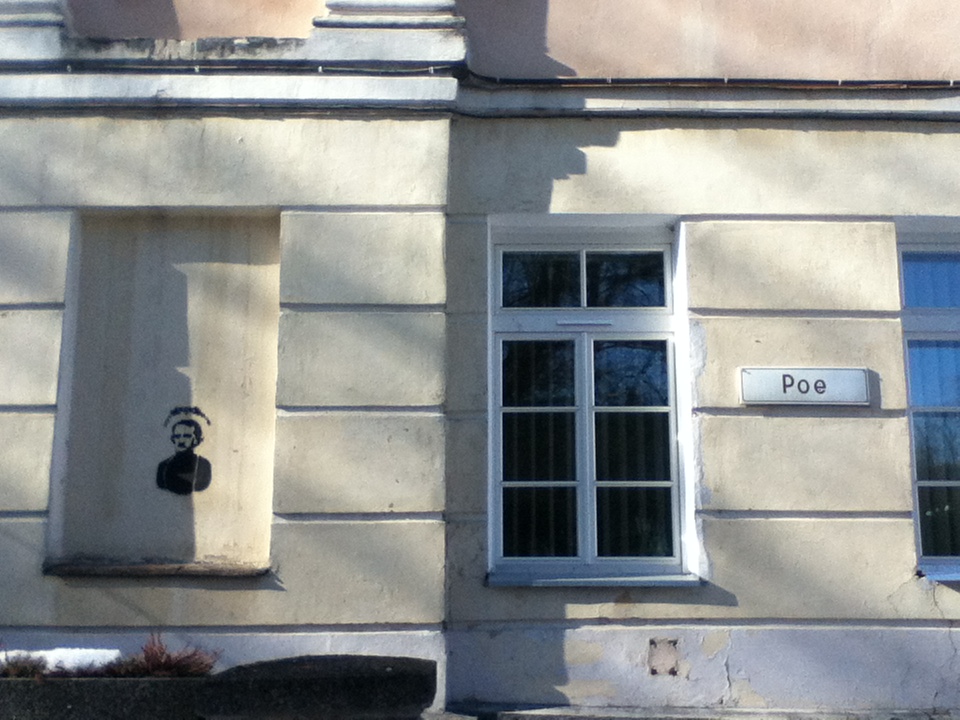
Oh lord. I imagine this is approximately how the Americans must feel at the moment. They've conquered almost the whole world with their cultural imperialism. Now we'll wait a couple of centuries for a certain John Doe to traverse these Eastern European lands and stumble upon
a stencil graffiti of Edgar Allan Poe in what used to be Poe (possessive form of "Shop" in Estonian) street.
The channel, the parasite, is not supplementary, but rather the ground for the aperationality of numerals. (Siegert & Winthrop-Young 2007: 38)
Replace "numerals" with "communication" and you have something that makes sense.
Babby, Ellen R. 1982. Alexandre Chenevert: Prisoner of Language. Modern Language Studies 12(2): 22-30.
His inability to capture thought, to transform it into language, tragically results in another type of imprisonment: that of prescribed linguistic formulae. Alexandre has already written the opening salutation of his letter; he has no difficulty with conventional discourse. (Babby 1982: 25)
Halfway through the paper we're inching toward the phati function. Not that I'm complaining - this literary analysis is a pleasurable read in itself, even though I don't understand French.
Alexandre's own discourse rarely performs a communicative function. Rather than being an istrument of reflection, his speech is often a purely mechanistic "mode of action". The degree to which his discourse is void of content is reflected in his use of verbal and non-verbal phatic language, language in which emphasis is not on transmitting thought, but rather on establishing and maintaining contact. In phatic language, the actual meaning of the discourse is irrelevant. This "aimless social intercourse" may include phrases of politeness, inquiries about health, comments on the weather, etc. Alexandre's conversation with M. Fontaine, his superior, provides a poignant example: "Quel ciel! quelle couleur! s'exclama Alexandre dont le coeur battait toujours assez fort dès qu'il s' obligeait par bienséance à adresser quelques mots à son directeur" (292). (Italics mine) This coerced speech is, according to Emil Benveniste, "at the limit of dialogue." Void of substance, it is a mere exchange of words. (Babby 1982: 26)
These are very common (meta-)phaticisms, but the fabric woven of them presents a poetry of its own. It's actually pretty nice how this author is able to transform very commonplace theoretical statements about phatic communion into a texture that I, at least, enjoy for aesthetic merits.
Within the city, spatial freedom is once again extinct. Alexandre becomes immobilized in crowded streets and busses. Sign systems, both linguistic and extralinguistic, bombard him with directives. Traffic signals and regulations control his very movements. The imprisoning nature of language becomes concretized through the overwhelming presence of imperatives which often assume privileged positions on the printed page. Italics and capital letters serve to amplify the force of these dictatures. (Babby 1982: 27)
Here we are dealing with the conative function, that of
commands. It is true, the cityscape is filled with commanding language, of verbs directing or instructing you to do this or that. I think I should actually take some time to travelse around Tartu and, like Ogier Ghiselin de Busbecq in the previous paper, take up
lectio "in the double meaning of collecting and reading" (Siegert & Winthrop-Young 2007: 36) and just note down every verbal command on every sign and inscription I come across. It might be a fun exercise.
The problem of communication in Alexandre Chenevert has been discussed by many critics: Cf. particularly: Ben Zion Shek, Social Realism in French Canada (Montréal: Harvest House, 1977); Fronçois Ricard, Gabrielle Roy (Montréal: Fides, 1975); Marc Cagné, Visages de Gabrielle Roy: L'oeuvre et l'écrivain (Montréal: Beauchemin, 1973). However, this problem has not been examined in terms of the problematic deteriorating signifier. (Babby 1982: 30; note 12)
Is that what phaticity is to you? I am offended. And aroused. This is idea of phaticity is "Frenchified" to the extreme.
Roman Jakobson, Essais de linguistique gènèrale (Paris: Editions de Minuit, 1963), p. 217. We shall presently limit our discussion to verbal phatic language. However, nonverbal phatic language acts are also manifest. The bringing of flowers to his wife in the hospital is a precise example. (Babby 1982: 30; note 13)
Funny how these sorts of notes can catch you by surprise. Yes, gifting flowers is indeed a nonverbal form of "phatic" communication. (The quotation marks, I think, are needed because "nonverbal phatic language" is multiply oxymoronic (nonverbal + etymologically "speech" and nonverbal + language).
Henstra, Sarah 2000. Looking the Part: Performative Narration in Djuna Barnes's Nightwood and Katherine Mansfield's "Je Ne Parle Pas Français". Twentieth Century Literature 46(2): 125-149.
Matthew and Raoul seem strangely alert to the staged or rehearsed quality of language in general and of their own identities in particular; the burden of this awareness places them at an unusual junction of narratorial trajectories. (Henstra 2000: 126)
You mean the conventionalisation of phatic utterances?
Further, self-centeredness, self-consciousness, and self-contradiction are not wholly reducible to self-delusion in these narratives. (Henstra 2000: 129)
An award for most
self- terms is necessary. This should surely be nominated.
When Dick abandons him, Raoul identifies his hurt as feminine, explaining, "I felt as a woman must feel when a man takes out his watch and remembers an appointment that cannot possibly concern her, except that its claim is the stronger" (94). (Henstra 2000: 132)
I can't yet explain why but this feels extremely touching.
Matthew's narration sets up a series of images to convey the relationship between the individual and the cartographic activity that delimits fields of social viability and unviability. His aphorism "Man has no foothold that is not also a bargain" (32) comments on the sacrifice or loss involved in taking one's place within the social landscape. (I take the word bargain here to mean a transaction of exchange rather than a good deal.) (Henstra 2000: 135)
Again: good literature, good phrases. Might work as an epigraph for the topic of phatic negotiation.
The statement implies something more than that the doctor uncovers the mapping process of regulatory discourse, as we have already examined; Felix's observation alludes to the way Matthew's fabulous lies effect a sedimentation of meaning which for the listener or reader builds slowly into an intrareferential mythological system. (Henstra 2000: 139)
These are some pretty vacuous, scientific-sounding phrases. Kudos for quasi-intellectuality.
A form of gesture deployed far more frequently in "Je Ne Parle Pas Français" than in Nightwood is the phatic statement. Roman Jakobson defines the phatic as a "contact function" in language, "serving primarily to establish, to prolong, or to discontinue communication" between speaker and interlocutor (355). Phatic statements are primitive, elementary specimens of discourse, used by talking birds and babies, but they are also metalingual, insofar as they address the code of address (for example, "What do you mean by that?") (356). To call the phatic a gestural form is to notice its attempt in the text to make contact with the narratee through a temporal and spatial collapse of the distance between speaker and spoken. In other words, the phatic is explicit about the circularity between who is being performed through an utterance and who is doing the performing. Raoul's speech performs and reiterates him as a (textual, narrative) subject who is cast as prior to or independent of his speech; however, in the phatic interjection he sidesteps this illusion of priority to actualize the presence of his body within his speech. When he sums up a list of examples with "You know the things" (90), the statement is a performative gesture that brings together himself and his narratee; Gerald Prince's description of the phatic refers to it as a "psycho-physiological connection" (71). The phatic gestures throughout Raoul's monologue create an atmosphere of appeal wherein his remorse and desire at once reach out to us and concretize us as presence in his narrative. Besides his many deictic comments constructing a context of "I" and "you" for his utterances, the phatic function is extended in more subtle ways: his overrepetition of the label "little fox-terrier" for himself, for one, becomes a gesture whereby we are encouraged to apply the term as a nickname or endearment to our hero rather than as a disparagement. (Henstra 2000: 143)
I finally get to the
one long paragraph in this paper that treats the phatic function and we get is a mix-up with the metalingual function and a whole lot of nonsense that sounds deep but doesn't mean anything.
The phatic gesture raises interesting questions about the role of the reader in a performative text. As manifest in my discussion of the tendency toward critical condemnation of Matthew and Raoul, the way the performance is read determines at least in part what is actually performed. Certainly these texts call for a reevaluation of the pact between reader and author: a cooperative, rational progression toward shared objectives, taken on premise in ironic readings of Raoul and Matthew, must be supplanted here by conflictive, shifting and highly ambiguous interactions. (Henstra 2000: 143)
I'm gonna cherish this paper. I'm gonna mark it with "DNF" despite finishing it,
because binary oppositions perform a duality of interpretive illiberality that manifests the symbolic gulf between discursive norms and the mobilized bodies of betrayed distress in instances of linguistic governmentability, and because I'm going to simulate the style of this paper when I get a chance to read a local Feminist book and write a literary critique of it, for money.
Lombardi, Olimpia; Sebastian Fortin and Leonardo Vanni 2015. A Pluralist View about Information. Philosophy of Science 82(5): 1248-1259.
As many recognize, information is a polysemantic concept that can be associated with different phenomena (Floridi 2010). In this conceptual tangle, the first distinction to be introduced is between a semantic and non-semantic view of information. According to the first view, information is something that carries semantic content (Bar-Hillel and Carnap 1953; Bar-Hillel 1964) and therefore is strongly related to semantic notions such as reference, meaning, and representation. In general, semantic information is carried by propositions that intend to represent states of affairs; hence, it has "aboutness," that is, it is directed to other things. And although it is still controversial whether false factual content may qualify as information, semantic information is strongly linked to the notion of truth. (Lombardi, Fortin & Vanni 2015: 1248-1249)
Or, in Aristotelian terms, this first concept of information is
apophantic. This is the type of information that phatic communion in most treatments of phaticity does not contain. Cf. non-referentiality, meaninglessness, and asemanticity.
Nonsemantic information, also called 'mathematical' or 'statistical', is concerned with the statistical properties of a given system and/or the correlations between the states of two systems, independently of the meanings of those states. The classical locus of mathematical information is the paper where Shannon (1948) introduces a precise formation designed to solve certain specific technological problems. Shannon's theory is purely quantitative; it ignores any issue related to informational content: "The semantic aspects of communication are irrelevant to the engineering problem. The significant aspect is that the actual message is one selected from a set of possible messages" (Shannon 1948, 379). (Lombardi, Fortin & Vanni 2015: 1249)
This was already discussed somewhere above in relation with the French philosopher Michel Serres. It's does apply, though, since from the communication engineering point of view it really does not matter what people talk about. What matters is that they talk.
According to Shannon's theory (Shannon 1948), transmission of information requires a source S, a receiver R, and a channel CH. (Lombardi, Fortin & Vanni 2015: 1249)
So that's how you abbreviate "channel". Details are good.
In recent years, it has been usual to hear in the philosophy of physics (not in the physics) community that the problem of the interpretation of information is dissolved because the word 'information' is an abstract noun. Timpson (2004, 2008) insists that what is produced at the source and what we desire to transmit is not a token sequence but a type sequence; however, types are abstract, and so they are not part of the spatiotemporal content of the world. Therefore, according to this view, information is not a substance, not even a physical entity, because it is not an entity at all: there is nothing the word 'information" refers to. (Lombardi, Fortin & Vanni 2015: 1251)
So if "phatic" is an abstract adjective then it is not a substance and there is nothing in the world it refers to?
Epistemic and Physical Interpretations of Information. A concept usually connected with the notion of information is that of knowledge: information provides knowledge, modifies the state of knowledge of those who receive it. Some believe that the link between information and knowledge is a feature of the everyday notion of information, which must be carefully distinguished from Shannon's technical concept (Timpson 2004). (Lombardi, Fortin & Vanni 2015: 1251)
This is brilliant. It is indeed a characteristic of phatic communion that it does not modify the state of your knowledge. It is
epistemic inconsequentiality, this characteristic.
According to MacKay, information is linked to an increase in knowledge on the receiver's side: "Suppose we begin by asking ourselves what we mean by information. Roughly speaking, we say that we have gained information when we know something now that we didn't know before; when 'what we know' has changed" (1969, 10). (Lombardi, Fortin & Vanni 2015: 1252)
There is no information in stating something perfectly obvious.
MacKay, Donald 1969. Information, Mechanism and Meaning. The Hague: Mouton.It is worth stressing that, from the epistemic perspective, the possibility of acquiring knowledge about a source by consulting the state of a receiver is rooted in the normic charactec of the regularities underlying the whole situation. In fact, the conditional probabilities that define the channel do not represent merely de facto correlations; they are determined by a network of lawful connections between the states of the source and the states of the receiver. (Lombardi, Fortin & Vanni 2015: 1252)
In other words the channel has an epistemic component in the states of knowledge of the participants.
However, from an epistemic interpretation, nothing prevents us from admitting the existence of an informational link between the two receivers. In fact, we can define a communication channel between RA and RB because it is possible to learn something about RB by looking at RA and vice versa: "from a theoretical point of view [...] the communication channel may be thought of as simply the set of depending relations between [a system] S and [a system] R. If the statistical relations defining equivocation and noise between S and R are appropriate, then there is a channel between these two points, and information passes between them, even if there is no direct physical link joining S with R" (Dretske 1981, 38). The receiver RB may even be farther from the source S than RA, so that the events at RB may occur later than those at RA. Nevertheless, this is irrelevant from the epistemic view of information: although the events at RB occur later, RA carries information about what will happen at RB. (Lombardi, Fortin & Vanni 2015: 1254)
Morris. Communization. Sharing without signs.
Kosso (1989) also adheres to this tradition with his "interaction-information" account of scientific observation. (Lombardi, Fortin & Vanni 2015: 1254)
Kosso, Peter 1989. Observability and Observation in Physical Science. Dordrecht: Kluwer.
Hess, Ursula and Agneta Fischer 2013. Emotional Mimicry as Social Regulation. Personality and Social Psychology Review 17(2): 142-157.
Emotions can be expressed in many ways. They may be displayed subtly or explicitly, through silence or screaming, through the raising of one eyebrow or by hitting a fist on the table, or simply by telling others how one feels. People react to these emotional signals with their own emotions, and these emotions may be either similar or different from the emotions in others that provoked these reactions. For example, people may react with contempt to a sentimental reaction such as crying, become frightened when confronted with an aggressive person, feel Schadenfreude when seeing an enemy in terror, or be envious when seeing someone proudly smile. On the other hand, people may also get tears in their eyes when seeing someone cry, afraid when seeing someone trembling with fear, or happy when seeing someone smile. (Hess & Fischer 2013: 142)
Or, to use E. R. Clay's terminology, there is homogeneous and heterogeneous sympathy.
Our overall aim is to present a contextualized view of emotional mimicry and to argue that emotional mimicry is dependent on the social context. To do this, we discuss the different functions that have been proposed for emotional mimicry on the basis of the available evidence and finish with an outline of an alternative model that emphasizes that (implicit or explicit) contextual information is needed for emotion mimicry to take place. (Hess & Fischer 2013: 142)
I am reading this at an opportune time, as the next chapter in Ogden and Richards I'll be reading is about the "sign-situation", i.e. a contextual theory of reference. It would be nice if I could amalgamate these two contextual theories in my own upcoming writings.
One of the central points is that mimicry serves to foster affiliation but also crucially depends on an initial affiliative stance, that is, an initial openness to engage with the other. Importantly, we define "contextualized" in its broadest sense, namely, the inclusion of social information. Context information can be explicit, for example, in references to the situation in which the expression occurs (e.g., funeral, or winning a context), but context information can also be implicit. For example, a smiling face provides not only information about the emotional state of the person, but the smile also signals affiliative intentions (Hess, Blairy, & Kleck, 2000) and the face provides information on the social group membership of the expresser (i.e., man or woman, a baby or an old man). (Hess & Fischer 2013: 143)
I've taken note of something like "an initial affiliative stance" in relation with first impressions somewhere among these readings. The role of smile in communicating
willingness to communicate is also a topic in Carnegie 1936).
According to the standard view, behavioral mimicry is an automatic, matched motor response, based on a perception-behavior link (Chartrand & Bargh, 1999; Preston & de Waal, 2003). We will refer to this idea as the Matched Motor Hypothesis, which assumes that merely perceiving a specific nonverbal display automatically entrains the same expression in the perceiver. The primary function of this imitative behavior is to foster affiliation and liking, because it smoothens the interaction and adjusts behavior by synchronizing the nonverbal behaviors of the interactants. Behavioral mimicry has therefore been referred to as "social glue" (Lakin, Jefferis, Cheng, & Chartrand, 2003). (Hess & Fischer 2013: 143)
There are two cardinally opposed metaphors at play in these sorts of invocations: social
glue and social
lubricant.
However, emotional mimicry and beavioral mimicry differ in a crucial way. Emotional expressions, in contrast with most other nonverbal behaviors, are intrinsically meaningful. Emotions are based on an appraisal of the emotion-eliciting event, which in turn is based on the expresser's preferences, values, and motivations (e.g., Scherer, 1987). People's naive emotion theories tend to be in line with these appraisals, that is, if people observe an emotion in others, they automatically try to infer why this person feels this emotion. Thus, naive emotion theories presume emotions to be elicited by the same classes of events that appraisal theories predict (Parkinson, 199, 2001; Roseman & Evdokas, 2004; Scherer, 1997; Smith & Ellsworth, 1985a, 1985b). (Hess & Fischer 2013: 143)
It sounds a bit like Jakobson's
introversive semiosis, this intrinsic meaningfulness.
We considered 40 published studies that assessed emotional mimicry in at least one experimental group without additional manipulations such as emotion induction or manipulations that suppress mimicry (see Table 1). [...] The vast majority of these studies have focused on only two emotions - anger and happiness. Consequently, only limited evidence can be found for the mimicry of discrete emotions other than happiness and anger (see Table 1). The most common additional emotion is sadness, although disgust, fear, and surprise have also been studied (see Table 1). (Hess & Fischer 2013: 144)
This actually highlights some problems that our own meta-analysis of phatic studies might present. Namely, there are - as far as I know - no standardized measures for considering
phaticity. If we were to create a table of phatic characteristics (common phaticisms, for example), the header would be very extensive. (Though this can probably be solved by rotating the table and making it a horizontal two-page ordeal.)
We now turn to studies in which the relational conetxt has been varied in some way or another. We begin by discussing various contextual influences to examine the first function of emotional mimicry - to promote affiliation. (Hess & Fischer 2013: 147)
"Relational context" and "promoting affiliation" are reasons for reading this paper among studies of phatics. The other two papers finishing this post are more like papers to emulate in formal structure when writing our meta-analysis of phatics.
A first factor relevant to emotional mimicry is one's positive or negative attitude toward the target. A negative attitude may inhibit emotional mimicry and increase the interpretation of emotional mimicry and increase the interpretation of emotional signals as hostile, even if it is a smile. For example, a political leader's emotional displays leads to less mimicry in observers with a different political orientation or a negative attitude toward this politician, compared with those who hold the same political opinion (Bourgeous & Hess, 2008; McHugo, Lanzetta, & Bush, 1991; McHugo, Lanzetta, Sullivan, Masters, & Englis, 1985). (Hess & Fischer 2013: 147)
Crucial aspects of the "opening" phase of interaction.
Third, similarity with the expresser may also foster mimicry. Specifically, individuals are more likely to mimic the emotional reactions of in-group members than those of out-group members. (Hess & Fischer 2013: 147)
In this sense the "breaking of silence" and establishing whether the newcomer speaks your language, for example, structures the consequent interaction on the nonverbal level.
Finally, the facial display itself tells the observer something about his or her potential relation with the expresser and, thus, provides implicit information about the intentions of the expresser. Specifically, some emotional expressions signal affiliation, whereas others do not. For example, when people do not have any other information, they spontaneously mimic a smile more than a frown. (Hess & Fischer 2013: 148)
It is easier to smile at a "neutral" person with whom you have not made contact. This demonstrates the disparity between Morris's and Ruesch's conceptions of
communization.
In addition, a smile has a very low social cost. Whereas mimicking sadness, for example, signals understanding of the other person's suffering and, hence, may result in requests for aid and succor, smiles signal that all is well and that no immediate action is required. (Hess & Fischer 2013: 148)
This is a good point. Smiling is a very low form of empathy, it has more (casual) social value than (invested) personal value.
In fact, the smiling of a stranger might even signal that no animosity should be expected and that resources will be shared (e.g., a happy salesman may give you something for free). (Hess & Fischer 2013: 148)
In other words, smiling has a propitiative function (of reducing or alleviating interpersonal tension).
In contrast to smiles, facial movements that signal potential animosity, such as a frown, a tightened jaw, or pressed lips, do not imply an affiliative desire to share one's feelings but are more likely understood as a warning signal. An angry face thus signals a lack of affiliative intent (Hess et al., 2000; Knutson, 1996) and the imitation of an angry face in a social context is unlikely to facilitate affiliation. Thus, the imitation of anger, disgust, and probably contempt, is inherently incongruent with the notion that mimicry functions to facilitate affiliation. (Hess & Fischer 2013: 148)
In effect this amounts to an examination of "the context of situation" in relation with emotional mimicry.
That said, for human beings as a social species, affiliative intent can be assumed to be the default stance for situations in which the other is a potential in-group member and no information suggesting otherwise is provided by the context. (Hess & Fischer 2013: 148)
Phatic communion is in this sense the "default" state.
Moreover, there is evidence that observers "mimic" an emotional signal in another channel, for example, facial mimicry to emotional sounds [...] This finding suggests that hearing an emotional sonud entrains the simulation of a corresponding facial expression. [...] One might argue that such matched expressions do not represent mimicry, as there are no facial displays to be mimicked. From our point of view, however, emotional mimicry is not the result of exact copying of what one sees but rather the interpretation of an emotional signal. This interpretation is based on some minimal form of shared understanding, as conveyed by one or more emotional signals. (Hess & Fischer 2013: 151)
"All experience [...] is either enjoyed or interpreted [...] and very little of it escapes some degree of interpretation." (Ogden & Richards 1946[1923]: 50)
Becuse emotions are mentally represented as abstract concepts (amodal) and not as specific modalities (faces, gestures, feelings, etc.), activation of an emotional state need not be embodied in the same channel (Hawk et al., 2011; Houde et al., 2009). A facial expression in reaction to a vocal stimulus can thus be considered as a reenactment of the emotion in the same way as a facial expression to a facial stimulus. Thus, emotional mimicry can be considered a case of embodied simulation. Thus embodied simulation both elicits liking and rapport and seems to support emotional understanding as outlined above. (Hess & Fischer 2013: 151)
Ergo it's importance for phatic studies. These studies deal with face-to-face interaction, but now we need to take on the interpretation and understanding of emotions and their expressions in the context of computer mediated communication.
We have distinguished two types of reactions to a facial display: a mimicry response and a reactive response (Preston & de Waal, 2003). These two types of reactions often cannot be disentangled, especially not in an acontextual paradigm in which participants see an emotional face without any additional information the person or the cause of his or her emotion. We have argued that a mimicry response occurs only if there is potential affiliative intent between the observer and the target (indicated by the upper route in Figure 1). The basic assumption of a contextual model of mimicry is that people mimic a discrete emotion only if they share the perspective that gave rise to that specific emotion (see Figure 1). (Hess & Fischer 2013: 152)
At the end of the day this does really boil down to E. R. Clay's
homogeneous sympathy (here,
mimicry response), and
heterogeneous sympathy (here,
reactive response).
Various studies have demonstrated that spontaneous mimicry occurs only when a minimal form of affiliation or bonding exists between observer and target. This means that social interaction goals or inferred intentions should be minimally neutral, and preferably affiliative, for emotional mimicry to occur. (Hess & Fischer 2013: 152)
"Social interaction goals" are exactly what we're dealing with in phatic studies.
People do not need to think about not smiling at the smile of their enemy. They are simply not tempted to mimic such a smile because they do not see it as an invitation to play or enjoy together. (Hess & Fischer 2013: 152)
The pleasure/leisure principle. Communion depends on mutual enjoyment of each other's company.
Stephens, Nicole M.; Stephanie A. Fryberg and Hazel Rose Markus 2012. Social Class Disparities in Health and Education: Reducing Inequality by Applying a Sociocultural Self Model of Behavior. Psychological Review 119(4): 723-744.
We propose that one barrier to effectively addressing social class disparities in health and education is the unresolved clash between two models of human behavior - what we refer to as the individual model and the structural model. The term model of behavior refers to assumptions about the sources of human behavior that are rarely explicitly identified or acknowledged but that are foundational to research and to interventions. (Stephens, Fryberg & Markus 2012: 723)
Interesting stuff but how does it differ from the discussion and distinction of individualism and collectivism? Or personal and social? Or public and private?
The sociocultural self model recognizes that both individual characteristics and structural conditions are situated in larger contexts, which reflect particular ecological, economic, political, and historical circumstances. The term sociocultural context refers to these larger, macro-level forces that ground the dynamic interaction of structural conditions and individual characteristics. (Stephens, Fryberg & Markus 2012: 725)
It sounds a bit like these
sociocultural contexts are the transactional "Third" class of systems.
By answering these questions, the sociocultural self model has the potential to bridge the gap between traditional explanations of inequality and, in doing so, to generate more integrative research efforts and effective interventions. (Stephens, Fryberg & Markus 2012: 725)
Phrasing. This is also our goal in formulating phatic studies and doing our best to integrate the various points of access to phatics.
Second, the individual model of behavior does not fully recognize the socioculturally shaped selves that guide how people make sense of their experiences and, in turn, how these understandings shape peopl's behavior. For example, in low SES environments that offer fewer opportunities for choice, control, or influence, people develop understandings of behavior that focus less on influencing the situation, enacting personal control, and having independence and instead focus more on adjusting to their environment and connecting with and responding to others (e.g., Stephen, Hamedani, Markus, Bergsieker, & Eloul, 2009). (Stephens, Fryberg & Markus 2012: 730)
Huh. It's interesting that the characteristics of low SES (socio-economic status) are closely aligned with the conceptual plane of phatic communion.
One area of research suggests that social class disparities in health are a product of differential access to the services, facilities, and safe living canditions that are known to foster healthy behavior (e.g., healthy diet, increased physical activity). For example, people in low SES neighborhoods have less access to parks, walking and biking trails, playgrounds, and safe spaces for recreation (Estabrooks, Lee, & Gyurcsik, 2003; Macintyre, Maciver, & Sooman, 1993). (Stephens, Fryberg & Markus 2012: 731)
These facilities are also conductive to phatic communion, co-operation, and leisure, i.e. places where social communion takes place.
We suggest that MTO may have been ineffective, in part, because it did not fully recognize the two important tenets that are central to the sociocultural self model of behavior: the principle of mutual constitution and attention to selves as a systematic source of the culture-specific meanings that guide behavior. (Stephens, Fryberg & Markus 2012: 732)
What does that even mean?
Second, MTO did not attend to the role of the socioculturally shaped selves that guide behavior by shaping how individuals make sense of their environments. The sociocultural self model considers that people's socioculturally shaped selves inform how people make sense of the situation (e.g., what it means to move to a "better" neighborhood; DeLuca, 2007; DeLuca & Rosenblatt, 2010). These understandings (e.g., whether people identify with the new neighborhood), in turn, guide how people respond to the opportunities that the new neighborhood presents (Schooler, 2007; Sewell, 1992). For example, even after moving to a new neighborhood with access to higher quality schools, individuals may not see themselves as "learners" or "students." Without these types of school-relevant selves, they may harbor low expectations for their educational attainment or have concerns about how teachers will view them, and as a result, they may not fully take advantage will view them, and as a result, they may not fully take advantage of the opportunities that are available to them. The nature and content of people's selves - whether individuals identify as "students" and understand school as something for "people like me" - will, in turn, influence whether or not a given strategy for improving academic performance will be effective. (Stephens, Fryberg & Markus 2012: 732)
This sounds like a reduction on another level: that people's "sociocultural selves" are primarily goal-oriented (self-efficacy and whatnot) self-descriptions. It certainly looks like in all this talk of "systemic" "sociocultural" "selves" there's a lot that's left out. I'm only halfway through this paper so it may still come through. But I'd like to see it address, for example, the meeting point between self-description (sociocultural selves), and the structural conditions that provide conceptual resources for such description. For example, someone reddit pointed out that so many low SES Mexicans go over to the US because the image of "Mexican immigrant", the illegal low-wage work they should be provided, etc. are all already in place.
In one direction, illustrating this process of mutual constitution, lower social class contexts with fewer material resources and greater constraints may foster higher individual levels of social responsiveness and attention to others than higher social class contexts (see Krauss, Piff, & Keltner, 2011; Stephens, Fryberg, & Markus 2011). (Stephens, Fryberg & Markus 2012: 734)
Again we are reminded that poor people have a stronger sense of community (perhaps even because they don't have much else).
The sociocultural self model is grounded in classic social psychological principles, but also builds on and extends these principles (cf. Adams, 2012; Markus & Hamedani, 2007). As elaborated in Ross and Nisbett's (1991) book, The Person and the Situation, the first social psychological principle, termed "the power of the situation," refers to the idea that subtle situational factors can have a powerful influence on psychological experience and behavior. Extending this principle, the sociocultural self model views the situation with a wide-angle lens and recognizes that "the situation" is more than just the immediate situation. That is, the sociocultural self model conceptualizes the situation as embedded in the larger sociocultural contexts in which individuals participate, such as those demarcated by social class, race/ethnicity, gender, religion, nation, and region of origin. The model gurther recognizes that these socially and historically reconstructed sociocultural contexts contain sets of culture-specific ideas, practices, and institutions that shape the selves that emerge in particular situations and, in turn, how people make sense of and respond to those situations. (Stephens, Fryberg & Markus 2012: 734)
Participate or
transact? I get the "social situation", but I can't help seeing similarities with the kind of "Lefty" political talk that attributes all social ills to "systemic" problems.
Extending this principle, the sociocultural self model reveals that the meaning of a situation is not just a function of individuals who choose to interpret situations in their own idiosyncratic ways. Rather, the meaning of a situation and how it is interpreted vary systematically according to people's socioculturally shaped selves. (Stephens, Fryberg & Markus 2012: 734)
And there we have it. "Systemic," mutters Jon Stewart, "I love that word, systemic."
In the following section, we describe emblematic examples from the literature on (a) social identity threat, (b) identity-based motivation, and (c) cultural models of self and agency. (Stephens, Fryberg & Markus 2012: 734)
So this
is about "identity politics"?
For the last two decades, an emerging area of research in cultural psychology has illuminated the sociocultural diversity of human behavior and psychological functioning (see Markus & Kitayama, 2010). The central premise of this research is that individuals' psychological functioning - how people think, feel, and act in the world - is a sociocultural product. As Markus and Kitayama (2003) explained, "Being a person and acting in the world are anything but natural acts; they are culturally saturated processes that entail engagement with culture-specific sets of meanings and practices" (p. 6). That is, contexts with different sets of ideas, practices, and institutions provide people with particular cultural models or sets of widely shared understandings of how to be an appropriate person in the world (Cross & Madson, 1997; Markus & Kitayama, 2003, 2010). These cultural models of self and agency guide individuals' behavior and serve as a blueprint for how people understand their own and others' behavior (Firske et al., 1998; Holland & Quinn, 1987; Shore, 1996). (Stephens, Fryberg & Markus 2012: 735)
It certainly sounds good. Very general, perhaps, but in line with cultural relativism that negates anything universal in the human experience (physiology is not a thing; you don't really believe in genes, do you?).
Participants were randomly assigned to read one of two welcome messages from their university. The independent message framed the university culture and college experience as about exploring personal interests, working independently, and paving one's own pathways. In contrast, the interdependent message framed the university culture and college experience as about being part of a community, working collaboratively, and connecting with others. As expected, when the college culture was framed in terms of independence (a cultural mismatch with working-class students' motives), students from working-class background experienced the performance task as more difficult than did students from middle-class backgrounds, and this construal of the task undermined working-class students' performance. Yet, when the college culture was framed in terms of interdependence (a cultural match with working-class students' motives0, working-class students experienced the performance task as less difficult, and the social class performance gap between working-class and middle-class students was eliminated (Shephens, Fryberg, Markus, Johnson, & Covarrubias, 2012). (Stephens, Fryberg & Markus 2012: 736)
I resent the implication that phatic communion is a "poor" thing, much like I detest the Russian author's explicit statement that "Female communication is phatic."
Above and beyond individual characteristics or access to material resources, the sociocultural self model extends traditional approaches by focusing on the self as a product of the mutual constitution of individuals and structures in particular sociocultural contexts over time. (Stephens, Fryberg & Markus 2012: 739)
In essence, systems and elements within those systems are mutually constitutive. Brilliant.
Carter, Dorothy R.; Leslie A. DeChurch, Michael T. Braun and Noshir S. Contractor 2015. Social Network Approaches to Leadership: An Integrative Conceptual Review. Journal of Applied Psychology 100(3): 597-622.
Social network approaches provide a set of theories and methods with which to articulate and investigate, with greater precision and rigor, the wide variety of relational perspectives implied by contemporary leadership theories. Our goal is to advance this domain through an integrative conceptual review. (Carter, DeChurch, Braun & Contractor 2015: 597)
I'm very interested in what
social network approaches actually are, for sake of my own meta-theoretical network approach. The end-goal is similarly an integrative conceptual review of phatic studies.
Although these core questions have changed little over the past century, a noticeable trend in recent research is the growing appreciation of the relational nature of leadership. Leadership is conceptualized as a "dyadic, shared, relational, strategic, global, and a complex social dynamic" (Avolio, Walumbwa, & Weber, 2009, p. 423). (Carter, DeChurch, Braun & Contractor 2015: 597)
The situation is largely the same in phatic studies. Especially the change over the past century, which has emphasized
relationality only during the past 40 years or so.
Social networks are the patterns of interpersonal relationships (i.e., ties) among a set of people (i.e., actors, nodes; Wasserman & Faust, 1994). Social network approaches offer theoretical rationale for understanding the development and utility of relationships, as well as a set of analytic tools designed to identify, describe, and explain relationships (e.g. Borgatti, Mehra, Brass, & Labianca, 2009; Contractor, Wasserman, & Faust, 2006). Thus, network approaches are well suited for investigating leadership as a relational phenomenon. The goal of our review is to advance this domain through an integrative conceptual review of social network approaches to leadership. We organize this prior research to facilitate understanding and integration across subdomains of this work, opening up fruitful new avenues for leadership inquiry. (Carter, DeChurch, Braun & Contractor 2015: 598)
The similarities continue. Integration across subdomains is especially prevalent, as phaticity is approached differently in various disciplines, and if integration be conducted the idiosyncracies of each must be considered.
Contemporary definitions have also advanced a view of leadership as situated in specific contexts, as a patterned phenomenon, and as a process that can be formal and/or informal. (Carter, DeChurch, Braun & Contractor 2015: 598)
Again, spot on. Phatic communion was conceptualized with the context of situation in mind in the first place, and Firth added the element of patterning (reconceptualizing phaticity as a system of signs), and formal vs informal problematic comes to the foreground when considering leisure (original orientation) and service encounters (since the 1990s).
Table 1. Exemplar Definitions of Leadership That Emphasize Its Relational, Situated, Patterned, and Formal/Informal Nature(Carter, DeChurch, Braun & Contractor 2015: 599)
This is the straw that broke the camel's back. This Table is why I decided that I need to read this paper. For our own meta-analysis we need to construct a similar table, demonstrating the various definitions of phatic communion, phatic function, and phatic communication. I won't re-type the whole Table (I'll screencap instead), but I'll note that this is a technique worth emulation. The only problem is, since we're dealing with several interrelated concepts or even subdivisions of characteristics, we might have to construct several such tables.
In summary, social network approaches provide a theoretical apparatus with which to articulate and investigate, with greater precision and rigor, the wide variety of relational perspectives implied by contemporary theories of leadership. (Carter, DeChurch, Braun & Contractor 2015: 600)
Something for the prolegomena ("Phatics, phaticity, and phatic studies"), where the variety of perspectives is surveyed and useful conceptions towards a theoretical apparatus are formalized.
We began our review by identifying all studies published within the past 15 years (1999-2014) in top-tier journals specializing in topics related to leadership, human resource management, organizational psychology, organizational behavior, sociology, social networks, and communication that included the terms leadership and networks as keywords and/or used network analytic techniques to study leadership. Next, we identified publications not explicitly using these search terms that fell within the scope of our review. These include leadership studies within management and applied psychology that may not mention networks but whose conceptual assumptions relied heavily on patterns of social processes (e.g., Aime, Humphrey, DeRue, & Paul, 2014). (Carter, DeChurch, Braun & Contractor 2015: 600)
Yup. That's my method as well. Though since "phatic" is such a restricted or rare concept, it's possible to survey more material (after this series I've planned 80 papers from 1920s to 1990s).
We turn now to the findings. Within each area, we present a brief synopsis of the dominant theoretical ideas. Then, we synthesize recent exemplar quantitative, qualitative, and case-based studies with regard to (a) network relations and metrics utilized, (b) conceptual orientations, (c) key findings, and (d) research design and sample type. (Carter, DeChurch, Braun & Contractor 2015: 603)
Okay. This is getting intense. There are very few quantitative studies in phaticity (still, there are a few), but qualitative and case-based studies are plenty. In our case we need to consider (a) the pertinent phatic (communion, communication, or function - in chronological order); (b) conceptual orientation (yes!), (c) findings (which may be boring), and ... I'm not really sure what to do with "research design and sample syze". We've yet to say anything about methodology - it's a white spot on our map.
See also: