·

·

Onto-Ethologies

Buchanan, Brett 2008. Onto-Ethologies: The Animal Environments of Uexküll, Heidegger, Merleau-Ponty, and Deleuze. State University of New York Press, Albany

Seda raamatut üritasin lugeda hiliskevadel, kuid piirdusin esimese osaga, mis käsitleb Uexkülli. Nüüd olen natuke rohkem tuttav ka ülejäänud mõtlejatega, niiet aeg selle lugemiseks on küps.

In studying the behavioral patterns of different animals, Uexküll noted that animals of all levels, from microorganisms to human animals, are capable of discerning meaning from environmental cues beyond a purely instinctual reaction. Such meaning is attributable to how organisms enter into relationships with other things and thus come to see the environment as laced not just with signs, but with significance itself. (Buchanan 2008: 8)
Natural selection is a dangerous idea for many reasons, perhaps the greatest of which is its ability to offer an observable, testable, and scientific account for evolution, where the repercussions extend into philosophical and religious beliefs. (Buchanan 2008: 11)
The animal, together with its environment, are observed to form a whole system that Uexküll called an Umwelt... (Buchanan 2008: 21)
It is true that one might and can grasp a door handle and think ‘This is a handle that I grasp and which allows this door to open such that I might enter the other room.’ But we don’t do this; we simply can’t live this way. Rather one simply grasps the handle and opens the door without thinking twice about it. This, incidentally, is what is wrong with many cognitive models in psychology that endlessly break down human behavior into functional bits (e.g., see handle, extend arm to handle, grasp handle, turn handle, pull, etc.). Merleau-Ponty in particular will critique a similar form of psychological reductionism by noting that human behavior is constituted by the whole body in the fluidity of its movements. If I want to kick a soccer ball, for example, I don’t think of all the steps required to kick the ball. Should I do so, my opponent would surely have already taken the ball away efore I had a chance to kick it for myself! The body acts as a whole in virtue of always already being in a world. (Buchanan 2008: 60)
After briefly recounting a day in the life of each, Clark arrives at three types of phenomena that may distinguish one type of being from the other: (1) experiential “feelings” such as hunger or desire; (2) thoughts and reasons; and (3) the “meta-flow” of thoughts about thoughts. (Buchanan 2008: 65)
Heidegger primarily highlights how behavior implies a certain self-retention, a mode of “driven performing” as opposed to the free “doing and acting” that human beings elicit. There are limits to behavior, but not just in the sense that one can behave this way and not that way. The limits are more fundamental in that an animal’s behavior is limited with respect to its own ‘self’-relation. The animal cannot get out of itself; it cannot, as Heidegger will claim elsewhere of human existence, transcend itself—neither temporally nor toward the world. (Buchanan 2008: 77)
If we are to find the totality of the organism in the phenomenon of behavior, then we must inquire into its meaning.6 But to look for an explicit definition of behavior may be an ineffective path. Merleau-Ponty doesn’t so much offer a clear formulation inasmuch as he offers a variety of different views. Accordingly, behavior is linked with a variety of other notions: behavior as structure, behavior as form, behavior as signification, behavior as a manner or attitude of existing. In each case, however, it is the ontological interpretation of the organism that is conveyed. Behavior demonstrates a relational enclosure insofar as the organism is structurally united with its world. (Buchanan 2008: 120)

Tulemus oli loodetust teistsugune. Mida ma lootsin? Käitumise käsitlemist. Sain aga ontoloogiate võrdluste, milles autor otsis välja nimetatud mõtlejate viited Uexküllile ja kuidas viimane on nende mõttetööd mõjutanud. Muidugi oli see raamat täis päris põnevat arutlelu ja faktoide (nt "organiteta keha" on muna), aga suur osa sellest on minu eesmärkide suhtes täiesti tarbetu (diskussioon sellest kuidas inimene, loom ja kivi "on").
Tekitas tahtmist kõnealuste mõtlejate endi tekste lugeda, kuid teisalt ähvardab seda teed minemine liiga filosoofiliseks muutumisega. Üle päris pika aja kasutan jälle silti Abstruse:

The World of Perception


Merleau-Ponty, Maurice 2004 [1948]. The World of Perception. Translated by Oliver Davis. Routledge.

Käesolev teos on Merleau-Ponty raadiosaate "Prantsuse kultuuritund" transkriptsioon. Koosneb seitsmest loengust, väga lühike ja kergesti loetav.

"post-modernism denies any special status to the natural sciences" (lk 14) - so that's what that is!

"The Cartesian position notoriously alienates us from others, since it implies that we can know them only indirectly via their behaviour, which is only a detached, contingent, expression of their thoughts and feelings, and one whose interpretation we can never validate since we have no other way of finding out about the other’s thoughts and feelings." (lk 26) - sounds about right

"...our relationship to space is not that of a pure disembodied subject to a distant object but rather that of a being which dwells in space relating to its natural habitat." (lk 55) - suhe ruumiga ei ole lihtne subjekti ja objekti vaheline suhe, vaid "olemine ruumis".

"...rather than a mind and a body, man is a mind with a body, a being who can only get to the truth of things because its body is, as it were, embedded in those things." (lk 56) - kehastumus

"This is why people’s tastes, character, and the attitude they adopt to the world and to particular things can be deciphered from the objects with which they choose to surround themselves, their preferences for certain colours or the places where they like to go for walks." (LK 63) - Midagi sellist, et inimese muusikamaitset saab dešifreerida muusika kaudu mida antud inimene eelistab kuulata.

"There is a Japanese engraving which shows an Elephant surrounded by blind men." (lk 76) - Ahhaa! Sealt pärinebki see stuff of psychology readers! Elevanti uurivad pimedad mehed ja kassipoeg kes näeb peeglist lõvi on psühholoogialugemike klassika.

"Descartes showed admirably that spirit is something altogether different. He demonstrated that its nature is quite other, for smoke and breath are, in their way, things – even if very subtle ones – whereas spirit is not a thing at all, does not occupy space, is not spread over a certain extension as all things are, but on the contrary is entirely compact and indivisible – a being – the essence of which is none other than to commune with, collect and know itself. This gave rise to the concepts of pure spirit and pure matter, or things. Yet it is clear that I can only find and, so to speak, touch this absolutely pure spirit in myself. Other human beings are never pure spirit for me: I only know them through their glances, their gestures, their speech – in other words, through their bodies. Of course another human being is certainly more than simply a body to me: rather, this other is a body animated by all manner of intentions, the origin of numerous actions and words. These I remember and they go to make up my sketch of their moral character. Yet I cannot detach someone from their silhouette, the tone of their voice and its accent. If I see them for even a moment, I can reconnect with them instantaneously and far more thoroughly than if I were to go through a list of everything I know about them from experience or hearsay." (lk 82) - Kogu lehekülg on väärt materjal. Kui intersubjektiivsuseni jõuan, tuleks seda kõike üle lugeda ja tõlgendada.

Kinesics and Context


Birdwhistell, Ray L. 1970. Kinesic and Context: Essays on Body-Motion Communication. Philadelphia : University of Pennsylvania Press

Esimese lugemisega võrreldes leidsin seekord umbkaudu samavõrd palju tsiteerimisväärset materjali, mis annab lootust, et ka kolmas kord kuluks ära. Momenti mil Birdwhistell ütleb midagi laadis "käitumine ehk märk" ei leidnudki sel korral. Ja kineemitähestikust saan nüüd vististi halvemini aru kui varem.

...behavior never stands alone - it is always modified by other identification signals and by the structure of the context in which the behavior occurs. (Birdwhistell 1970: 45)
Teisest kultuurist pärit laste käitumist jälgides on liigutusi "kergem näha":
If we were watching children from another culture, whose behavior is very bizarre in our terms, it would be very much easier to see. (Birdwhistell 1970: 48)
Suhtlemise uurimisel on mitteverbaalset aspekti varem kas välditud või antud marginaalne positsioon:
A majority of all discussions of communication have thus been phrased in terms of the passage of words from wirter to reader, from speaker to auditor. The accompanying behavior, even when recognized as coterminous with the words, has been by and large relegated to a position of being, at best, a modifier of the messages carried by the words. More commonly, the accompanying behavior is seen to interfere with the transmission of meaning, and "good" communication depends upon the elimination or reduction of the extraneous circumlexical behavior. (Birdwhistell 1970: 67)
Suhtlemine, õppimine ja ühiskonnas elamine:
To be viable members of their social groupings, fish, birds, mammals, and man must engage in significant symbolization - must learn to recognize, receive, and send ordered messages. In other words, the individual must learn to behave in appropriate ways which permit the other members of the group th recognize and anticipate his behavior. Society is that way in which behavior is calibrated so that existence is not a process of continuous and wasteful trial and error. (Birdwhistell 1970: 74)
We think og communication as centrally verbal - centrally cognitive and centrally willful and only laterally and by imperfection influenced by the other modalities of interaction. It is no suprise that our research designs will mirror this structure of conventional reality. (Birdwhistell 1970: 87)
It has been our experience that even preliminary research, using structural linguistic and kinesic methods, lends confidence to a description of communication as being a continuous process made up of isolable discontinuous units. THese units are always multifunctional; they have distinguishable contrast meaning on one level and a cross-referencing function (meaning) on others. Under inspection, each level of behavioral activity is discontinous - that is, is made up of a series of discrete, arbitrary elements - and none of these elements has explicit or implicit social meaning in and of itself. (Birdwhistell 1970: 88)
Personaalne ja jagatud tähendus on siin idiosünkraatne ja institutsionaalne:
Unless the student of structural analysis of communication is so omnivorous in his conception of communication that he defines it to include all of culture, he must have distinct, or at least heuristically distinguishable, contexts for measuring the behavior which he is attempting to order. If he is going to study the communicated shifts of behavior in groups, he must know the contexts of these occurrences. Only in this way can he isolate the strictly communicational behavior from the idiosyncratic, on the one hand, and from the institutionally internalized, on the other. (Birdwhistell 1970: 95)
I stated above that I object to any attempt to subsume all social behavior under a linguistic, kinesic rubric. I do not think, as presently conceived, that all interactive behavior should be relegated to a communicational or "semiotic" frame. (Birdwhistell 1970: 98)
Extensive and technically difficult research reveals that there are four significant degrees of lid closure: "overopen," "slit," "closed," and "squeezed." There are besides these a series of circumorbital kinic complexes that have resisted analysis. For instance, contraction of the distal aspects of the circumorbital area gives us the familiar "laugh lines." We have not yet been able to determine whether this distal crinkling has kinemic status. It is clear that its absence significantly varies the "meaning" of a smile or laugh, but until we can demonstrate that it is not merely an allokine of lid closure, we must withhold its assignment. (Birdwhistell 1970: 100)
Teda nimetatakse alusetult relativistiks, sest tegelikult oli tal lihtsalt rõhuvamaid küsimusi millele vastata kui liigutuste päritolu:
There is no more evidence for this than there isthat syntactic activity is not ultimately a derivation from body movement. From my point of view, it is premature at this stage of analysis to conjecture about origins. Our central concern is how such behaviors operate, not where they came from. (Birdwhistell 1970: 125)
Siin jõuab Birdwhistell kummastavalt lotmaniaanlikule järeldusele, et märgisüsteemide läbipõimimine on suhtlemiseks vajalik:
My own research has led me to the point that I am no longer willing to call either linguistic or kinesicsystems communication systems. All of the emerging data seem to me to support the contiention that linguistics and kinesics are infracommunicational systems. Only in their interrelationship with each other and with comparable systems from other sensory modalities are the emergent communication systems achieved. (Birdwhitell 1970: 127)
Kineesika ja lingvistika analoogiat saab järeldada siit:
A phone or a kine, a word or a kinemorph, a sentence or a complex kinemorphic construction can be produced at will by a sufficiently skilled analyst or actor. (Birdwhistell 1970: 155)
Kui palju materjali on vaja?
Without longer stretches of film, say an hour, and without perspective on the social and cultural matrix in which the activity occurs, such a record provides little more than an extended set of candid closeups or, at best, a piece of ethnographic curiosae. But in a familiar context even very brief pieces of behavior provide us with extensive generalizations which can be systematically tested. (Birdwhistell 1970: 157)
Veel üks hoiatus "märgikandja" ahvatluse suhtes:
The recognition that communicational behavior can be congruent in one setting and incongruent in another should serve as a warning against any theory of meaning which suggests that the particles carry meaning in and of themselves. (Birdwhistell 1970: 179)
Kineesilise uurimise põhieeldused:
  1. Like other events in nature, no body movement or expression is without meaning in the context in which it appears.
  2. Like other aspects of human behavior, body posture, movement, and facial expression are patterned and, thus, subject to systematic analysis.
  3. While the possible limitations imposed by particular biological substrata are recognized, until otherwise demonstrated, the systematic body motion of the members of a community is considered a function of the social system to which the group belongs.
  4. Visible body activity, like audible acoustic activity, systematically influences the behavior of other members of any particular group.
  5. Until otherwise demonstrated such behavior will be considered to have an investigable communicational function.
  6. The meanings derived therefrom are functions both of the behavior and of the operations by which it is investigated.
  7. The particular biological system and the special life experience of any individual will contribute idiosyncratic elements to his kinesic system, but the individual or symptomatic quality of these elements can only be assessed following the analysis of the larger system of which his is a part.
(Birdwhistell 1970: 183-184)
Idiokineesiline süsteem:
The idiokinesic system of any actor is derived from a multiple of experiences with a wide variety of exposures to often quite differing systems. (Birdwhistell 1970: 185)
viis ahvatlust:
  1. "Märgiandja" ahvatlus - tuleneb lingvistilisest naiivsusest mis eeldab, et igale žestile vastab "päris" tähendust just nagu sõnadel peaks olema.
  2. "Loomulikuma" ahvatlus - eeldused, et keha liikumine on primitiivsem ja seega lähemal bioloogilisele loomusele kui verbaalne käitumine ning on seetõttu mustritu; ja et imikute käitumine on loomulikum kui täiskasvanute käitumine.
  3. "Muutja" ahvatlus - eeldus, et sõnad kannavad tähendust ja mittesõnaline käitumine ainult muudab seda. Usk, et suhtlemine on põhiliselt verbaalne.
  4. "Keskse liikumise" ahvatlus - uurija eeldus, et üks kehaosa "kannab tähendust" ja teine "muudab" seda.
  5. "Analüütilise informaatori" ahvatlus - informaatori selgitused pakuvad edasisi andmeid, mitte tegelikke selgitusi.
(Birdwhistell 1970: 1986-191)
Käituma õppides õpime ka mitte teadvustama õpitut:
Kinesics is concerned with the abstraction of those portions of body motion activity which contribute to the process of human interaction. Much, if not the overwhelming proportion, of such behavior is learned by a member of any society without being aware of the learning process. It is my belief that not only is much of such behavior not within the range of easy recall but that the learning pattern may carry within it positive prohibitions to such recall. Kinesics is not concerned, as such, with the movement potential of the human species, but rather with those portions of the movement spectrum which are selected by the particular culture or patterned performance and perception. At the same time, as is strue with other cultural behavior, much of what happens and which is necessary to the proper performance of a social act cannot be recalled by the actor or the untrained spectator. I have long had the belief that as the child is taught to move, to view and meaningfully to reproduce movement, an integral part of his education is concerned with enhancing or preventing recall of much of this activity. (Birdwhistell 1970: 190-191)
Mis Kendoni arvustuses oli "transfix", on Birdwhistelli enda sõnades tegelikult "stance":
Stance is a term designed to cover a pattern of toal body behavior which is sustained through time, within which one or a series of constructions takes place, and which contrasts with a different stance. Stance subsumes position (p), (which is a statement of the relative position of all the body parts in space), locomotion (l), (the movement of the body through space), and velocity (v) (which covers sustained velocity of movement of the total body). (Birdwhistell 1970: 200)
Käitumistüüpide vastandused, mida võiks jaotada Mehrabiani semantilise ruumi alusel kolmeks, kui võimalus avaneb.
  1. Unilateral-Bilateral: Mover favors right or left side of body, contrasts with inclusion of both sides in performance (not just handedness).
  2. Specific-Generalized: Mover tends to utilize one body area for major proportion of kinesic activities as contrasted to more extensive utilization.
  3. Rhythmic-Disrhythmic: Mover tends to adobt a definite rhythm within which he moves (often marked by kinemorphic or stance shift junctures) as contrasted to a clearly defined pattern of rhythm interruption (not just nonrhythmic).
  4. Graceful-Awkward: Mover tends to make major proportion of movements in a directed, minimally interrupted manner, as contrasted to a start-stop-proceed action with a series of abortive inclusions. (Grace is characterized as containing minimal "searching" behavior in contrast to awkwardness where searching is maximized.)
  5. Fast-Slow: (Not to be confused with the duration qualifier.) Mover tends to high velocity of production of kinemorph and kinemorphic constructions as contrasted to a low production rate.
  6. Integrated-Fragmented: Integrated mover tends toward harmonic organization of various body parts (whether generalized or specific) whereas fragmented mover may divide body into nonharmonic - even apparently contradictory - parts. A finger, a hand, or an eye may seem to have existence independent of remainder of body activity. May involve the full division of the body into two spheres as: above and below pelvic girdle or (in one case) right through the middle of the body, leaving a right and left sphere.
  7. Intertensive-Intratensive: Intertensive mover tends to be highly responsive to behavior of other communicants - engages in consistent check and modification behavior as contrasted to the intratensive mover, who appears to engage in extended autostiumlation but with minimal apparent strenuous rejection. At first these seemed aspects of the encounter-interaction process but, as research continued, it became clear that such behavior continued even after interaction was clearly in progress. As in the case of the "self-possessed-self-contained" type which follows, this typology has special significance for clinical observation.
  8. Self-possessed-Self-contained: The self-possessed mover is characterized by a reduction of qualifier width without incongruence, by the harmonic organization of the body parts, by minimal searching behavior, and by what might be loosely characterized as "poise." Only the fact that self-possession seems to appear intermittently within or beyong and apparently quite independent of the qualities persuades me that this is a category of another order than quality. Self-possession appears to relate to social "ease" and "confidence" in interaction (neither of which terms have more than impressionistic value in this presentation). Our description of self-containment is equally impressionistic, characterized by seeming intratension: the general feeling is one of restraint and "avoidance" of stimuli. Category by category the behavior is congruent, but it is best characterized as systematically resistent to anychange in the interaction beyond narrowly established limits.
  9. Mirror-Parallel: Mirror behavior is characterized by one or more actors acting in mirror image of a central actor. Parallel behavior occurs when two or more actors move in parallel.
  10. Rhythmic-Disrhythmic: WHen the interactional behavior of two or more actors contains a clearly perceptible beat, introduced either in parallel or in series, such interaction is termed rhythmic. Disrhythmic interaction occurs when established rhythms are repeatedly interrupted.
  11. Open-Closed: An interaction is termed open when the behavior is characterized by searching the environment for other stimuli. To the extent that the participants are so highly interactive that they do not respond appropriately to other stimuli in the milieu, the interaction is closed.
(Birdwhistell 1970: 215-219)
Tähenduse asemel kõneleb ta "tuletatud funktsioonist":
In other words, while the punctuational behavior can be located in the speech context in certain positions, the analysis has not yet reached a point where we can posit obligatory binding between linguistic and kinesic events. With this caveat, we may list a series of derived functions that markers play in the interaction sequence. By "derived function" I mean an observable set of behaviors in a given context which can be abstracted and interpreted as related. Since my condidence in such interpretation is, at the moment, relatively low, I prefer to use "derived function" rather than some kind of "meaning." (Birdwhistell 1970: 222)
Kineemi mõiste:
At the present writing, a kineme is:
a class of allokines which can be demonstrated in kinemorphs to be substitutable.
Note: If more than one allokine is discovered to be present in the same structural neighbourhood, the kine representing it may be either:
  1. a mamber of more than one kinemic class
  2. an insufficiently refined kine, or,
  3. the morphology has been insufficiently analyzed and we are probably dealing with an intersection of levels in the behavioral stream.
(Birdwhistell 1970: 229-230)
Loomuomaselt kodeeritud käitumisest:
In the Cigarette Scene, the acts of lighting the cigarette, Gregort's manipulation of the match, and Doris' adjustment of her shoe strap may be termed instrumental behavior. Moreover, the fact that Doris and Gregory are seated for an extended conversation is, at one level, instrumental. To say that an act is instrumental, however, does not define it, in itself, as without signal or message value. The performance of any act in the presence of others must be comprehended as having the stamp of individual and social practice. Yet, at this writing, acts such as walking, smoking, eating, knitting, woodworking, still must be filed as "instrumental" and/or "task oriented" until we know more about their communicatice structure. (Birdwhistell 1970: 231)
Oo püha multimodaalsus:
Any discourse analysis, conversation analysis, communicational analysis, or interactional analysis which would attent to but one modality - lexical, linguistic, or kinesic - must suffer from (or, at least, be responsible for) the assumption that the other modalities maintain a steady or noninfluential state. (Birdwhistell 1970: 250)

Kineesika ja konteksti arvustused

Järgnevad on raamatuarvustuste lugemistest kogutud infokillud Birdwhistelli teose kohta. Antud valik arvustusi pärineb internetiarhiivist jstor.org

Kinesics and Context: Essays on Body Motion Communication by Ray L. Birdwhistell
Review by: Edward E. Hunt, Jr.
American Anthropologist, New Series, Vol. 73, No. 4 (Aug., 1971), pp. 948-950

Published by: Blackwell Publishing on behalf of the American Anthropological Association
Stable URL: http://www.jstor.org/stable/671381 .

Kultuurilisti mustreid uurivatest teadlastest kõneles ka Margaret Mead Semiotica esimeses köites ja seal tõi ta üles sama ülemineku:
Kinesics, linguistics, and ethology are now undergoing what Birdwhistell calls a "phenomenological revolution" through the use of cinema, television, and tape recordings, and particularly equipment for replaying events in slow motion and still pictures. This instrumentation reveals a wealth of subtle, almost instantaneous kinesic patterns and allows the study of body regions both piecemeal and in combination with each other and with speech. (Hunt 1971: 948)
Birdwhistelli notatsioonisüsteemi võib nimetada ka "kinegraafiliseks tähestikuks".
Birdwhistell rightly considers kinesics as more than "paralinguistic" behavior. To him, communication has many channels such as body contact, olfaction, taste, and proprioception, but speech and kinesics so far are the most feasible channels for study. Indeed, he uses somewhat similar concepts in linguistics and kinesics, which I interpret as follows: Kine: a limited class of motion in one body region (equivalent to phone in linguistics); Kineme: a class of alternative, substitutable kines (allokines), not necessarily in the same body region (analogous to phoneme); Kinemorph: an assemblage of kines in a given body region (comparable to natural class in the theory of sound production); Kinemorpheme: one or more kinemes which contribute minimal isolable meaning to a kinesic communication (similar to morpheme in linguistics). (Hunt 1971:949)

Kinesics and Context: Essays on Body Motion Communication. by Ray L. Birdwhistell; Erving Goffman; Dell Hymes
Review by: Weston La Barre
American Journal of Sociology, Vol. 77, No. 5 (Mar., 1972), pp. 999-1000

Published by: The University of Chicago Press
Stable URL: http://www.jstor.org/stable/2776944 .

The fear of data is the beginning of wisdom. And these data are formidable indeed, with a virtually clinical complexity. The reader ready to protest at the horrendously difficult kineme-notation system should keep this complexity in mind and remember that serious involvement with kinesics is no easy amateurism but often sheer hard work. (La Barre 1972: 999)

Kinesics and Context: Essays on Body Motion Communication by Ray L. Birdwhistell
Review by: Adam Kendon
The American Journal of Psychology, Vol. 85, No. 3 (Sep., 1972), pp. 441-455

Published by: University of Illinois Press
Stable URL: http://www.jstor.org/stable/1420845

By this systemic view of communication, anything that anyone does in the presence of another must be considered as potentially part of the system. Speech and gesture, posture and orientation, touch and relative position in space - all must be taken into account if we are to comprehend communication. We cannot at the outset of our investigations decide not to attend to certain aspects of behavior. So long as it is detectable by the other, it must be presumed communicative until proven otherwise. That is, though we must exclude nothing at the outset, one of the outcomes of our work would be to show what aspects of behavior are not part of the system. (Kendon 1972: 442)

In Birdwhistell's approach, one begins not with an interest in the emotions but with an interest in the face itself. One would ask first, What are the various things the face does? One would then proceed to determine, by careful observation, the various settings in which repeatedly observed units of facial behavior can be seen to occur, and the question would always be, WHat functions for the interaction do these differentiable units of facial behavior have? From this point of view, in other words, the question of what inner state is supposedly made manifest in the face is not relevant. What is relevant is what difference different facial displays make to the organization of the occasions of interaction in which they occur. (Kendon 1972: 444)

Birdwhistell himself, in the book here reviewed, offers an essay on the smile. In it he points out how the smile in itself ia s highly complex phenomenon, with a wide variety of social functions, and that to consider it merely, in this phrase, as a "visible transform of an inner physiological state" would be to miss entirely its significance as a social signal. He also refers, in various places in the book, to how movements in the face may be brought into play in association with speech, and to how these movements, along with movements of the head and libs, have a complex relationship both with the structuring of the speech as an activity and also with its content. Facial displays can serve to mark out points of emphasis in speech, they can serve to mark off whole segments of speech as distinct units or as contained or embedded units, and they can also provide a sort of commentary on what is being said. If we watch the faces of listeners, too, we can see that nods, smiles, frowns, raised eyebrows, appear frequently in some circumstances and are an important part of the repertoire of the listeners' behaviors and serve to regulate the behavior of the speaker. (Kendon 1972: 445)

Siit ilmneb oluline punkt: eristus nö traditsioonilise (afekte uuriva psühholoogilise) lähenemise ja Birdwhistelli rajatud interaktsioonilise lähenemise vahel:
...Ekman's investigations follow the traditional approach - that he is interested in the face only insofar as it seems to allow one to apprehend the inner states of the individual. He does not ask, as Birdwhistell would, How is the face used in interaction? Nor do his findings contribute to any answer to this. When Ekman uses the phrase 'expression of emotion,' he uses it in the traditional sense that the emotion is something 'inside' the individual that 'comes out' on the face in a particular way. Birdwhistell, on the other hand, approaching behavior in terms of its communicative function, rarely discusses emotion as such. (Kendon 1972: 445-446)

Siit ilmneb, et kineemilistel konstruktsioonidel on raamistik, ehk pidevad aspektid käitumisest nagu poos ja suhteline positsioon ruumis. See meikib väga palju senssi ja teisalt ütleb, et Judi Jamesi tõlgendus, et transfix on "vesteldes liikumatuks jäämine kui teine vahele segab", on kineesika seisukohast väär:
A stance, it will be seen, is not a construction of smaller elements but an element in its own right, an element which, as I have indicated, functions to 'frame' sequences of constructions. It is important that this be brought out, for some readers of Birdwhistell get the impression that he regards all of body motion, as it functions in communication, as beuing built up of elementary units, or kinemes. On the contrary, the constructions that do emerge from combinations of kinemes must be joined together and they must always occur within a 'transfixing' frame, which is supplied by such enduring aspects of behavior as posture and relative position in space. (Kendon 1972: 449)

In some ways, Birdwhistell's view of meaning is closest to that known as the context-of-situation theory, originally stated by Malinowski (1923) and later developed by J. R. Firth (1957). (Kendon 1972: 454)
Kirjandus:
  • Dittman, A. T., and Llewellyn, Lynn A. 1969. Body movement and speech rhythm in social conversation. Journal of Personality and Social Psychology 11:98-106
  • Eibl-Eibesfeldt, I. 1970. Ethology: The biology of behavior. New York: Holt, Rinehart and Wilson
  • Malinowski, B. 1923. The problem of meaning in primitive languages. In The meaning of meaning, by C. K. Ogden and I. A. Richards, appendix 3. London: Routledge and Kegan Paul
  • Scheflen, A. E. 1964. The significance of posture in communication systems. Psychiatry 27:316-331
  • Scheflen, A. E. 1965. Stream and structure of communicational behaviour. Philadelphia: Eastern Pennsylvania Psychiatric Institute.

Political Authority and Bureaucratic Power


Page, Edaward C. 1985. Political Authority and Bureaucratic Power: A Comparative Analysis. Knoxville : The University of Tennessee Press

Hmm... Kui võtta arvesse ainult pealkirja esimene ja viimane sõna, ilmneks selle raamatu üldine kirjeldus: Political Analysis. Õigemini on kogu teos "võrdlev analüüs" nelja riigi (USA, Inglismaa, Prantsusmaa ja Saksamaa) bürokraatlikest süsteemidest, ehk kokkuvõte paljudest poliitanalüüsidest. Kaaneserval on selline tekst:
Page compares the role of state and local government in service delivery and the organisational structures of governmental departments. He argues that the main danger of beaucratic government is not that it produces bad, ineffective or illiberal government, but rather a system over which there is no public control.

Lugesin seda nagu ilukirjandust, sest 25-aasta vanust poliitanalüüsi ei saa mitte kuidagi tõsiselt võtta. Raamat on kirjutatud Max Weberi vaimus, mistõttu on pentsik lugeda nt kuidas sellest, kuidas Weber osutas liiga vähe tähelepanu survegruppidele. On imetlusväärne, et Weberi kirjutistest niigi palju klappis autori kaasajaga. Teose lõppkokkuvõte oligi vist mõte, et üheski neist neljast riigist ei ole poliitilise juhi iseloom selline, nagu Weber seda kirjeldas. Eeldan, et palju läks ka arvustajale kaotsi, sest kaaneservalt pärinev "kokkuvõte" on tegelikult tõlgendus raamatu viimasest kahest leheküljest. Igatahes, lugemine ise oli tänuväärsem, kui mingi lõplik point.
Page oli esitanud täitsa asjalikud käsimused: nt kuidas eristada poliitikuid ja ametnikke millise väljaõppe saavad tippametnikud nimetatud riikides? Sain teada midagi, mida oleksin pidanud juba teadma: eelarved on inkrementaalsed. Tähendab, eelneva aasta eelarve võetakse aluseks millele parlament arvutab juurde kasvu, mis on enamjaolt "lagi" ehk kõige kõrgem võimalik summa. USA poliitsüsteemis on huvigruppide liiasus, igale grupile on ka oma vastu-grupp. Ja fakt, et Adenaueri üritus luua 1961. aastal rahvuslikku telekanalit kuulutati mittepõhiseaduslikuks, paneb mõtlema kuidas meie riigis õnnestus tekkida telekanal pealinnale (Tallinna TV?). Sisutäiteks mõned tsitaadid:
For Weber, politics is the struggle of personal power. Political activity involves building up coalitions and popular following, making compromises and being accountable for one's own ideas. Political leadership exists where one can find a politician at the apex of a state authority. A politician has the authority and skill to assert his own preferences and priorities desipte the constraits of bureaucratic government. (Page 1985: 135)
There are two broad conditions for the existence of political leadership, and the degree to which they are present or absent shapes the type of limitations which in turn may characterise the constraints upon political leadership in different bureaucratic systems. First, the supply of political leaders - men who have made their careers out of the political struggle for power with the capacity to mobilise political support for their preferred policy initiatives, and second, the existence of a comprehensive, hierarchically-structured governmental organization. There are differences between each of the four countries on each of these two dimensions, and it is possible to use these two conditions to pinpoint the specific problem for the exercise of political leadership within each of the four countries. (Page 1985: 142)
Headey distinguishes between five different types of ministers. Policy initiators are those who promote their own policy initiatives; policy selectors are those who accept the objectives of the department and see their role as choosing between alternatives presented to them by officials; executive ministers are concerned with particular aspects of the management of their ministry and in maintaining morale; ambassadors see their function as representing the department in relations with interest groups and parliament, and minimalists conceive of their role as simply the person who signs official documents, bats for the department in Cabinet and makes sure that he does not make any blunders in parliament. (Page 1985: 156)

Kinesics and Context


Birdwhistell, Ray L. 1971. Kinesic and Context: Essays on Body-Motion Communication. Allen Lane The Penguin Press

Käesolev on esimene lugemine. Essee kirjutamiseks lähen peagi teiselegi ringile. Tuleb arvestada, et käesolevat raamatut loen ma veel mitu korda.

Kuidas laps õpib kehalise suhtlemise repertuaari selgeks. Tsitaadi lõpus on kirjeldus metakommunikatsioonist:
Even with our present limited knowledge about the process, which admittedly has been gathered by a dual process of limited observation and questionable extrapolation backward from the behavior of older children, we can generalize that the child learns his communication behavior through the incorporation of a series of modifying and interlocking patterns. Intimately associated with his enculturation and socialization, his language and his motion system provide him with contact with the problems of his environment and often with their solutions. Through this system he finds out who he is in relation to others and what his expectancies and responsibilities are. In short, it is through the various modalities of his communication system that he structures, anticipates, and is rewarded or failed by his environment. Through out-of-awareness, but clearly discrete, signals he learns the directives, the prohibitions, the encouragements, and the warnings which govern his consistent association with other members of his society. His language and his body motion system are flexible and malleable, yet, at the same time they are adaptive and functional only because they are so systematically organized. Not only do they carry instructions and descriptions and responses - reaffirmation of old understandings and directions which result in the acceptance of new ones - but also these messages are cross-referenced by statements about the messages themselves. For this insight I am particularly grateful to Gregory Bateson. The messages are cross-references by explicit and analyzable behavior which instructs as to whether the message is to be taken literally or metaphorically, as a joke, or as an unavoidable prescription. (Birdwhistell 1971: 10)

Suhtlemine on ühiskonna eeltingimus:
Most students of animal or human behavior are now prepared to agree that social life, or society, to put the statement in a different form, is absolutely an adaptive necessity for human existence. Communication, in this sense, is that system of coadaption by which society is sustained, and, which in turn, makes human life possible.
Viewed from this perspective, communication is that system through which human beings establish a predictable continuity in life. Far from being a process centrally devoted to change, most of social interaction is concerned with maintaining an ongoing equilibrium. (Birdwhistell 1971: 14)

Naeratuse tähendusest:
Insofar as I have been able to determine, just as there are no universal words, no sound complexes, which carry the same meaning the world over, there are no body motions, facial expressions, or gestures which provoke identical responses the world over. A body can be bowed in grief, in humility, in laughter, or in readiness for aggression. A "smile" in one society portrays friendliness, in another embarrassment, and, in still another may contain a warning that, unless tension is reduced, hostility and attack will follow. (Birdwhistell 1971: 34)

Teiste kohalolu tähtsus:
All kinesic research rests upon the assumption that, without the participant's being aware of it, human beings are constantly engaged in adjustments to the presence and activities of other human beings. As sensitive organisms, they utilize their full sensory equipment in this adjustment. Any particular sensory modality may have paramount definitional power in a particular communicationsituation, but these modalities may only be heuristically abstracted for study and analysis. That is, although at any punctiform moment a person may be seen to be moving or vocalizing, the study of communicational scenes reveals that all the abstractable modalities are necessary to understanding the communication situation. (Birdwhistell 1971: 48-49)

Kommunikatsioonisüsteem on mitmekanaliline:
We get an entirely different picture of communication if we recognize that communication is not just what happens in one channel. We cannot investigate communication by isolating and measuring one channel, the acoustic (that is, the sound-sending and sound-receiving channel). Communication, upon investigation appears to be a system which makes use of the channels of all of the sensory modalities. By this model, communication is a continuous process utilizing the various channels and the combinations of them as appropriate to the particular situation. (Birdwhistell 1971: 70)

Suhtlemise funktsiooniks pole ainult informatsiooni loomine ja edastamine, vaid ka interaktsiooni säilitamine:
...the conveyance of new information is no more important than what we call the integrational aspect of the communicative process. In the broadest sense, the integrational aspect includes all behavioral operations which:
  1. keep the system in operation
  2. regulate the interactional process
  3. cross-reference particular messages to comprehensibility in a particular context
  4. relate the particular context to the larger contexts of which the interaction is but a special situation
(Birdwhistell 1971: 86-87)

Tähendus sõltub kontekstist ja valitud koodist:
We do not, as yet, know enough about words or gesture or their association to know the shapes and sizes of the presently only vaguely conceptualized semiotic or communicational units. Nor do I believe that we are going to be able to weigh the effect of their words or body motion complexes in interaction until we know enough about the matrices of their occurrence to study them. As our studies approach the point where we must deal with social meaning, we need clear statements regarding the structure of the social contexts of communicational occurrences. It is difficult, if not impossible, to answer the question: What does this symbol or that gesture mean? Meaning is not immanent in particular symbols, words, sentences, or acts of whatever duration but in the behavior elicited by the presence or absence of such behavior in particular contexts. The derivation and comprehension of social meaning thus rests equally upon comprehension of the code and of the context which selects from the possibilities provided by the code structure. (Birdwhistell 1971: 96)

Kõne ja kehaliigutuste seos:
Inspection of the wrorking transcript of the linguistically and kinesically recorded data revealed repetitive and apparently systematic body of behaviors directly associable with the vocalic stream. That is, there seemed to be some systematic regularity in the movements people made when they talked. These in both shape and structural activity seemed distinguishable from the clearly structural kinesic particles which occur both concurrently and apart from the flow of speech. (Birdwhistell 1971: 116-117)

Sõnadesse "üleuskumine":
What I am trying to say is that men have not communicated with each other by spoken language alone any more than they have lived by metabolism. Speech contributes to the total communication process; the metabolic process is but one aspect of the vital process.
One last, practical note: if this is so, there is a good reason why Johnny has so much trouble learning to write. Writing must derive and abstract both spoken and body motion activity. If Johnny is taught that he is only dealing with lexicallu bound speech material, he has to deny reality to be literate. The multimodal universe of television may teach him this and he may very well revolt against the teacher who overbelieves in words. If our formulations are correct, the grammarian must turn to body motion for data to make sense out of a number of areas now hidden in the parts of speech. (Birdwhistell 1971: 127)

While body motion behavior is based in the physiological structure, the communicative aspects of this behavior are patterned by social and cultural experience. The meaning of such behavior is not so simple that it can be itemized in a glossary of gestures. Nor is meaning encapsulated atomistically in particular motions. It can be derived only from the examination of the patterned structure of the system of body motion as a whole as this manifests itself in the particular social situation. (Birdwhistell 1971: 173)

Birdwhistell haarab ka prokseemikat:
Interpersonal space variations are in part extensions of kinesic activity and are often definitional of communication situations. (Birdwhistell 1971: 177)

Siin nimetab ta denotatiivse sõnaraamatu koostamist (nagu tehakse kehakeele aimekirjanduses) esimeseks "kandja" (nagu märgi-kandja) ahvatluseks (The "Carrier" Temptarion):
This derives from a linguistic naiveté which assumes that each gesture, whether as gross as a thumbed nose or as tiny as a first-degree right lid droop, has a "real" meaning just as "words" are supposed to have. If the investigator succumbs to this, his attention is directed into a kind of "lexicon" wherein he draws up lists of moves and their meanings only to discover that most human being are kinesically illiterate and move improper English. (Birdwhistell 1971: 186)

Kineesika:
A product of systematic social interaction, the kinesic system is a social system. Out of the range of muscular adjustments produced by a human being, some are utilized by the social system for communicational purposes. Thus, to say it simply, no human body produces a kine (least kinesic unit); it moves or adjusts in a set of muscular relationships. In social interaction, certain of these have demonstrable special utility in the communicational process. That is, under analysis, they emerge as kines. Every visible body movement, accordingly, is not a kine any more than every audible noise made by the vocal apparatus is a phone. Only after analysis has revealed that the presence or absence of a given movement in a particular context systematically affects the interactional process do we assert that that movement has kinesic significance. (Birdwhistell 1971: 193)

Kultuur, korrastus, süsteem:
A kine is an abstraction of that range of behavior produced by a member of a given social group which, for another member of that same group, stands in perceptual contrast to a different range of such behavior. While, theoretically, within certain limits provided by the physiological structure, a given complex of muscular reactions may produce a continuous series of positions, in actuality, any social system patterns these into a discontinuous or discrete series for reception or reproduction. Thus, while, for example, the membership of culture A will report only 2 degrees of lid closure, culture B may recognize as many as five. As a skilled spectator under optimal conditions, I can record or reproduce 15 degrees of lid closure quite distinct from each other, but most middle majority informants "see" only three. (Birdwhistell 1971: 193)

The final answers to "What does X mean" can only be arrived at when all of the other social systems interacting in any situation are equally thoroughly analyzed. (Birdwhistell 1971: 227)

Immenentselt (loomuomaselt) kodeeritud käitumine näib Birdwhistelli käsitluses kandvat nime instrumentaalne käitumine:
In the Cigarette Scene, the acts of lighting the cigarette, Gregory's manipulation of the match, and Doris' adjustment of her shoe strap may be termed instrumental behavior. Moreover, the fact that Doris and Gregory are seated for an extended conversation is, at one level, instrumental. To say that an act is instrumental, however, does not define it, in itself, as without signal or message value. The performance of any act in the presence of others must be comprehended as having the stamp of individual and social practice. Yet, at this writing, acts such as walking, smoking, eating, knitting, woodworking, still must be filed as "instrumental" and/or "task oriented" until we know more about their communicative structure. (Birdwhistell 1971: 231)

Kirjandust:
  • Bateson, F., and Mead, M. 1942. Balinese Character: A Photographic Analysis. New York: Special Publications of the New York Academy of Sciences. Vol. II
  • Harris, Marvin, 1964. The Nature of Cultural Things. New York: Random House.
  • Caroll, J. C. 1953. The Study of Language: A Survey of Linguistics and Related Disciplines in America. Cambridge: Hardward University Press
  • Kluckhohn, C. 1949. Mirror for Man. New York: Whittlesby House, McGraw-Hill. London: McGraw-Hill, 1963
  • Knapp, P. H. 1963a. Expression of Emotion in Man. New York: International Universities Press
  • LaBarre, W. 1954. The Human Animal. Chicago: University of Chicago Press.
  • McLuhan, M. 1962. Gutenberg Galaxy. London: ROutledge & Kegan Paul
  • Luria, A. R. 1961. The Role of Speech in the Regulation of Behavior. London: Permagon Press
  • Morris, C. W. 1938. Foundations of the Theory of Signs. London: University of Chicago Press
  • Ogden, C. K., and Richards, I. A. 1938: The Meaning of Meaning. 5th ed. New York: Harcourt, Brace; London: Routledge & Kegan Paul, 1949.
  • Ruesch, J. 1951. COmmunication: The Social Matrix of Psychiatry. New York: Norton.

Semiotica Vol. 1 (1)


Mead, Margaret 1969. "From Intuition to Analysis in Communication Research". In Semiotica (Vol. 1), pp. 13-25
Siin kurdab Mead selle üle, et uute tehnoloogiatega on läinud kaduma intuitiivne oskus märgata (kultuurilisi) mustreid, kuid õnneks tehnoloogia kompenseerib seda:
We have been concentrating - between 1950 and 1965 - on encouraging and developing finer and finer instrumentation to make our work more accessible to other students and more subject to cross checking (Adair and Worth, 1967). While we were doing this a new generation was growing up, many of them without either the experience or training in the arts from which part of our earlier diagnostic skills derived. But the instrumentation which will make it possible for them to construct patterns, even though they cannot perceive them intuitively, is now there for them to use. (Mead 1969: 19)
Kui eelmine tsitaat vihjas kaudselt Birdwhistelli laborile, siis järgmisel leheküljel nimetab ta kineesikast pärinevaid ühikuid koos Alan Lomaxi ühikutega, mida Birdwhistell julgustas:
For those who insist on having units to count, we can give them units, units which come from kinesic, choreometric or cantometric or proxemic analysis (Hall, 1963). (Mead 1969: 20)
Pelc, Jerzy 1969. "Meanins as an Instrument". In Semiotica (Vol. 1), pp. 26-48
Siin on viidatud Osgoodile ja Morrisele kui "arenenud behavioristidele" ja samas ka nimetatud mitteverbaalse suhtlemise alusteks olevat ikoonilised ja indeksilised märgid (märkasin seda ka Tenjese doktoritöös).
The third group of views on the meaning of expressions is formed on the STIMULUS-RESPONSE theories. They are behaviouristic in nature. In their more primitive variations they state that the meaning of an expression is that situation in which that expression has been uttered, and the listener's response to that utterance as a stimulus. In their more refiner form (Ch. Osgood, Ch. Morris) the theory emphasizes the response to the stimulus, while the stimulus situation is disregarded. The starting point here was an analysis of indexical signs, or natural signs, as opposed to conventional symbols. THe modification consists in that a defined response to an utterance ceases to be considered the meaning of that utterenace; it is replaced in that róle by the type of response, i.e., a regular and potential response. This theory is, as it were, a behaviourist, external aspect of associationism: the association of thoughts and/or ideas is replaced by a relationship between acts and types of behaviour. In both cases, however, the underlying idea is that of certain psychological and physiological regularities, with the proviso that the latter prevail in the case of the stimulus-response theory. The latter makes a bridge to the operational theory, which also is based on certain (active) forms of human behaviour. (Pelc 1969: 34)
Ekman, Paul, and Wallace V. Friesen 1969b. "The Repertoire of Nonverbal Behavior: Categories, Origins, Usage, and Coding." In Semiotica (Vol. 1), pp. 49-98
Kohe eesimeses lõigus määratlevad nad pealkirjas esiatus mõisted, millele mina annaksin alternatiivsed nimed etogeenne, kontekstuaalne/pragmaatiline ja semiootiline:
If we are to understand fully any instance of a person's non-verbal behavior - that is, any movement or position of the face and/or the body - we must discover how that behavior became part of the person's repertoire, the circumstances of its use, and the rules which explain how the behavior contains or conveys information. We will call these three fundamental considerations ORIGIN, USAGE, and CODING. (Ekman and Friesen 1969b: 49)
Kasutus:
The term 'usage' refers to regular and consistent circumstances surrounding the occurrence of a nonverbal act. Usage includes (1) the external conditions found whenever the act occurs, (2) the realtionship of the act to the associated verbal behvaior, (3) the person's awareness of emitting the act, (4) the person's intention to communicate, (5) feedback from the person observing the act, and (6) the type of information conveyed by the act. (Ekman and Friesen 1969b: 53)
Kriitika Birdwhiselli suunas:
Birdwshitell and Scheflen have applied a communication framework to nonverbal behavior, based largely upon the argument that much of the nonverbal behavior they observe influences the behavior of the other interactants. We believe that their use of the term 'communicative' is too broad; it fails to distinguish among that behavior which has a shared decoded meaning (informative), that which influences the other person's interaction (interactive), and that which intended to transmit a message (communicative). Many nonverbal behaviors may have interactive effects, but not be intended to communicate nor best be considered as analogous to verbal communication. Similarly, nonverbal behavior with a shared decoded meaning may not be intended to communicate, nor be best considered as analogous to linguistic phenomena. (Ekman and Friesen 1969b: 57)
The last of the three aspects of nonverbal behavior which must be examined is the principle of corresponcence between the act and its meaning. The code which describes how meaning is contained is a non-verbal act, that is, the rule which characterizes the relationship between the act itself and that which it signfies, may be EXTRINSIC or INTRINSIC. An extrinsic code is one in which it signifies or stand for something else, and the coding may be arbitrary or iconic. An intrinsic code is in a sense no code in that the act does not stand for but IS its significant; the meaning of the act is intrinsic to the action itself. We will characterize these as three coding principles: ARBITRARY (extrinsic) codes, ICONIC (extrinsic) codes, and INTRINSIC codes. (Ekman and Friesen 1969b: 60)
Spatial illustrators are iconic if tehy represent spatial relationships, intrinsically coded if they actually change spatial relationships. (Ekman and Friesen 1969b: 70)
Kuvamisreegleid on nelja tüüpi:
DISPLAY RULES are socially learned, probably quite early in life, and prescribe different procedures for the management of affect displays in various social settings, roles, etc. We can distinguish at least four display rules. One rule is to de-intensify the appearance clues to a given affect; for example, when one is extremely fearful he must attempt to look only moderately or slightly fearful. A second display rule is to over-intensify: for example, when one is slightly fearfl he must attempt to look extremely fearful. A third display rule is to look affectless or neutral; for example, when one is fearful, he must attempt to look as if no affect were being experienced. A fourth rule is to mask the felt affect as completely as possible by dissimulating it with another effect; for example, when one is fearful, he must attempt to look happy. (Ekman and Friesen 1969b: 75)
Implitsiitse suhtlemise mõiste satub küsimuse alla, kui näoilmed muutuvad embleemideks:
Affect displays can be related to verbal behavior in a number of ways. They can repeat, qualify or contradict a verbally stated affect, or be a separate, unrelated channel of communication. Affect displays can be emblems, in that a particular social group or culture may select an entire affective display or an element of an affective display and code it so explicitly that it is recognized and used as an emblem; the smile in many cultures is such an emblem. (Ekman and Friesen 1969b: 77)
Scholte, Bob 1969. "Compte-rendu / Review article: Lévi-Strauss' Penelopean Effort: The Analysis of Myths". In Semiotica (Vol. 1), pp. 99-124
Sarnasus Juri Lotmaniga:
More importantly, we find the continued use of such logico-mathematical terms as symmetry, inversion, equivalence, homology, isomorphism, etc. (CC: 39). Although admittedly to his prevarious and even naive usage of these concepts, Lévi-Strauss employs them freely and often, almost invariably in diagrammatic representations governed by the familiar binary logic (although analogic models are also in evidence, cf. Lévi-Strauss' reply to Leach on p. 74 of Du Miel aux cendres). (Scholte 1969: 102)
Modaalsuse ja koodid:
As this reference indicates, Mythologiques makes extensive use of codes not previously as pronounced in Lévi-Strauss' work - especially those pertaining to the senses: auditory, gustatory, olfactory and tactile. There are still other and related ones (e.g., zoological, botanical, organic, aesthetic, religious), but the codes of the senses dominate Mythologiques - from the reflection on music in the "Ouverture" in Le Cru et le cuit to the analysis of "les instruments des ténébres" in Du Miel aux cendres. (Scholte 1969: 105)

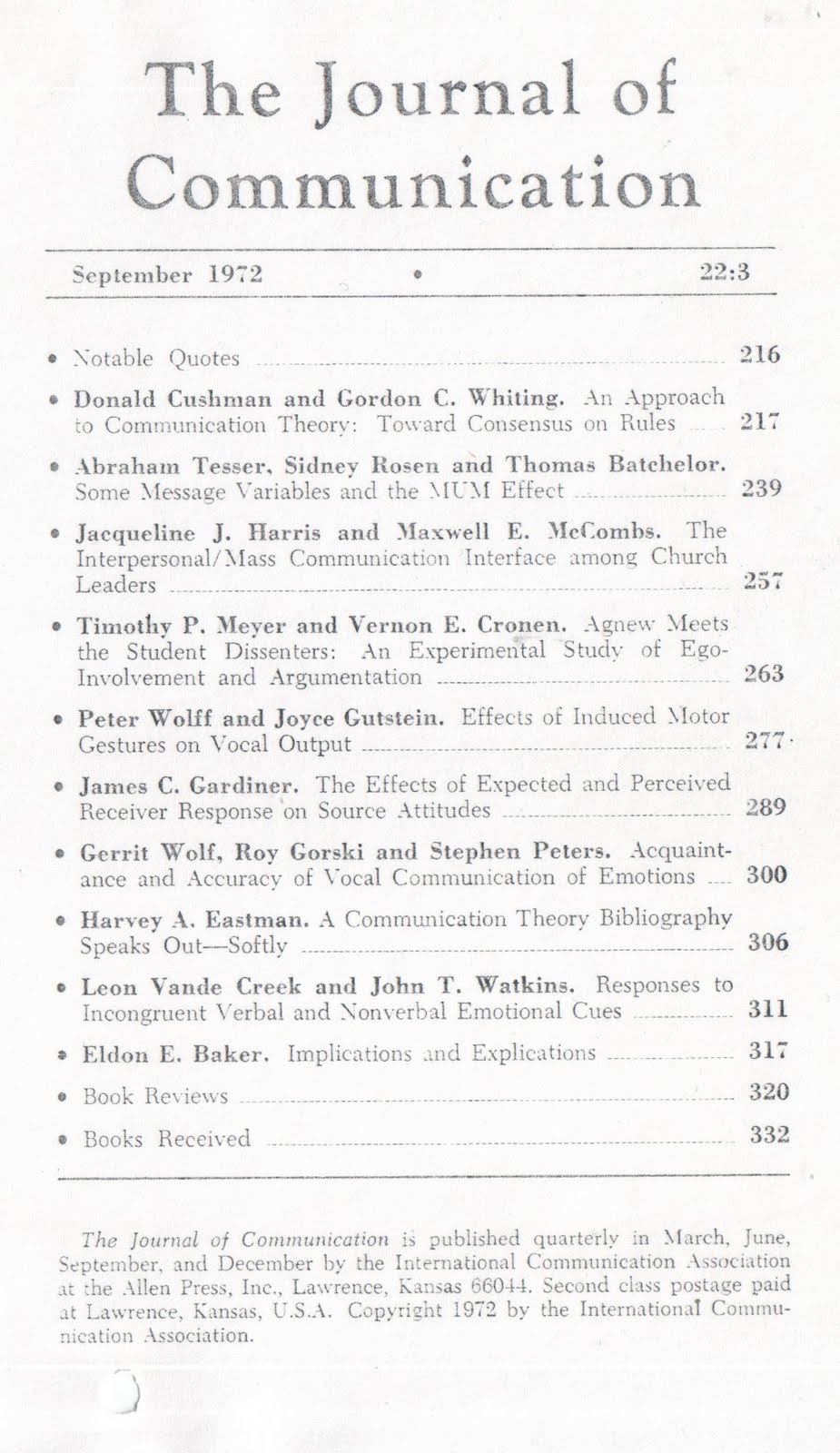
The Journal of Communication, Vol. 22 (3)

The Journal of Communication, Vol. 22 (3), September 1972. Ma pole endiselt kindel, kas selline viitamine on õige. Vol. 22 (4) on eriväljaaanne, mille toimetajate nimed (Harrison & Knapp) olid teada, käesoleva väljaande toimetajaks on märgitud Paul D. Holtzmann. Erinevalt eriväljaandest, mis oli pühendatud mitteverbaalsele suhtlemisele, on käesolevas mõned artiklid mis puudutavad žeste ja paralingvistikat, ülejäänud käsitlevad kommunikatsiooniteooriaga seotud aspekte.

Donald Cushamn and Cordon C. Whiting. An Approach to Communication Theory: Toward Consensus and Rules

Kahte tüüpi reeglid:
We believe there is a class of human actions whose significance is largely dependent on consensually shared rules. These rules control the unfolding of the action over time and constitute its meaning. The rules, it seems to us, are of two basic types: (1) those which specify the action's content (its meaning, what it is to count as) and those which specify the procedures appropriate to carrying out the action. It is these rules which assure the success of complex, interdependent transactions in society. The constitutive rules govern, the procedural rules guide. (Cushan & Whiting 1972: 217)

Reeglid saavutavad korra ja regulaarsuse suhtlemisprotsessis:
What do rules attain? Order and regularity in the communication process. They do this by governing and guiding the communicative transactions. As indivated, we distinguish two general classes of communication rules: the content or constitutive rules and the procedural rules. (Cushan & Whiting 1972: 219-220)

Muud huvitavat: tähenduse personaalne ja interpersonaalne tasand.

Abraham Tesser, Sidney Rosen and Thomas Batchelor. Some Message Variables and the MUM Effect


No doubt there are numerous possible determinants of felt desire to communicate. Some of the reasons may be instrumental. For example, the communicator may anticipate some material benefit in exchange for transmitting. Or, he may derive status satisfaction from being perceived as a possessor of news. On the other hand, the reasons may be terminal. For example, he may look forward with enjoyment to the anticipated emotional response of the recipient. Or, he may enjoy talking. He may also enjoy the role of informant. (Tesser, Rosen & Batchelor 1972: 241)


Jacquieline J. Harris and Maxwell E. MeCombs. The Interpersonal/Mass Communication Interface Among Church Leaders


Nada. Statistiline uurimus sellest kui palju kirikutegelased otsivad informatsiooni massimeediast.


Timothy P. Meyer and Vernon E. Cronen. Agnew Meets the Student Dissenters: An Experimental Study of Ego-Involvement and Argumentation


Nada. Poliitiline analüüs tollase asepresidendi ja üliõpilaste suhetest ja kuidas televisioon seda muutis.

Peter Wolff and Joyce Gutstein. Effects of Induced Motor Gestures on Vocal Output

Siin on sama idee mis kumab Tenjese töödes - käežestid eelnevad sõnadele ja on tõenäoliselt sama tähendussüsteemi osad:
While the organized lexicon is presumed to be an integral part of the linguistic production and interpretation system, story production involves a thematic organization which may occur prior to its linguistic interpretation. If so, it is reasonable to propose that the gestures were processed at a level more fundamental than that of a lexicon, and perhaps more fundamental than the vocal system itself. The fact that self-produced gestures, as well as observed gestures affected the stories make the hypothesis at least plausible that during the communication act, non-verbal activity is based in this same prelinguistic meaning system as the concurrent vocal activity. Furthermore, the motoric expressive system may actually influence the vocal. In our observations of video-taped monologues we have isolated several segments which further support this hypothesis. Ocasionally an S[ubject], involved in vocal exposition with accompanying gestures, would express an idea or a physical description motorically before the verbal statement became available.(Wolff and Gutstein 1972: 287)

James C. Cardiner. The Effects of Expected and Perceived Receiver Responses on Source Attitudes


It was reasoned that the communication source brings a number of salient cognitions into a communication event. First, he has a self-concept as a communicator, based on his past successful or unsuccessful performances. Second, he has had an expectation of the response he will receive from the audience. Third, he has an attitude toward the audience. Finally, he has an attitude toward the topic he is presenting. As the communication event progresses, and the receivers respond to the message, these four attitudes will interact and change. The manner in which they are modified was the focus of this study. (Cardiner, 1972: 290)


Geriff Wolf, Roy Gorski and Stephen Peters. Acquaintance and Accuracy of Vocal Communication of Emotions


Nada.

Harvey A. Eastman. A Communication Theory Bibliography Speaks Out - Softly

Statistiline analüüs märksõnadest mis seostuvad kommunikatsiooniteooriaga.

Lean Vande Creek and John T. Watkins. Responses to Incongruent Verbal and Nonverbal Emotional Cues

Channel reliance, mittemidagiütlev eksperiment.

Eldon E. Baker. Implictions and Explications

Viimaks mõned asjalikud mõtteterad mille kallal nokkida:
  1. "Communication can be associated with successful transmission of information from participant to participant." Participants disrutb light or sound waves. Information or "patterned energy" resides in the participants. Measures of shared information, therefore, must be dependent on the participants' behaviors, not the physical dynamis of transmission.
  2. "Communication involves understanding by the receiver as intended by the source." Communication or "meaning assignation" occurs in the relative absence of understanding by the receiver as intended by the source, perhaps most of the time.
  3. "No major communication theorist has systematically treated content and procedural rules as a fundamental concern in communication theory." I can discern little difference between "content and procedural rules" and "mental sets." Mental sets have been concerned for communication theorists for many years. Cushman and Whiting, however, make a contribution by amplifying the nature and role of rules or mental sets in the communication process.
(Baker 1972: 317)

Book Review Section edited by John L. Petelle

Kõneldes raamatust "Imagery And Verbal Process" mille autoriks on Alan Paivio, öeldakse järgnevat:
Paivio concludes that imagery that is "...nonverbal memory representations of concrete objects and events .... actively generated and manipulated by the individual ..." is generally visual and concrete, whereas the verbal process can be concrete, but is typified by higher abstractness, much as Sir Francis Galton (inquiries into Human Faculty and its Development, 1883) and Count Alfred Korzybski (Science and Sanity, 1933) believed.

Nonverbal means as regulators in communication


Tenjes, Silvi 2001. Nonverbal means as regulators in communication: sociocultural perspectives. Tartu: Tartu University Press

Nüüdseks olen läbi lugenud nii bakatöö, magistritöö ja doktoritöö. Viimase teistkordsel lugemisel sulas tekst pilgu all kiiresti, sest eelnevate tööde lugemisest tundsin paljud teemad ära. Kindlasti jäi selle tõttu ka palju kahe silma vahele, aga üldpilt kujunes seekord paremini. Esimesel korral kurdsin katsekirjelduste rohkuse üle, sel korral tajusin, et samade empiiriliste andmete kohta järeldati erinevates artiklites erinevaid asju.
Kuna enamus tekstist voolas sujuvalt mõttelt mõttele ja iga vähegi kaugeleulatuvam idee oli toetatud tsitaadiga mõnest žeste käsitlevast artiklist, jäi järele väga vähe sellist teksti, mida pean kasulikuks tsiteerida. Järgnev blockquote on kokkuvõte Efroni kategooriatest, mis tegelikult tuleks ümber tõsta Efroni raamatu kokkuvõttesse, kui ma kunagi kord peaksin Efroni raamatut ise lugema.
  • Spatial-temporal. He first studies the spatial-temporal aspects of gestures. Here, a gesture is just a movement that portrays relationships in space:
    1. radius (span of movement);
    2. shape (straightforward, circular);
    3. direction (relathionship between the speaker and the listener);
    4. parts of the body (head, fingers; unilateral or bilateral movement).
  • Interlocutive, i.e. involving interactive aspects of gestures:
    1. familiarity;
    2. performance of simultaneous gestures;
    3. use of space and distance;
    4. gestures towards objects.
  • Linguistic. Efron investigates the referential meaning of a gesture and provides the following classification:
    1. Logic-discursive: Gestures not related to an object or idea but ot the process of expressing these ideas in action. They stress the verbal-vocal behavior or the content of the message, and are related to the presented ideas on the how - rather than on the what - level.
      1. batons, omvement sthat accent a particular word or phrase. They denote the tempo of the mental activity accompanying speech.
      2. ideographs: movements that trace the flow of an idea;
    2. Objective: gestures possessing their own, speech-independent meaning which may or may not change the meaning of the message:
      1. deictic: gestures referring to an observable object, pointing to available referents;
      2. pictographs: gestures conveying their meaning in an observable way:
        1. iconographs: gestures depicting the form of the observable object;
        2. kinetographs: movements that depict a bodily action;
      3. emblems or symbols: gestures that replace words and are encoded arbitrarily and with intent (e.g., the hand signals of a baseball catcher or a coach). They have a standard meaning in a culture that is specifically attached to the meaning. If an emblem possesses a morphological similarity to the depicted object it is considered a hybrid emblem.
(Tenjes 1996: 167-168
Midagi ligilähedast mõistetele "mitteverbaalsele märgi-repertuaar" või "ihuline ajalugu":
Iconic gestures are designed to communicate; they provide imagery and kinaesthetic profiles. Gestures receive the attention of the listener and thereby become components of conceptual understanding. Gestures are functionally adapted to the requirements of understanding in human communication. Therefore, one has to examine how these structures aid listeners in the processing of speech. It is appreciated when speakers have the ability to make themselves understood because of the unconscious intelligence of their bodies, that is, their hand's competence is surrounding speech with subtle, intricate, and "telling" spatial imagery. (Tenjes 2001b: 17)
Mõned viited:
  • Tenjes, Silvi 1996. "Gestures in Dialogue". In Estonian in the Changing World. H. Õim, ed. 163-192, Tartu : University of Tartu
  • Tenjes, Silvi 2001. "Gestures as pre-positions in communication". Trames, Vol 5 (55/50), No 4, pp 302-320.
  • Efron, David 1972. Gesture, Race and Culture. Paris and Hague: Mouton (Originally published in 1941 as Gesture and Environment. New York: King's Crown Press)
  • McNeill, D. 1992. Hand and Mind: What Gestures Reveal About Thought. Chicago: University of Chicago Press
  • Mehrabian, A. 1971. Silent Messages. Belmont: Wadsworth
  • Poyatos, F. 1980. "Interactive Functions and Limitations of Verbal and Nonverbal Behaviors in Natural Conversation". Semiotica 30, 3/4, 211-244
  • Scheflen, A. E. 1973. Communicational Structure. Bloomington: Indiana University press

The Explanation of Social Behaviour


Harré, Rom & Secord, P. F. 1976. The Explanation of Social Behaviour. Oxford : Blackwell

Viite sellele raamatule leidsin Argyle'i raamatu sissejuhatusest/tänusõnadest. Üks autoritest on sotsiaalpsühholoog ja teine on filosoof. Teose eesmärk näib olevat käitumise uurimiseks "uue meetodi" formaliseerimine. Sisaldab rohkesti kriitikat laborikatsetele ja behaviourismile (Skinner saab jälle vatti) ning laenab sellistelt autoritelt nagu Goffman, Garfinkel, Austin, Chomsky, Levi-Strauss jne.
Raamatu füüsilisel koopial näib olevat pikk ajalugu. Selles on mingi Soome kirjastuse/ülikooli templeid, rohkesti eesti/soome-keelseid harilikuga tehtud ääremärkusi (põhiliselt lõikude üldidee ühe-kahe sõnaga) ning Tartu Ülikooli psühholoogia- ja sotsiaalteaduste osakondade templeid. Mina sain ta sotsiaalteaduste osakonna raamatukogu hoidlast. Hoolimata sellest, et raamatu esimene kolmandik hakkab kergelt välja kukkuma kaante vahelt, leidsin sellest palju huvitavat. Sh on võimalik, et nende autorite "episood" ja Juri Lotmani "tekst" on võrreldavad. Arvan, et seda teost tuleks lugeda vanema-targemana uuesti.

"Mõistatuslikud" episoodid ei oma selget struktuuri ega selgitust (erinevalt paradigmaatilisest):
Most episodes cannot be clearly classified: they are enigmatic, having neither an explicit set of rules, nor produced by well-established causal mechanisms. Enigmatic episodes are explained by applying to them concepts used in the explanation of those paradigmatic episodes which themselves have clear explanations, be they formal or causal. The structure of episodes has two levels: overt and covert. The former consists of the act-action sequence, contained in the episode; the latter, of the permanent and transitory powers and states of readiness and the flux of emotions that underlie the episode. (Harré & Secord 1976: 12)

Social behavior must be conceived of as action mediated by meanings, not responses caused by stimuli. (Harré & Secord 1976: 29)

Ühiskondlik käitumine on tähenduslik käitumine ja muuhulgas suhtlemise tähtsus:
Social behaviour is meaningful behaviour. It involves an agent with certain intentions and expectations, an agent capable of deliberating and choosing from a variety of courses of action, and whose words and actions are understood by his fellows. A central part of this whole process is communication between people. (Harré & Secord 1976: 35)

Semiootilise reaalsuse algmed:
...if we consider people as agents, then we must connect their social behaviour to a network of concepts appropriate to the description of self-controlled actions in a world of agents who have interests and who follow rules and plans in their dealings with other agents. So, what we see in social reality, is not, for example, an arm moving upwards, but a man trying to attract attention, a man greeting a friend, and so on. When we see an action of a certain sort we thus connect what we see with a conceptual context uttely different from that involved in seeing movements, and this context determines the form of explanation that is appropriate. (Harré & Secord 1976: 38)

Siit tuleneb võimalus astuda edasi kehaliste liikumiste uurimisest ühiskondliku käitumise suunas:
In effect, the philosophers we referred to above are recommending a consideration of the kind of explanation of behaviour that is familiar to us as laymen, and that is naturally couched in the subtle and expressive medium of ordinary language. It is an explanation of action that is intentional and purposive. Actions are explained in terms of the ends for which they are performed. Objections to teleological forms of explanation that had once been considered definitive have been re-examined by philosophers and found to be neither as sound nor as final as they once seemed to be. This point of view also implies that the behaviourist programme of reducing complex actions to simple, independent behavioural elements, capable of independent explanation, is impossible, since psychologists would then be studying something quite different from the social life of human beings. It is complex and deliberate actions, unified through their contributions to the meaning of the total act, that constitute the true subject matter of human social behaviour.
Our view of man, which we elaborate still further as our investigation develops, may be summarized as follows:
1. A man is capable of initiating action, action that may take place only after deliberation and with a more or less clear end in view. The whole of the action sequence may be anticipated in a more or less clearly formulated plan.
2. Most human action cannot be, and may need not be traced to antecedent events linked to the actions in a regular, chain-like fashion in order to be explained in a satisfactory manner. An explanation is not unscientific because it makes reference to such items as plans and rules, or because it assumes the social actor to be one who deliberately follows them.
3. Action cannot be described reductively in terms of movements which are the vehicles for action, without losing its character and meaning. Human action is by nature psychological, and it cannot be reduced to physiological or physics, or even to simply observed behavioural elements without destroying it. (Harré & Secord 1976: 40-41)

Verbaalsete interaktsioonide ritualiseeritus:
A good many verbal interactions between strangers are constrained by highly developed rituals, as in many customer-salesman interactions, such as the rituals governing calls at service stations, purchases in a shop, paying conductors on buses and the like. In the cases just mentioned there is a clear role definition for each participant and that determines which ritual is performed. By adhering to the role definitions other aspects of the self are protected. Even when there are no clear role definitions interaction between strangers occurs under powerful conventions giving it a highly ritualstic character. Most, if not all cultures, have definite rituals by which this situation is handled. (Harré & Secord 1976: 62)

Veenmisel pööratakse tähelepanu aspektidele, millele varem tähelepanu ei pööratud:
The over-riding of the self-ascription of mentalistic predicated does occur, but not by confrontation with any bodily fact. It occurs by a restructuring of meaning. When we try to persuade the person to 'see' his situation differently, to attend to other aspects of a situation than those he was considering, and so on, we are trying to change the meaning of the situation for him. We are trying to get him to ascribe different meanings to things and situations from those he ascribed before which influenced his past choice of mentalistic predicates. If this is true, it must be possible for out subject to counter-persuade us to see the matter his way too. (Harré & Secord 1976: 113)

Kaks käitumist suunavat äärmust, väline ja sisemine mõju:
The regularities observed in the behaviour of people may be explained according to several different schemata. One of the most interesting and natural dimensions along which these explanatory schemata may be contrasted is the extent to which the person is regarded as an agent directing his own behaviour. At one extreme he may be seen simply as an object responding to the push and pull of forces exerted by the environment. At the other, he may be seen as an agent guiding his behaviour toward some explicit goal by some means of which he is thoroughly aware. We may think of the former as focusing upon environmental contingencies and biological mechanisms and the latter as emphasizing self-direction, often by such means as following a rule. (Harré & Secord 1976: 136)

Episoodi kontsept:
1. Any natural division of social life is an episode.
2. The content of a social episode includes not only overt behaviour, but the thoughts, feelings, intentions and plans, etc., of the participants. (Harré & Secord 1976: 147)

Kehalised liigutused, tegutsemine ja tegu:
A person makes all sorts of bodily movements in the course of an episode, contracting and relaxing muscles in various sequences. Some of these movements can be seen or heard or felt by others, some are known to others only through their effects. Some of these movements we wish to treat as actions, and in some of these actions we see acts performed. We watch a man's hand move toward the extended fourth finger of a woman and slip a gold ring on that finger. If this movement meets certain criteria it is an action in the performing of which, together with certain other actions, a marriage is achieved, that is, an act is performed. A movement is given meaning as an action by being identified as the performance or part of the performance of an act. (Harré & Secord 1976: 158)

Jagatud tähendused - sarnased käitumised:
On the Role-rule group of models similarities in people's behaviour does not necessarily derive from similarities in external manipulation or change of a parameter, or from internal modifications, but from shared meanings and commonly accepted conventions, rules and paradigms. (Harré & Secord 1976: 234)

Võimu peatükist leidsin midagi sümbolitega manipuleerimisest; lõpus esitatud väide, et mitteverbaalne interaktsioon ei ole refleksiivne pärineb Argyle'i raamatust "Social Interaction":
Thus possibility in the ethogenic context is related to such concepts as 'plan', 'foresight' and the like. These in turn can be referred to that very generla linguistic capacity or power to handle symbols. Such powers endow their possessors not only with the capacity to conceive plans and to discuss what might or could be done, but also endow them with the powers of symbolic interaction, which were seen by G. H. Mead as the basis of all social phenomena, among men and social animals. This entails the existence of capacities to understand symbols as well as to emit them, and is what enables us to use symbols reflexively, i.e., to understand what we are saying as well as to give ourselves orders. Non-verbal interaction is not reflexive since it need contain no element of awareness. (Harré & Secord 1976: 246-247)

Nonverbal Communication


Mehrabian, Albert 1972. Nonverbal Communication. University of California, Los Angeles

Kohe esimesel leheküljel annab Mehrabian mitteverbaalsele suhtlemisele määratluse:
In its narrow and more accurate sense, "nonverbal behavior" refers to actions as distinct from speech. [...] In the broader sense in which the concept has been used traditionally, however, the term "nonverbal behavior" is a misnomer, for a variety of subtle aspects of speech frequently have been included in discussions of nonverbal phenomena. These include paralinguistic or vocal phenomena, such as fundamental frequency range and intensity range, speech errors or pauses, speech rate, and speech duration. (Mehrabian 1972: 1)

Miks Mehrabian eelistab "implitsiitset kommunikatsiooni"? Sest mitteverbaalse suhtlemise jaoks puuduvad eksplitsiitsed kodeerimisreeglid enamikes kultuurides:
It is more the subtlety, then, of a communication form than its verbal versus nonverbal quality which determines its consideration within the nonverbal literature. Nonverbal behaviors per se form the backbone of this literature. Their subtlety can be attributed to the lack of explicit coding rules for these behaviors in most cultures. Whereas verbal cues are definable by an explicitndictionary and by rules of syntax, there are only vague and informal explanations of the significance of various nonverbal behaviors. Similarly, there are no explicit rules for encoding or decoding paralinguistic phenomena or the more complex combinations of verbal and nonverbal behavior in which the nonverbal elements contribute heavily to the significance of a message. (Mehrabian 1972: 2)

Mida mina mõtlesin arusaamatuse vältimiseks nimetada "prokseemiliseks vahetuseks" (immediacy), et eristada seda meediumi vahetuseks, on siin Watsoni järgi vahetuskäitumised:
Differential preferences of proxemic or immediacy cues have been the major focus of the available studies of cultural communication codes. Immediacy behaviors are those which increase the mutual sensory stimulation between two persons. (Mehrabian 1972: 6)

Meediasemiootiline diskussioon:
Beyond its use for categorizing posture and position cues, the concept of immediacy broadly describes the extent to which any communication behavior reflects or involves a closer interaction. For the posture and position cues, greater immediacy is the result of increasing physical proximity and/or perceptual availability of the communicator to the addressee. Thus, a face-to-face conversation is more immediate than one via video tape, which in turn is more immediate than a conversation over the telephone. Less immediate still is a communication, such as a letter, involving the written medium only. The basic hypothesis relating immediacy to attitudes predicts that less immediacy is selected by a communicator when he has negative feelings toward his addressee, toward the contents of his communication, or toward his addressee, toward the contents of his communication, or toward the act of communicating those contents (Wiener and Mehrabian, 1968). An employer is using less immediate communication when he expresses discontent to ann employee via an intermediary rather than in a face-to-face confrontation. In line with the hypothesis, the employer's choice illustrates his difficulty or discomfort in expressing what he has to say. The "Dear John" letter also exemplifies the preference for a less immediate medium to convey contents that are distressing to express in person. (Mehrabian 1972: 31)

Mittesuheldavus?
Verbal communications seem to have evolved to denote an "objective" world. Consequently, experiences of affect, evaluation, or preference, which are concomitant with the experience of a complex stimulus, cannot be readily and verbally expressed. That is, in most cultures there are restraints imposed on the communication of affect, evaluation, or preference, particularly when these are negative. If a person experiences affect about an event and does not describe it, then there is an additional component accruing to his experience - the relative uncommunicability of that affect. This unverbalized affect can interfere with the communication process, resulting in ambiguous or idiosyncratic references to internal states. It can also lead to speech disruptions such as the slips, errors, or false starts analyzed by Mahl (1959), or to blocking and hesitation. For example, if someone cannot use the direct form, "Jack makes me anxious," sequencing may be evident in his statements as follows: "I see Jack. . . . I don't feel so good." In this instance both components are present in the communication, but they are not related. (Mehrabian 1972: 32-33)

Miks tüübid kes tänaval jalutades ALATI naeratavad näivad olevat väga madala enesekindlusega:
...frequent smiling in a socially akward situation may indicate a less confident feeling in the communicator rather than a liking for the addressee. In other social situations, however, where the communicator and addressee are moderately familiar, frequency of smiling could be more an indicator of liking than of discomfort. (Mehrabian 1971: 82)

Veel üks nimekiri kommunikatsiooninähtustest, mille üle tasuks mõtiskleda:
Thus, the study included negative affect-arousing cues in combination with social situations varying in formality. One group of factors was: (1) liking of the addressee, (2) degree of conflict and irritation between the speaker and addressee, and (3) pleasantness of the addressee's behavior toward the speaker. A second group of factors related to the formality of the communication situations: (4) the degree of formality of the communication setting, (5) the status of the speaker relative to the addressee, (6) the presence versus absence of bystanders at the time of the addressee to accept unambiguous expressions of dislike toward himself, and (8) the implicit versus explicit quality of a negative message from the addressee to the speaker. (Mehrabian 1972: 111)

Midagi feministliku diskursuse tarbeks:
These findings supported the view expressed by Wiener and Mehrabian (1968) that our culture discourages the explicit verbalization of negative feelings, and consequently the implicit communication channels have assumed the function of expressing such attitudes. The finding that females are better encoders of negative attitude than are females is in line with this cultural explanation, since males seem to have greater latitude to express negative feelings explicitly. (Mehrabian 1972: 145)

Siin ilmneb, et manipulatiivse käitumise puhul suureneb responsiveness, kuid tegelik positiivne suhtumine suureneb väga vähesel määral. Kõlab loogiliselt, sest veenmisele orienteeritud suhtluskaaslased üritavad tagasside kaudu kontrollida oma esitust, kuid liigse sõbralikkusega kaotaksid nad oma ohjad olukorra üle:
The second factor, responsiveness, which is correlated only slightly with communication of liking, reflects the extent to which the subject is reacting to another, whether in a positive or a negative way. In persuasive communication situations, for instance, in which the nonverbal expression of liking may be construed as manupulative or insincere, it has been found that increased attempts at persuasion are associated with increased responsiveness to the listener but with only slight increases in actual positiveness toward him. (Mehrabian 1972: 153)

Olen varem lugenud selle kohta, kuidas Mehrabiani jt katseid on väärtõlgendatud. Nüüd leidsin, et käesoleva raamatu 182. lehekülg on selle väärtõlgenduse põhjuseks. Kuigi kõne all on taaskord inconsistent messages, ütleb sõnastus, et need arvud võivad kehtida enamikel juhtudel ("Our studies have produced an answer for most cases in the form ofa simple linear model."). Kaasa aitab ka see, et sama valem on samal leheküljel kaks korda, esimesel korral "Total liking" ja teisel korral "Total feeling". Mis tuli mulle aga üllatusena on otsene väärtõlgendus: kehakeeleõpikud ütlevad, et 55% infost pärineb "kehakeelest", Mehrabian ise ütleb aga, et näoilmetest!
Total liking = 7% verbal liking + 38% vocal liking + 55% facial liking
Lõppkokkuvõttes oli raamatu sisu midagi muud kui olin lootnud. Tegelik sisu koosnes teaduslike katsetuste kirjeldustest. Nagu oli hoiatatud, läks keskel tõepoolest väga kvantitatiivseks. Kohe nii väga, et neist arvudest tehtud järeldused olid lugemisel kogu aeg kahtluse all. See pani mõtlema, et kui keegi väidab midagi tühja koha peale ja teeb seda veenvalt, on seda väga kerge tõe pähe võtta; teisalt kui esitatakse põhjalik kirjeldus sellest kuidas hüpoteesi kontrollitakse, tekib ikkagi kahtlus, kas tulemusi annab usaldada. Kvantitatiivses osas saavutatud järeldustele pöörasin lugedes ka vähem tähelepanu. Mul on teos PDF failina olemas, niiet kui on vaja midagi järele vaadata, on selleks alati võimalus. Kunagi tuleks üle vaadata ka raamatu lõpus esitatud nimekiri muutujatest, mida Mehrabian oma katsetes kasutas. Nimekiri on põhjalik ja kuigi tänapäeval enam ei ammenda suurt midagi, annab vähemasti aimu kuhu poole katsetes on tüüritud. Teistkordsel lugemisel tuleks silma peal hoida ka sellel, kuidas Mehrabian oma semantilist ruumi (kolme dimensiooni) igas peatükis kirjeldab - just nagu Lotman oma teksti ja kultuuriga, näis Mehrabian oma semantilist ruumi vastavalt vajadusele nipet-näpet muutvat. Nendest erinevustest võib midagi saada.